Friday, March 6, 2015

Find Me A Victim


I've been reading "A Farewell to Mars: An Evangelical Pastor's Journey Toward the Biblical Gospel of Peace", by Brian Zahnd.  It's a wonderfully written book - not difficult to read, and yet it gets its point across very well.  And the point of the book is one that is so important for the Church today - especially the Church in America.  The point being to challenge our sacred violence, especially within the context of our religious and political systems, which all too often serve to legitimate and sacralize our violence.

I found Chapter 5 of this book to be particularly insightful, and it inspired me to write my own thoughts.  The chapter is an in depth look at John chapter 8.  Before I get into this passage, I would like to lay out some groundwork.

The Bible As Constitution

One of the worst things to happen to Christianity, in my opinion, is when the Bible was divided into chapter and verse.  Oh, of course this makes certain things much easier - I benefit from this every time I write a blog, because without this divisional system I would not be able to call attention to statements and stories so quickly and easily.  But the division causes us to be lazy readers.  We all too easily forget that the original readers of these passages did not have chapter and verse, and would read the entire thing all at once - and thus the passages and verses were naturally contextualized within the whole "book" they were within.

But when we remove verses and passages from their context, we all too often fall into a pattern of reading the Bible - as Brian McClaren puts it in his book "A New Kind of Christianity: Ten Questions That Are Transforming the Faith" - like a constitutional lawyer.  I think that this analogy of McClaren's is brilliant, but I would want to further clarify it - because we do it like a bad constitutional lawyer.

One of the best examples of this comes in the form of the gun debate.  There was an article on Mother Jones that demonstrated how, historically, the 2nd amendment of the constitution has never been interpreted to mean that anyone can have any kind of weapon and in any quantity and they can purchase them without any kind of check to make sure they are not mentally disturbed (or anything of the kind).  And in fact, as the article demonstrates, the purpose of the NRA used to be to encourage people to be more safe with their guns - but more recently, it has transformed into a lobbying group whose purpose is to radically change the perspective on the 2nd amendment to mean "anyone can have any kind of weapon and in any quantity and they can purchase them without any kind of check to make sure they are not mentally disturbed (or anything of the kind)."

This redefinition of the 2nd Amendment is accomplished by focusing very heavily on certain phrases within the 2nd amendment while at the same time blatantly ignoring their context (both literal and historical).  Those who push for this reading of the amendment will emphasize the phrases "Congress shall make no law" and "right to bear arms" - but when they do so, they have to ignore the fact that the amendment starts out with the phrase: "a well regulated militia being necessary to the security of a free state".  Notice the terminology: "well regulated militia".  This means that if you wish to bear arms, you must be part of a well regulated militia - it seems pretty clear from this phrase that the purpose of the amendment was not to mean that the government can never regulate arms.

But if this doesn't make it clear enough, we can check Article I, Section  8 of the Constitution itself for the definition of a militia, which states that Congress (ahem…the Federal Government…) shall have the power:

Clause 15:
To provide for calling forth the Militia to execute the Laws of the Union, suppress Insurrections and repel Invasions;
Clause 16:
To provide for organizing, arming, and disciplining, the Militia, and for governing such Part of them as may be employed in the Service of the United States, reserving to the States respectively, the Appointment of the Officers, and the Authority of training the Militia according to the discipline prescribed by Congress;
The fact that the purpose of a militia - according to this passage of the constitution - is to be a force that the Federal government can call upon to suppress insurrections and repel invasions, and which the government can organize and discipline, makes it pretty clear that the purpose of the 2nd amendment was never to mean "anyone can have any kind of weapon and in any quantity and they can purchase them without any kind of check to make sure they are not mentally disturbed (or anything of the kind)."

Just like the bad constitutional lawyer who emphasizes the phrases "Congress shall make no law" and "right to bear arms" while ignoring the rest of the amendment and Article I, Section 8 of the Constitution itself, we do the same thing with the Bible all the time - we take phrases out of context and form theologies out of them, and then no matter what other sections of the Bible are called to our attention we argue and fight for our perspective.  I've actually written about how the 2nd amendment ties in to this bad form of Biblical interpretation before, and that post is relevant to this one in more ways than one - but for the purpose of this post I would like to now move on to another analogy before I begin to tie this all in to John chapter 8.

The Scapegoat Mechanism
In another one of my posts I wrote about how the atonement of the cross is connected to scapegoating, and I summarized Rene Girard's brilliant theory on mimesis and the scapegoat mechanism.  This theory also plays out in John chapter 8, so I'd like to once more summarize Girard's theory, which consists of 6 steps:

  1. Mimetic Desire
    Mimesis is our human tendency to learn by imitating each other.  This tendency starts the moment we exit the womb - as has been demonstrated by one study, conducted on 74 newborn babies, that found that the mean age at which these babies began to demonstrate the ability to imitate facial expressions was 36 hours.  This mimesis is how we learn - and thus it is one of our greatest strengths.  Without it, we would not even learn how to talk.  But, it comes with a weakness - we not only learn good habits and behaviors, but bad habits and behaviors as well.  And not only this, but it is through mimesis that we learn what to desire - and so often these learned desires are harmful desires.
  2. Mimetic Rivalry
    This learned desire often turns into a rivalry when we end up desiring the same things as the ones we imitate - when we all desire the same things, but there is a limited quantity of these things, we end up preventing each other from obtaining these things.  So this turns into a vicious cycle - the ones we imitate first said “be like me: value this object.”  But when we reach out to take it, the ones we imitate say “Do not be like me - the object is mine, and you can't have it!”  This rivalry is demonstrated at a very early age - my own children are wonderful examples of this.  I have two daughters who share a bedroom.  The older of the two has many stuffed animals - most of which she never plays with.  The younger - who is now 2 - has begun taking these dolls, which are otherwise never played with, and she will play with them.  But the older child is then incensed - "those are mine!"  The older child takes these dolls from the younger forcefully, and then we scold her for doing so.  So then she waits for the moment that the younger child puts the doll down so that she can scoop it up and pretend that she is very interested in playing with the doll - but she has never played with this doll before.  You see, the doll becomes much more desirable to my older daughter because someone else wants it.
  3. The Crisis of Distinctions
    Our societies so often distinguish classes of people according to "haves" and "have-nots".  In this way, we tend to sacralize the desires spoken of in steps 1 and 2, and we distinguish the value of people by how much of these resources they have obtained.  But when everyone wants the same things, what often happens is that we end up causing a shortage of the resource - sometimes because we have used the resource up, sometimes because of a natural disaster (which could be a weather event, a disease, a famine, etc.).  When this happens, the distinctions that formerly separated persons and groups of persons into classes disappear.  Walter Wink summarizes what happens next in "Engaging the Powers: Discernment and Resistance in a World of Domination":
    Students seize the administration building, demanding a share in decision-making power that has previously been the sole prerogative of the administrators. Mill workers shut down the plant, insisting on a voice in shaping their new contract. The hierarchical barriers that society has so carefully erected, unjust as they may be, dike society against the flood of anarchy. When these distinctions collapse (as when soldiers in Vietnam refused to obey orders from their officers), that social system faces the possibility of collapse. Collapse can be averted, however, if society can find a scapegoat.
    At this stage, society threatens to tear itself apart because we've got people fighting over these commonly desired resources.  If the fighting does not stop somehow, our societal structures will collapse.  This brings us to the next step:
  4. The Necessary Victim
    In order to “save” society from the chaos that results from steps 1-3, a victim must be found - towards which all the violence of that society is then directed and released upon.  In order to do this, the society must find a victim which they can all agree is guilty, and this victim needs to be incapable of defending themselves against the mob.  So this victim often ends up being one which has features distinguishing himself/herself/themselves from the "norm" - the average citizen.  Once society has found such a victim - and one that they can all agree is guilty - the blame for all of society's problems is pinned on this victim, and they are punished by that society.  This victim then serves as a release valve - releasing the “steam” of the society’s violence.  What makes the scapegoat mechanism so insidious is that it works - after we've destroyed our victim, for a time the violence of our society disappears.  We feel good - we've taken out our anger on this scapegoat, and now people who were once enemies are friends because they've been united against a common enemy. 
    The fact that the mechanism seems to have worked leads to the next step:
  5. Sacralizing the Victim
    The scapegoat is made sacred by being simultaneously regarded as cursed and life-bringing - the victim is cursed, because they were (according to our myths) to blame for all our problems, but they are life-bringing because destroying them caused the cathartic release from step 4.  Because the chaos within step 4 was survived and released through the scapegoat, the story of the scapegoat becomes sacred and cannot be challenged - a challenge to our scapegoat mechanism is a threat to society itself.  In other words, it becomes very difficult to challenge the guilt of the scapegoat, because society knows that if the scapegoat is not truly guilty, that means society shares in the blame - so if you stand up for a scapegoat, this often results in turning you into the next scapegoat.
    But this is not the final step of the cycle - because the scapegoat was not truly the problem.  Our mimetic rivalry and the fact that we never challenged our learned desires (do I really need this stuffed animal I've never played with before?) was always the issue.  So this leads to step 6:
  6. Sacrificial Repetition
    The violence directed towards a scapegoat releases pressure on society, but only for a time.  And so the type of person who was made the scapegoat in step 4 must be repeatedly victimized and used as a release valve in order to control society’s violence.  This becomes a religious structure of organized violence in the interest of social tranquility.
This cycle is illustrated in the flow of John chapter 8 - but before I move on to demonstrate this, I would like to bring in just one more analogy.  Bear with me, and I promise I will tie all of this together.

Find Me A Victim

Find me a victim, or you'll be the victim!
When I was a child, one of my favorite things was Looney Tunes - Bugs Bunny, Sylvester and Tweety, Speedy Gonzales....  My family and I can quote entire scenes from some of these cartoons.  There is one particular episode that chapter 5 of Brian Zahnd's book reminded me of - it's called "Roman Legion-Hare" (you can watch it here if you like, though I will warn you that there are pop up ads).  The episode begins with a crowd at a Colosseum, awaiting the spectacle of a victim being thrown to a lion.  But after Emperor Nero announces the command to throw out the first victim, one soldier replies in a nasally voice "but sire, we're all out of victims!"  So Nero calls Yosemite Sam, and tells him to "get me a victim right away, or you'll be the victim!"  

Already, I would argue, we see a prophetic picture of the violence of Rome - as history shows us, Rome was so murderously violent that they could never find enough victims, and in the end the empire is so divided by its own competition and inner violence that they are defeated by an opponent which would seem to be weaker then their mighty empire.  So the picture in this cartoon is actually a great way for understanding how the supposed guilt of the scapegoat is really just a foil to mask our insane desire to take our violence out on someone, and this is why anyone who gets in between us and our victim often ends up being the next victim.

But back to the cartoon - after being told that if he does not find a victim, he'll be the next victim, Yosemite Sam scrambles off to find one and save his neck.  And of course, quite predictably, he runs into the wily trickster himself, Bugs Bunny.  As Sam repeatedly tries to capture Bugs, over and over he ends up being attacked by the lions which were intended for the victim.  At the end of the episode, both Yosemite Sam and Nero are standing on top of a pillar as these lions - intended for the sacred victim Sam was supposed to bring - are clawing after the victimizers.  As the old cliché goes - what goes around comes around. 

This is actually a great metaphor for how the scapegoat mechanism works!  Because if we're completely honest, it never fixes our problems, and in the end, those problems - our consuming desires and the rivalry that results from them, represented powerfully by the lions in the cartoon - end up devouring us!  We thought that by throwing a victim to our lions, we would be saved - but the lions are never satisfied!  This is because the solution to our mimetic desire and rivalry is not to find a victim - it is the realization that we don't really need the doll to be happy, and in fact if we'd just share this doll with our sister, we'd receive something much more valuable than a doll: a friend!

And now I will tie this all together, as promised.

The Truth Will Set You Free
In chapter 5 of "A Farewell to Mars: An Evangelical Pastor's Journey Toward the Biblical Gospel of Peace", Zahnd talks about how we've stripped a certain saying of Jesus from John chapter 8 of its meaning and turned it into a meaningless cliché - that saying is "the truth will set you free."  It is because we don't pay attention to the whole chapter that we've done this - just like the bad constitutional lawyer.  Because we haven't paid careful attention to the context this saying is set within, we've made "the truth" of this saying into an arbitrary thing - "the truth" can be anything!  Or more specifically, "the truth" that "sets you free" is always whatever I say it is - and not what Jesus means by "the truth".  And so the saying becomes meaningless.


But if we really want to understand what Jesus is talking about when he mentions "the truth", we ought to pay careful attention to the entire chapter this saying is set within.  And when Zahnd did this, he discovered that the saying is bracketed by two attempted stonings - and so he feels that we should interpret the saying within their context.  This bracketing, by the way, actually seems to be a commonly used literary device in Jewish writing - it is used quite often in the Gospel of Mark, and without realizing that this is what is happening, certain stories can seem quite odd.  A great example of this is when Mark brackets the "cleansing of the temple" with the cursing and subsequent withering of the fig tree - if we don't understand that the fig tree is meant to help us interpret the "cleansing of the temple", it might seem very odd that Jesus has cursed a fig tree for not bearing fruit in the middle of a season in which no fig tree would have been bearing fruit in the first place (and thus, this would seem a misuse of Jesus' power).  But if we understand that the fig tree is meant to be a metaphorical aid for understanding what happens in the temple, the problems disappear.

Likewise, in John chapter 8, "the truth will set you free" is bracketed by two attempted stonings.  At the beginning of the chapter, "the scribes and Pharisees" - or the "religious industrial complex" of their day - bring Jesus a victim (think back to Yosemite Sam and the Scapegoat Mechanism).  This victim is clearly guilty, according to them - she has been "caught in the act of committing adultery"!  Never-mind the fact that one might question the circumstances in which one would catch this act happening (what were you doing sneaking around someone else's house?), or the absence of the other party in this accusation (hey, it takes two to commit adultery).  We have a sacrificial victim here, to satisfy our need to take out our violence on someone.  So the religious leaders demand that Jesus allow them to turn this woman into a scapegoat and stone her.


Now, we should pay careful attention to the fact that this is a stoning that they are demanding.  Zahnd highlights the importance of this by pointing out how stoning is not a very efficient way to kill someone - there are far more efficient ways to do this, and ones that could have been performed by the scribes and Pharisees without seeking the cooperation of a crowd.  So why is stoning the approved form of execution in Jewish law?

Notice how other forms of execution appoint a certain member of society to carry out the execution - the ruling authorities of society are never the ones to perform the act of execution that they demand, and thus they are able to avoid the guilt.  But no matter the circumstances - even when the victim is known to be guilty without a shadow of a doubt in the mind of the executioner and thus to be "deserving" of the execution - the executioner cannot help but feel guilty for this act.  This is why so often executioners have employed various coping mechanisms - such as wearing a hood or mask in order to, as it were, pretend that it is not them doing this thing.  Modern executioners have to repeatedly tell themselves that they are performing their duty - in essence they are displacing the guilt of the execution upon the government.

But stoning is a unique method of execution in that it is a communal form of execution - the whole society joins in the ceremony, and thus all members are able to release their need for violence upon this victim!  Not only that, but they are simultaneously able to lie to themselves about the hand they have played in killing this victim.  In a stoning, each person throws a stone - an act which, alone, would not kill the victim but merely bruise them.  Collectively, however, these stones are effective for killing the victim.  In this way, each member of the society is able to deny the hand they played in killing their victim while simultaneously satisfying their need for violence. 

So the religious authorities bring their scapegoat to Jesus and demand that he let them perform their sacred violence - but Jesus unmasks this mechanism and exposes it by demanding that the first stone be thrown by someone who is without sin!  This is a brilliant move on Jesus' part, because he is exposing the scapegoat mechanism as a way for fooling ourselves into thinking we've solved the problems that are tearing apart our society through killing a victim!  This context should not be ignored when we read Jesus saying, immediately after releasing their scapegoat:

I am the light of the world. Whoever follows me will never walk in darkness but will have the light of life.
Jesus has just acted as light by exposing the scapegoat mechanism as a fraud, and demonstrating mercy - and this demonstration of mercy is the context for the phrase: "whoever follows me".  Jesus is asking us to follow him in the way of mercy - the way of releasing our need to carry out our violence, and to crucify our ego, as it were, so that we can stop fighting amongst ourselves over the same resources!  It is our egoic desire which causes conflict, and this is why Paul said in Acts 20:35 that "it is more blessed to give than to receive" - he is challenging the selfish desires that result in mimetic rivalry!

But going back to John 8 - after Jesus says he is the light of the world, the religious authorities question his testimony.  It really stings when our scapegoating has been invalidated, and so they are now seeking to redirect their violence upon Jesus - but first they need an excuse to do so.  They need to prove to themselves that Jesus is guilty.  In this context, Jesus then makes a powerful statement that is all too often ignored in Christian theology: "You judge by human standards; I judge no one." (John 8:15) 

It is further on in this same speech by Jesus that he declares (verses 31-32):

If you continue in my word, you are truly my disciples; and you will know the truth, and the truth will make you free.
It is Zahnd's contention in his book - and I would agree with him - that this statement should be contextualized within the events of the whole chapter.  Jesus has just freed a sacrificial victim and exposed the scapegoat mechanism as a fraud - and afterwards he said that he judges no one.  It is this word of non-judgement and mercy that Jesus is speaking of in the first half of the above statement - Jesus is saying that if you want to be his disciples, you must commit to a radically merciful life in which you judge no one.  And if you do this, you will know the truth, and the truth will set you free.

Now watch what happens next - because as I said, the author uses the Jewish literary technique of bracketing here in order to help us understand what is going on in this statement.  After Jesus talks about knowing the truth and being made free, it says in verse 33:

They answered him, “We are descendants of Abraham and have never been slaves to anyone. What do you mean by saying, ‘You will be made free’?”
The fact that Jesus has implied that they are not already free upsets them - they are indignant over this implication!  But Jesus immediately replies in verse 34 that when we commit a sin, we are a slave to that sin.  Is Jesus speaking generally about sin here?  Perhaps.  But I think it would be better to consider the sin he seems to very specifically have within his sights throughout this passage - the sin of judging one another and victimizing; the sin of mimetic violence.  And Jesus delivers the punchline in verse 37:
I know that you are descendants of Abraham; yet you look for an opportunity to kill me, because there is no place in you for my word.
Do you see what's going on here?  These people need a victim.  Just like Jesus pointed out in verse 34, they are slaves to their violent behavior.  As soon as Jesus released their sacred victim, they started looking for another, and so they set their sights on Jesus.  Indeed, the chapter even lets us know this is going on right from the start when it starts the story of the woman they were trying to stone by saying in verse 6 that this whole scenario was a set up "so that they might have some charge to bring against him".

Further on in the story, the Pharisees insist that Abraham is their father - an attempt to proclaim their innocence of Jesus charge against their victimizing.  In Jesus' reply, he states (verse 41) that they are doing what their father does, and then he states in verse 44:

You are from your father the devil, and you choose to do your father’s desires. He was a murderer from the beginning and does not stand in the truth, because there is no truth in him. When he lies, he speaks according to his own nature, for he is a liar and the father of lies.
Now, does Jesus mean that Satan - as a literal being with his/her own person-hood - has literally fathered them?  He has impregnated their mothers in a dark inverse of the virgin birth?  No, I am sure he means this metaphorically - indeed, I have argued in my series "Satan: Lifting the Veil" that ha satan (literally: the accuser) is a metaphor for our accusing nature which causes violence.  So Jesus is saying here that our tendency to accuse each other when we don't get what we want is the cause of violence, and that accusation is always a lie in some form.  Once again we see that the theme of this passage is that Jesus calls his disciples to a radical mercy that refuses to ever judge anyone. 

But the Pharisees are relentless - they turn right around and accuse Jesus of being a Samaritan and of having a demon in verse 48.  This is an astounding accusation - proving that someone does or does not have a demon is an impossible task, but it could certainly be proven in a verifiable manner that Jesus was not a Samaritan, as this was (in their time) a matter of genetics and place of birth.  But why would they accuse Jesus of being one?  Because Samaritans were one of their favorite scapegoats - the relationship between Samaritans and "mainline Jews" of their day was similar to Christians and Jews, or perhaps Christians and Muslims
(understand that Samaritans had shared the same religious views, but had broken with the "mainline Jews" over the issue of worshiping at the temple in Jerusalem).  In both cases (Jews and Muslims), there is a relationship with Christianity in that much of the same religious literature is shared, and many of the same convictions.  But the members of these religions are seen as "other", and are quite often portrayed by Christians as being violent, scary, without morals, etc., and they are highly resented.  This was very similar to the attitude between mainline Jews and Samaritans in Jesus' day.  The fact that these Pharisees accuse Jesus (quite falsely) of being a Samaritan exposes their pathological need to find a victim, and we see this carried out to the end of the passage in verses 56-59:
Your ancestor Abraham rejoiced that he would see my day; he saw it and was glad.” Then the Jews said to him, “You are not yet fifty years old, and have you seen Abraham?” Jesus said to them, “Very truly, I tell you, before Abraham was, I am.” So they picked up stones to throw at him, but Jesus hid himself and went out of the temple.
This entire chapter is about mimetic violence, and Jesus' call to radical mercy as the only thing which can solve the problems this violence creates.  But when we take a single statement like "the truth will set you free" out of its context, it renders it meaningless and turns it into a cliché.  But if we can see how our violence always comes back to devour us - like the lions in the Bugs Bunny cartoon - we can follow Jesus in the Way of mercy, and we will be set free!

Friday, January 16, 2015

The Science of Evil, Privatio Boni, and Hell


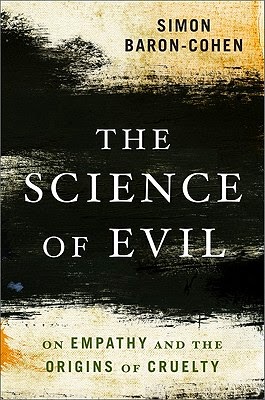
In "The Science of Evil: On Empathy and the Origins of Cruelty", Professor Simon Baron-Cohen explores an idea I found very interesting - the idea that what we call "evil" is caused by a lack of empathy.  He believes that because of this lack of empathy, people who do evil things objectify the people they do evil to - they do not see them as persons, and this protects them from the guilt they would otherwise feel as a result of the cruel things they do to these objectified persons. 

Professor Baron-Cohen defines empathy in this manner:

Empathy is our ability to identify what someone else is thinking or feeling and to respond to their thoughts and feelings with an appropriate emotion. This suggests there are at least two stages in empathy: recognition and response.  Both are needed, since if you have the former without the latter you haven’t empathized at all. If I can see in your face that you are struggling to lift your suitcase onto the overhead rack on the train and I just sit there and watch, then I have failed to respond to your feelings (of frustration).
The Empathy Circuit
In the second chapter of his book, he explores the various parts of the brain that are involved in "the empathy circuit" - and it is interesting to note how there are 10 regions of the brain that he names as playing a part in this "empathy circuit".  Baron-Cohen explains how each part contributes, or how our empathy can be damaged if these parts do not function correctly.  For example, Professor Baron-Cohen explains the part played by the medial prefrontal cortex (MPFC) - the hub for social information processing (where we think about how others might think or feel, as well as where we develop self-awareness).  

Baron-Cohen goes on to note that the famous case of Phineas Gage - a railroad construction foreman who survived an accident where a metal rod impaled his brain - demonstrates how this part of the brain contributes to empathy.  Gage's MPFC was damaged, and whereas before the accident he was said to be a very polite individual, after his accident he was reported to be childish, rude, and prone to profanity and a lack of social inhibition (all signs of a lack of empathy towards others). 

Understanding how his brain damage caused his lack of empathy makes it harder to directly blame him for his "evil" - doesn't it?


Phineas Gage
Professor Baron-Cohen goes on to explore three types of personalities which exhibit a lack of empathy - or more specifically, three types which have a negative form of this lack of empathy.  Interestingly enough, he goes on later in the book to explore a positive form of lack of empathy - Asperger's - where the tendency to systematize seems to balance out the lack of empathy and, rather than causing immorality, the overactive systematizing mechanism causes a form of super-morality (characterized by a lack of ability to understand nuance - rules have no exceptions).  The positive benefits of this combination of lack of empathy and high tendency to systematize is that people with Asperger's are often Savants who tend to discover patterns that most people overlook - reaping huge scientific benefit.  Note that calling this a positive form of a lack of empathy doesn't mean that it never causes harm - a person with Asperger's can be brutally honest, for example, and will see nothing wrong with telling you that your haircut is ugly (they simply do not understand how this is wrong, and in fact, their high standards of truth seem to make it right in their mind).  It simply means that a positive form of lack of empathy is one where there is not a tendency to cause physical harm, and where there seem to be side benefits.

This positive form of lack of empathy is very interesting to note and has its own nuances, but exploring the concept in more detail is outside of the purposes of this post, so I will leave the topic as it stands and return to exploring the negative forms.

Type B
The first personality type with negative lack of empathy is referred to in psychology as borderline personality disorder - Type B.  Baron-Cohen explains this disorder in this way:

The hallmark of borderlines is a constant fear of abandonment, emotional pain and loneliness, hatred (of others and of themselves), impulsivity, and self-destructive, highly inconsistent behavior.
The first thing one might note is what a miserable existence people with borderline personality disorder seem to have - they are constantly in a world of conflicting emotions, where they cannot be alone, and yet they oscillate between either pushing people who get close away or desperately clinging to them in a way that becomes off-putting.  But more importantly, Baron-Cohen explores the causes of this disorder.  Borderlines almost always have a history of parental dysfunction - one or both of the parents was either abusive or neglectful (abandoning the child and withholding affection).  And when scientists have studied the brains of people with borderline personality disorder, they have discovered abnormalities in many of the areas of the brain that Baron-Cohen writes about in chapter 2 of his book.  He states:
One interpretation of all this evidence is that early negative experiences of abuse and neglect change how the brain turns out. But the key point is that the zero degrees of empathy in borderlines arises from abnormalities in the empathy circuit of the brain.
Type P
The second type of personality which exhibits a lack of empathy is the psychopath - Type P (this is often referred to as antisocial personality disorder).  Psyhchopaths exhibit a total preoccupation with self very similar to borderlines, but in their case it is characterized by a willingness to do whatever it takes to satisfy their desires - Baron-Cohen writes:

This might take the form of a hair-trigger violent reaction to the smallest thing that thwarts the person. Or it might take the form of cold, calculated cruelty. Sometimes the mindless aggression is not triggered by a perceived threat but by a need to dominate, to get what one wants, a complete detachment from another person’s feelings, and possibly even some pleasure at seeing someone else suffer.
Later on, Baron-Cohen gives this list of characteristics that are indicative of psychopathic personality disorder:
  • superficial charm
  • lack of anxiety or guilt
  • undependability and dishonesty
  • egocentricity
  • inability to form lasting intimate relationships
  • failure to learn from punishment
  • poverty of emotions
  • lack of insight into the impact of their behavior
  • failure to plan ahead
Many of these are easy to spot as signs of - or a result of - a lack of empathy.  For example, the second characteristic - a lack of anxiety or guilt - is a key feature, as a person without empathy will not feel guilt when they hurt others.  Additionally, a lack of insight and egocentricity are easy to spot as coming from a lack of empathy.

Much like the case of borderline personality disorder, an important factor in the development of psychopathic personality disorder seems to be parental rejection.  During their development, a child that develops psychopathic personality disorder silently rages inside at the parental alienation, and this develops into full blown hate.  Eventually, these feelings build up (like steam in a pressure cooker) until they cannot be contained, and they are released as violent acts
(see the story of Matthew Murray).  

Doctors who have studied psychopaths have found that because of an insecure parental relationship, these children go on to be unable to form anything but superficial relationships with anyone else as well.  Secure relationships are needed for both social and language development, and so these children end up developing abnormally without them.  Even more disturbing is the fact that often, these individuals grow up to be parents who are harsh and abusive, and the cycle continues across generations. 

On the opposite side of this, parents who give affection and security to their children fill them with good feelings - sort of like an inner pot of gold - which seems to immunize them against falling into negativity when bad circumstances come into their lives later on.  Baron-Cohen mentions a friend of his - Peter Fonagy, who is a professor of psychoanalysis at University College London and director of the Anna Freud Centre in Hampstead in London - who theorizes that during the attachment phase of a child's development, they try to "mentalize" the caregiver's mind, imagining what the caregiver thinks and feels, which is especially important in relation to the child as far as the development of self-image goes.  If the relationship is not safe - that is, if the child has reason to think that their caregiver hates them or wishes they didn't exist - they are unable to develop good empathy because they shut down their attempts to mentalize the minds of others, and the areas of the brain involved in this type of thought do not develop normally.

Along with a parental rejection, another cause of psychopathy seems to be prolonged stress - which eventually damages the hippocampus.  This results is a reactive aggression - rather than "fight or flight", flight is never an option and even the slightest provocation is handled with aggression.  When this mechanism is triggered, because of an under-developed frontal cortex - which would otherwise regulate the response - the reaction is uninhibited and an attack is launched.

Perhaps one of the more interesting features of the list of characteristics above is the characteristic of failure to learn from punishment - those with psychopathic personality disorder seem to have developed a defense mechanism as a result of their dysfunctional parental relationships that prevents them from fearing the repercussions of their actions. 

Additionally, when scanning the brains of psychopaths, researchers have found brain abnormalities in some of the 10 brain regions I mentioned earlier - once again, psychopaths were not able to develop the capability to empathize during their childhood.

Type N
The third, and final, type of personality which exhibits a lack of empathy is the narcissist - Type N (referred to in psychology as narcissistic personality disorder).  Narcissists exhibit a tendency to entitlement - they feel that they have an automatic right to be treated well, regardless of how they've treated others.  Additionally, they have a tendency to overstate their own strengths and achievements.  Other people's opinions do not factor in to this equation, but it is as if the sole purpose of others is to exist as an audience that agrees with and admires the narcissist.  But narcissists live in a very fragile world - their mood often plummets into depression, because of their need for constant affirmation.  People who develop relationships with narcissists often feel that they can never give enough, and will often withdraw - this withdrawal does not go unnoticed, and a narcissist often responds with negativity, which only drives their friends and loved ones further away.

Narcissists do not usually display cruelty, however - Baron-Cohen writes:

Rather, in the absence of any humility, narcissists think they are much better than other people, as if they have special gifts that others lack. Indeed, the continuous boastfulness and self-promotion are partly what others find offensive, not because they are jealous, but because they see these as indicators of the narcissist’s total self-preoccupation. Narcissists, like the other Zero-Negative forms, fail to recognize the importance of relationships being two way. For those who have zero degrees of empathy, relationships are not really relationships because they are one way. This is even evident in how much narcissists talk. There is no attempt to make space in the conversation for the other person or to find out about the other person. Narcissists simply lecture, holding forth about him or herself, and they decide when to end the conversation. They have monologues, not dialogues.
As to the causes of narcissism, Professor Baron-Cohen writes:
Like Types P and B, early emotional abuse has been suggested as a possible cause of Type N, again reminding us of the importance of that internal pot of gold. But unlike the other Zero-Negative types, it is speculated that Type N may also derive from excessive admiration, excessive praise for their good looks or talents, overindulgence, and being over-valued in the absence of realistic feedback (by parents).
He notes that, unfortunately, there has not been very much research into Type N - unlike the other two types - and this may perhaps be explained by the fact that narcissists do not tend to be violent like the other two types.  But despite the differences between these three types of personality disorders, he notes, the glaringly obvious connection between them all is a lack of empathy.  In fact, the research indicates that these types of people are not capable of experiencing empathy in the way most people are, because of abnormalities in the areas of the brain outlined in chapter 2 of Baron-Cohen's book.  And it seems that in most cases, these abnormalities can be traced to an impoverished childhood rearing - an environment where the child was not supplied with the experiences necessary to develop empathy.

Up until now, I've discussed the environmental factors which contribute to low empathy.  But Professor Baron-Cohen also discusses the fact that genes contribute as well, to complicate things.  Professor Baron-Cohen gives the example of a friend of his who grew up in an environment with an unusually high percentage of criminals - but this friend grew up to be a noteworthy and talented psychologist against all odds.  Additionally, studies have shown that there is a higher chance of Type P and Type B amongst brothers, sisters, children, and parents (there is, yet again, not enough research into Type N to form conclusions in this area).  To summarize his conclusions at this point, Baron-Cohen states:

While it is tempting to blame zero degrees of empathy on either genes or environment, a mix of factors is clearly causal.
My Conclusions
So why did I find this book so interesting?  First off, I felt affirmed by the fact that the conclusions presented in this book harmonize quite well with the concept of privatio boni, which I explored in one of my posts in my series on Satan.  This theory that the cause of what we call "evil" is a lack of empathy - and thus is a "nothing" rather than a "something" - aligns well with my own thoughts on evil as an absence of good.  And I think it draws out an interesting connotation on a quote by Karl Barth I had used in my series:

That which God renounces and abandons in virtue of his decision [i.e., to freely elect what he will] is not merely nothing. It is nothingness. . . . Nothingness is that which God does not will. It lives only by the fact that it is that which God does not will. But it does live by this fact. For not only what God wills, but what he does not will, is potent, and must have a real correspondence. What really corresponds to that which God does not will is nothingness.
But along with this, the knowledge that genes and environment produce what we call evil must lead one to wonder how much we can blame people for their own sin?  I don't know about you, but for me, knowing that some people simply can't help their lack of empathy makes me want to extend empathy and mercy towards them all the more.

This also ties into the concept of hell (see my series, Checkmate For Hell).  In "God's Final Victory", authors John Kronen and Eric Reitan made an interesting argument related to this, which Reitan summarized on his blog like so:

Here is, for me, the big problem: God’s preordaining some sinners for reprobation is supposed to reflect God’s justice, which tempers His mercy and love (or the other way around?). The idea is that sin is such an intolerable affront to God’s holiness and majesty that divine justice demands that it be repudiated. And so God casts some sinners away forever as a display of His just wrath against sin, even as he elects others for salvation to display His mercy and benevolence.

The problem is this: In casting sinners away from His presence, He casts them away from the only thing that (according to the very theology underlying this theory) can overcome sin. Thus, God guarantees that this intolerable affront to His majesty continues eternally in the souls of the damned. In short, the view essentially amounts to this: sin is so terrible that God decisively acts to guarantee that this intolerable thing continue in all its intolerability forever and ever. “What you’re doing is so inconceivably unacceptable that I am going to make absolutely sure that there is no way for you to ever stop doing it!”

And making sure that this intolerable affront to His holiness never stops is supposed to be God’s justifying reason for not electing all, and so for truncating the scope of his benevolence? Is that a coherent understanding of divine justice?
The Bible says in I John 4:8 and 16 that God is love - the original Greek word used here connotes a selfless form of love, very similar to empathy.  So if we accept that sin or evil comes from a lack of empathy - as the scientific evidence suggests - then Reitan's argument states the problem with eternal hell very well.  

This causes problems for Calvinists and Arminians alike - because for Calvinists, God withholds the only thing that could fix the problem of evil simply for His own glory (which doesn't sound very empathetic to me - sounds more like the description of a psychopath). 

And for the Arminian side, if God gives up and stops trying to extend His empathy to the lost, we have the same problem - God has withdrawn the only thing that could fix the problem because He gives up on them, and this doesn't sound very empathetic either.  It would essentially require God to shut off of the very characteristic that is supposed to define Himeself, and this is a very strange idea when you think about it: God has to stop acting like God in order for there to be Hell.  


Additionally, there is a strange irony to this - God acts un-empathetic towards the un-empathetic in order to punish them for their lack of empathy.  In other words, God does the very thing the evil were doing in order to "make things right".  One might also wonder about the irony of the State when it commands executioners to shut off their empathy towards those who have committed crimes that were a result of a lack of empathy - in essence, turning the executioner into a mirror image of the executee in the moment of the execution.

I'd also like to echo something Professor Simon Baron-Cohen said in the final chapter of his book:

[E]mpathy itself is the most valuable resource in our world. Given this assertion, it is puzzling that in school or parenting curricula empathy figures hardly at all, and in politics, business, the courts, or policing it is rarely, if ever, on the agenda.
Along with this, I wonder (sorrowfully) why our churches do not expend more efforts in methods of empathy training?  Why is it that our theology is so centered around conceptualizing ideas about the afterlife, invisible personalities, and the eschaton, rather than centering around the practice of empathy?

And finally, it should be noted that quite often, the acts of history that we would qualify as evil are performed by men and women whom are quite empathetic at home, with their own group of loved ones.  But the difference here is that these individuals harbored beliefs that encouraged them not to extend that empathy to other groups, or to shut off their empathy circuit when it came to these outsiders.  So I have to ask - are our doctrinal systems sacralizing beliefs that encourage a lack of empathy towards certain types or groups of people?  I think some are, and so I have to ask: why is it so hard to get people to challenge these beliefs?  Shouldn't the job of the church of Christ include challenging people to extend empathy to people they have a hard time empathizing with?  Shouldn't the whole point of faith be to cultivate empathy?

Matthew 5:43-48 NRSV
"You have heard that it was said, ‘You shall love your neighbor and hate your enemy.’  But I say to you, Love your enemies and pray for those who persecute you, so that you may be children of your Father in heaven; for he makes his sun rise on the evil and on the good, and sends rain on the righteous and on the unrighteous.  For if you love those who love you, what reward do you have?  Do not even the tax collectors do the same?  And if you greet only your brothers and sisters, what more are you doing than others?  Do not even the Gentiles do the same?  Be perfect, therefore, as your heavenly Father is perfect."

Friday, December 12, 2014

The Truth in the Nativity

Introduction

About a year ago, I published a post on another blog (which has now gone private) with the same title as this post.  When I did, I felt like I had to summarize and leave out so much information (while this post is much longer, the feeling is still there) - this is one of the perils of blogging (write too much and people might not read it, write too little and people might not get it).  I had always wanted to write a longer version of the same post, and originally intended to include this as part of the series I keep saying I'm going to eventually finish and publish which I'm calling "Judaism and the Mystical Christ".  But, due to the season we're in and the fact that this just seemed to flow naturally from the last post I published, On Being a Skeptical Christian, I felt it appropriate to just do it.

Originally, when I published my old post titled "The Truth in the Nativity", I mentioned that after reading an article on Huffington Post about a concept called "Pub Theology" and reading the book by the same name (and author), I started talking to some people about starting our own group.  In our discussion, we agreed that one of the goals of the group would be to give people a chance to voice their views, no matter what they may be, and to be a safe-haven for people of varying backgrounds to explore the deep questions of life together.  This would be a way to bring skeptics and believers together.  We wanted to give our group a unique name, and decided to call it "The Thirsty Skeptics" - and the previously mentioned last post on my blog explains some of my own thought process behind living out that name as well.

Because of my efforts to be, as I explained, a "Skeptical Christian", I often feel as though I am right in the middle – right between the "True Believers™" and the skeptics.  Sometimes I feel as though one side is trying to tell me that I should renounce all belief as it is all preposterous, and the other side is trying to tell me to shut off my brain and stop thinking so much.  This is a common problem with the modern mindset – dualistic thinking.  There’s only two possibilities: black and white; right and wrong; good and evil.

The Nativity is one of those stories of faith that can be a battleground for these dualistic fights.  Are we really to believe that a virgin conceived a child as an act of God?  The skeptics will tell you that this is superstition, and the true believers will call you a heretic if you don’t repent and believe.  Are these the only options?


My own proposal (and that of many scholars) for what the stories of the Nativity represent are that they are part of a mythicized history.  Now right there, some of my readers might be tempted to throw their keyboard on the ground, shout at the screen, and close this window.  I hope they keep reading.  But the reaction would be understandable because with our modern western sensibilities, "myth" is virtually synonymous with "lie", and is seen as a vicious attempt to mislead a person.  This can hardly be helped when we speak of "dispelling myths" and watch TV shows called "MythBusters" (I love that show, by the way).  But the ancients did not share these sensibilities - they had no problem with mixing myth and history together.  For them, this was a way to infuse a historical event with meaning - to tell the audience what the events meant, not only for the present, but to point "the Way" forward to the future as well.  (And I hope with that last sentence my readers hear an echo in a certain statement from the gospel of John where Jesus says he is "the Way").  

I will be further exploring this concept of mythicized history in my upcoming series, but for now I'd like to move forward to examine some of the problems with taking The Nativity as literal history.  I'm going to start with an issue that by itself is no kind of proof at all (it would be called an argument from silence), but taken along with what follows I believe it takes on some importance.

The Omission

There is, today, a scholarly consensus that the gospel of Mark is the first of the four gospels to be written – partially because of the analysis of language, and largely because of the fact that Matthew and Luke both seem to use Mark as a source document.  There are very few passages in Mark which are not also found in either Matthew or Luke, while the latter two seem to have some other sections in common which are not in Mark – scholars believe they drew on another common source that was a lost document referred to as "Q".  Matthew and Luke also have stories and sayings which are unique to each of them.  


Keeping in mind the Marcan priority, it is interesting that Mark has completely omitted any mention of the birth of Jesus. It was apparently either not considered important, or simply not known.  Additionally, it is widely agreed that the apostle Paul was the earliest Christian writer, and he never mentions Jesus’ birth story in his writings.  Even more curious, the gospel of John, which is regarded to be the last of the four gospels to be written, also does not mention Jesus’ birth.

Why is it that this story was completely left out of all the earliest writings, as well as the gospel of John?  And why was the story added in later by Matthew and Luke?

The Differences

The second problem with a literal historical interpretation of the Nativity stories is that there are contrasts between Matthew’s story, and Luke’s version of it.

The first striking difference is the genealogies.  While both trace Jesus back to King David, Matthew only goes back as far as Abraham, and Luke goes back to Adam.  But if you line up both genealogies starting with David, you’ll notice that between David and Jesus, they don’t have a lot in common - and perhaps worse, the names they do have in common are ordered differently.  You can see this here:


I've heard some apologists try to get around this difference by saying one is the genealogy of Mary and the other Joseph, but both genealogies go from Joseph to Jesus, so that seems to me a convenient stretch.  But there are a few other problems between the genealogies as well - Matthew goes from David to Solomon (a king), and Luke has the prophet Nathan as David's descendant (which is pretty unlikely - I'd use this as an argument for taking this metaphorically, as in a "spiritual ancestor").  But also notice how Luke has Eliakim before Salathiel and Zorobabel and Matthew after?  And while both genealogies have a similar name for Joseph's grandfather (the difference between Matthat and Matthan may amount to a mispelling that occurred somewhere), there is a difference in Joseph's father.

The next difference you might notice in the stories themselves is that there seems to almost be a discrepancy between the two as to where Joseph and Mary lived.  Luke has their hometown as Nazareth, traveling to Bethlehem because of a census.  Matthew simply says that Bethlehem was where Jesus was born – as if this were their hometown.  In Matthew, Nazareth only becomes Jesus’ home after the family had moved to Egypt for a while, then moved to Nazareth because Joseph was afraid to move back to Bethlehem with Archelaus reigning in Judea (see Mt. 2:21-23).  If you read the entire story of Luke and pay attention to the logistics, the path goes: Nazareth (Lk. 1:26), Bethlehem (Lk. 2:4), Jerusalem (Lk. 2:22), Nazareth (Lk. 2:39) - this addition in Luke of going to the temple 8 days after Jesus was born presents a bit of a problem for those who wish to mash the two stories together as they were supposed to be avoiding Herod, not going to his own home city (note how the presentation at the temple is often left out in Christmas pageants).

I would also like to note here that Mark only ever mentions Nazareth as being Jesus’ hometown.  The gospel of John seems to support the idea of Jesus coming from Nazareth as well – and we find that this town does not have a very good reputation (see John 1:46).

The third difference you will find is in the visitors – Matthew has "wise men from the East" who follow a special star (how does a star visibly move through the sky in a way that can lead to a place?), while Luke omits this entirely and has shepherds visiting instead.  This does not represent a direct contradiction, but it is curious that there is no overlap between the stories amongst the visitors.  Also, the visit of the wise men poses an additional problem with the visit to Jerusalem - if the family had gone off to the temple, the Magi might have missed them!


One must also ask, of Matthew's star - how does a star visibly move through the sky in a way that can lead to a place?  This story might make sense if we still believed in a three-tiered universe, but, if taken literally, makes no sense at all in our post-Copernican views of the universe.  As former Bishop John Shelby Spong puts it in "Biblical Literalism: A Gentile Heresy: A Journey into a New Christianity Through the Doorway of Matthew's Gospel":
Could a star wander through the sky so slowly that wise men could follow it? That might be conceivable if we assumed that God or one of God’s angels could pull that star on a string across the roof of the earth, which would be the floor of heaven, to guide these wise men to their destination. We are told, however, in Matthew’s story that the star did not lead them to the Christ child. It rather led them to the palace of King Herod (Matt. 2:1, 2). Did the star get lost? No, Matthew was saying, it simply needed to be reprogrammed by Jewish scripture in order to get back on the right track (Matt. 2:3-6 [...]). Reading the Bible literally requires the suspension of all reason. What kind of people, we might also ask, would it be who, upon seeing a new star in the sky, would immediately interpret that star as announcing the birth of a new king of the Jews, and therefore set out at once on a journey to an unknown destination to pay homage to that infant king? Did they keep not only the camels nearby to transport them, but also a supply of gold, frankincense and myrrh, just in case these gifts were needed for this purpose?
The fourth difference is in the plot of Herod in the second chapter of Matthew.  There are historical problems with this story.  While there is ample evidence to show that Herod was ruthless and cruel, there can be found no other evidence of this massacre besides the tale in the gospel of Matthew.  This is remarkable, as there are many chronicles written about “Herod the Great”, and the stories of his cruelty are not omitted in them, so it doesn’t appear to be that a coverup is going on here.

There are other differences between the birth stories, but let’s move on to another historical problem: Luke’s census.  Luke claims that the Syrian governor, Quirinius, called for a census and people were required to go to their hometown to register for this.  There is historical evidence to show that 10 years after Herod’s death – in the year 6 A.D. – such a census did, in fact, happen.  But now we are faced with some major issues:

  1. As Herod was dead when this census happened, we now have a discrepancy between the timing of Jesus’ birth between Luke and Matthew.
  2. Because the purpose of a census was taxation, a census would have registered citizens in their current residence in order to assess their property.  There is nothing written in any of the legal code of Rome – and Rome was known for their thorough documentation – to suggest a practice of sending people to their original hometowns for such a census.  Additionally on this point, there are about fifty generations between David and Joseph - so if Rome had actually ruled that everyone from David’s time up must go to the hometown where their ancestor from fifty years ago resided, the descendents “of David” would have numbered in the billions (had they all survived).  Not only would this have flooded the little town of Bethlehem beyond what it could bear, but tracking this would have been impossible with Rome’s technology.
  3. There is no record of Rome having ever required an entire family to register together for a census - on the contrary, only the head of the household is required to register on behalf of his household.  So it would have made no sense for Joseph to drag his pregnant wife along on a very long journey by foot.
Depiction of a Roman Census
While I disagree with his conclusion (namely, that Jesus was a Zealot - or, a violent resistance leader), Reza Aslan does a good job of outlining the problem with the second item in his book, Zealot:
Luke’s suggestion that the entire Roman economy would periodically be placed on hold as every Roman subject was forced to uproot himself and his entire family in order to travel great distances to the place of his father’s birth, and then wait there patiently, perhaps for months, for an official to take stock of his family and his possessions, which, in any case, he would have left behind in his place of residence, is, in a word, preposterous.
And there's one final issue I'd like to explore with Luke's story.  Let's put it this way - if Luke were created as a movie, it would be a Disney musical.  In Luke's Nativity, characters (Mary, Zechariah, Simeon, and the angels) spontaneously burst into songs with very well-developed poetry, and no one around seems to have a problem with this - a problem which Disney's "Enchanted" explores:


In a Disney musical, bursting into well-developed song spontaneously is no problem, but in real life it doesn't really work out that way.  It tends to work more like this:


So with these problems with viewing this story as history, what is the spiritually minded person who is drawn to the story of Jesus to do with these problems? Does he insist that the stories of Matthew and Luke are true, despite these issues?  Or does he reject Christianity altogether and either become agnostic, atheist, or look at other religions for spiritual guidance?

Something's wrong here...
Or perhaps there is a third option – somewhere in between rejecting Christianity, and accepting these stories as being factual despite their problems?

The Truth of the Nativity

A reasonable case can be made that a man named Jesus existed and was executed by Rome.  I say that this is reasonable because it is confirmed by sources which were not “Christian” in nature.  The historian Josephus mentions Jesus twice in separate sources.  The first mention is in Book 20 of his Antiquities of the Jews.  In chapter 9, he describes law-breakers being stoned, and one of them is “the brother of Jesus, who was called Christ, whose name was James.”  The second is a longer passage in the Testimonium Flavianum in which Josephus describes Jesus as a wise man who was a “doer of startling deeds,” a teacher who gained a large following, was condemned to death on a cross by Pilate, and “up until this very day the tribe of Christians (named after him) has not died out.”  Now, it is important to note here that scholarship widely agrees that the passage of the Testimonium Flavianum is not accurate in its entirety but was added to later on by the Church in order to give more weight to its claims - however, it is not a majority opinion that the entire passage was made up.

The second “non-Christian” source for the validity of Jesus’ existence is from the Roman historian Tacitus, who records in “The Annals” that the Emperor Nero pinned the blame for the fire on Rome “on a class hated for their abominations, called Christians by the populace. Christus, from whom the name had its origin, suffered the extreme penalty during the reign of Tiberius at the hands of one of our procurators, Pontius Pilatus….”


And in addition to these, there is a reference that scholarship argues over from Suetonius.  Suetonius and Tacitus are of some importance as they were in no way in support of Christianity - and thus would have no reason for making up a historical person or even writing about one which could have been completely made up as myth.

So we can reasonably assume that there was a man named Jesus who lived and died by execution in Rome, and Christianity broke out as a result of his movement.

But what can we reasonably say about his birth?

There is actually a very old argument by opponents of Christianity that Jesus was an illegitimate child of his mother.  Shockingly, this may actually have Biblical grounding.  In Mark chapter 6, we find Jesus preaching in his hometown, and the reaction was one of surprise – as if Jesus was not the same man they had known who grew up with them.  Verse 3 has the audience saying “Is not this...the son of Mary?”  When you put this into the historical context, this is a very important statement: in this day and age, there were no surnames, and you would identify people by their fathers – Jesus would have been “Jesus bar Joseph” (literally: "Jesus son of Joseph"), not “Jesus bar Mary”.  Calling someone by their mother’s name was not just unusual, it would have been seen as an insult – the implications would have been obvious to anyone in that culture: Jesus was an illegitimate child.  Even more curious, Matthew and Luke both have similar reactions, but Matthew has the audience ask first about his father and then about his mother (Mt. 13:55), and Luke drops the reference to Mary altogether (Luke 4:22).

Now, as there is no argument, even from Mark, that Jesus had brothers, it is impossible to know how this illegitimate birth occurred – whether Mary had been raped by a Roman Centurion (as the Greek philosopher Celsus argues), or whether Joseph and Mary had just jumped the gun.  But with the evidence, it is plausible to conclude that Jesus was at least widely regarded as an illegitimate child!

So what does this mean for the stories of Matthew and Luke?

A Tale of Two Lordships


The conclusions I draw from this evidence - as I mentioned before - are that Matthew and Luke are both mixing mythology and legend with historical fact – a practice which would not have been unusual with writers in that day.  Moreover, the audiences would have realized this!  If it was widely known that there had been a man named Jesus who had gained a following and who was considered to have been illegitimately born, the audience would have picked up on the fact that Matthew and Luke were trying to get them to see these circumstances in a new light.  They would have picked up on the fact that a well-known story was being retold in a new way.

With this in mind, I suggest that rather than asking "is this story factual?", we should rather ask "what were they trying to say?"  In other words, it's not so much that I am saying "these are the things I don’t believe" or "these are the things I reject", but more along the lines of asking: what is the message the writers of the gospels wished to convey?  What were the important ideas they wanted to get across?  And when we find that a literal interpretation of a story is not plausible, that doesn’t so much mean that we are saying that it is not true, as merely saying that it’s a different kind of truth - just as a fable or a parable is not literally truth but is metaphorically true.  Or, as scholar John Dominic Crossan puts it in Who Is Jesus?: Answers to Your Questions about the Historical Jesus:

My point... is not that those ancient people told literal stories and we are now smart enough to take them symbolically, but that they told them symbolically and we are now dumb enough to take them literally.
The first thing you need to consider when trying to answer the question of meaning is the intended audience. Starting with Luke, the stage is set for explaining the similar intentions of the author of Matthew.  Luke is widely regarded to have been intended for an international audience – meaning that he was not so much writing for Jews, but for the purposes of evangelizing non-Jews within the empire of Rome.  As such, there are certain details which this audience would have picked up on that are largely ignored by modern readers.

The very word "gospel" has a meaning which is largely lost on modern readers.  It comes from the Greek word "
euaggelion", which literally means “good news”.  But this word was not used for just any good news – it was used to indicate a specific kind of good news: the news of a new Caesar and/or the news of victory (when Pheidippides returned from the battle of Marathon, he cried "euaggelion").  Vol. 2 of the Theological Dictionary of the New Testament says that "euaggelion" was "a technical term for news of victory".

To understand how such an ambiguous word could indicate such specific connotations in that culture, consider this - in American culture, if I said "inauguration", people would immediately assume I was talking about a ceremony for a new President.  However, the word literally means "a ceremony to mark the beginning of something" - it is our frequent use to indicate a Presidential inauguration that gives it the connotation I'm speaking of, and due to the frequency that euaggelion appeared in the context of speaking of a new Caesar, the assumption would be similar in that culture.

This is the inscription on a tablet from the city of Priene, believed to have been inscribed around 9 B.C.:

The providence which has ordered the whole of our life showing concern and zeal has ordained the most perfect consummation for human life by giving it to Augustus by filling him with virtue for doing the work of a benefactor for men and by sending in him as it were a savior for us and those who come after us, to make war cease, to create order everywhere ...; the birthday of the god (Augustus) was the beginning for the world of the euaggelion[translated “good news”] that have come to men through him... [emphasis mine]

There are other similar inscriptions to be found - in the city of Myra (on the southern coast of western Turkey) is found an inscription to the "divine Augustus Caesar, son of a god, imperator of land and sea, the benefactor and savior of the whole world."  North of this city is Halicarnassus where there is the following inscription: 

Since the eternal and immortal nature of everything has bestowed upon mankind the greatest good with extraordinary benefactions by bringing Caesar Augustus in our blessed time the father of his own country, divine Rome, and ancestral Zeus, savior of the common race of men, whose providence has not only fulfilled but actually exceeded the prayers of all. For land and sea are at peace and the cities flourish with good order, concord, and prosperity. [emphasis mine]

The Roman poet Virgil wrote in the Aenid:

From this noble line shall be born the Trojan Caesar, who shall extend his empire to the ocean, his glory to the stars, a Julius [Augustus], name descended from great Iulus!
Afterwards, the speaker (who happens to be Jupiter) says that “wars shall cease and savage ages soften” into peace on earth.


In "The First Christmas", scholars Marcus Borg and John Dominic Crossan write:

Julius Caesar, along with his grandnephew and adopted son Octavian - the later Caesar Augustus - belonged to the Julian tribal family (gens). They claimed a millennium-old descent from the goddess Venus, daughter of Jupiter, and her human consort Anchises, a Trojan hero from the time of that legendary war against the Greeks. The divine son of Venus and Anchises was named Aeneas, and it is through his son, Julus, that the Julian line claimed descent. 
As you can see, this was a common way of speaking about Rome’s emperors.  Rome treated its emperors as divinely sanctioned authority – gods, even.  They were the “savior of the world”, they were called "Lord", they made wars cease (by having crushed all their enemies), they brought economic prosperity (to those who were already rich to begin with), and their birth was good news (literally euaggelion– and it was only good news to some).  Notice how the language matches language used of Jesus - "providence", or the "eternal and immortal nature of everything" has given us this "savior" as an answer to "prayer", who has brought benefits that exceed expectations and the kingdom of this "divine" figure shall have no end and his glory shall extend to the stars.

The Roman governor of the province of Asia minor, Paulus Fabius Maximus, also wrote of how "the birthday of the most divine Caesar" (speaking of Augustus) was "set on a part with the beginning of everything", "that he restored order when everything was disintegrating and falling into chaos", changed "the whole world" which "would have met destruction...if Caesar had not been born as a common blessing to all.  For that reason one might justly take this to be the beginning of life and living...."  He continues on to propose that Augustus' birthday be treated as the New Year's Day.  Note especially how, for the Roman cultus, Augustus' birth marked the beginning of a new creation.

One can hardly help but hear the echos on the declarations the gospel writers make about Jesus - putting him in direct competition with Caesar, which would have been very subversive (high treason, even).  But let's compare this to the message Luke has an angel bringing to lowly shepherds to see the difference:

Luke 2:10-12
But the angel said to them, “Do not be afraid; for see - I am bringing you good news [literally euaggelion] of great joy for all the people: to you is born this day in the city of David a Savior, who is the Messiah, the Lord.  This will be a sign for you: you will find a child wrapped in bands of cloth and lying in a manger.”  [emphasis mine]
Luke’s audience would have immediately picked up on the fact that he was borrowing language commonly used about Rome’s Caesars and pointing them at Jesus, but he was doing this in a way that turned the whole thing upside down.  Rather than being good news just for Caesar’s allies (specifically those who were rich and important), it was good news for all the people.  The message of this son of God’s birth was brought not to the rich and powerful, but to lowly shepherds: the poorest of the poor (shepherds in that culture were often former land owners who'd lost their land to the banking system, and were now working for "minimum wage" on their own land) - the gospel is proclaimed to the marginalized ones, rather than the royal dominators.  And this Savior was born in a manger.  The message would have been clear to Luke’s audience: greatness does not lie in a palace – greatness is found in the lowliest of places.  Jesus’ entire story plays on this juxtaposition.  He does not pander to the rich and powerful as Caesar does – Jesus values the poor; the sick; the outcasts of society, and says that the kingdom belongs to them.  Jesus does not make peace by crushing his enemies through warfare and hoisting his enemies up on crosses – he makes peace by giving up his own life on a cross.

Now it should be noted that virgin births were not all that uncommon in the time when the gospel of Luke was written, and Augustus (literally "worthy of worship") had his own tale.  In "The Lives of the Caesars", Suetonius writes of a prophecy that came before Augustus was born "which gave warning that nature was pregnant with a king for the Roman people; thereupon the senate in consternation decreed that no male child born that year should be reared; but those whose wives were with child saw to it that the decree was not filed in the treasury, since each one appropriated the prediction to his own family."  Do you notice the similarity between this story and Matthew's story of Herod killing all the baby boys in Bethlehem?  


Suetonius goes on to describe the conception:

When Atia had come in the middle of the night to the solemn service of Apollo, she had her litter set down in the temple and fell asleep, while the rest of the matrons also slept. On a sudden a serpent glided up to her and shortly went away. When she awoke, she purified her self, as if after the embraces of her husband, and at once there appeared on her body a mark in colors like a serpent, and she could never get rid of it; so that presently she ceased ever to go to the public baths. In the tenth month after that Augustus was born and was therefore regarded as the son of Apollo.
One key difference to note here - Apollo did not request any permission from Augustus' mother.  This amounts to a divine rape of sorts.  Meanwhile, in Luke's gospel, an angel is sent to Mary prior to the conception, which is a stark contrast.

Marcus Borg and John Dominic Crossan write about this story in "The First Christmas":

The story of Octavian’s divine conception is modeled on the earlier and similar conceptions for the Greek general Alexander, imperial conqueror of the Persians, and for the Roman general Scipio Africanus, imperial conqueror of the Carthaginians. Augustus was destined to out-conquer them both.
He’s not that kind of god…
The Greeks had many “gods” and heroes who were born of virgins: Odysseus, Romulus, Dionysus, Heracles, and Mithras among them.  But these characters had stories involving a different kind of might – physical might used for war – and were surrounded by riches.  Jesus’ story, in contrast, involves a man who asked his followers to renounce riches in order to serve the poor, and who resisted his enemies using non-violent means.  This was an altogether different kind of “Son of God” for the audience Luke wrote to.

Matthew makes similar moves on his audience – the Jews.  The Jews had always believed that one day, a Messiah would come and would restore the kingdom of Israel.  This Messiah was expected to overthrow Rome through a display of power and might, and restore the temple in Jerusalem.  In the time Jesus was born, Rome had appointed Herod as the “king of the Jews”, and he had heavily taxed his people in order to undertake a massive rebuilding project in the city of Jerusalem, including a new temple.  But Herod was widely known as a ruthless and cruel ruler – even killing his own wife and sons.  Herod flexed his power through bloodshed and by humiliating his enemies – and he was called “the Great” for the fear that he instilled in his subjects.


Herod also believed in peace through victory, domination, and by crushing one's enemies.  But as Borg and Crossan write
in "The First Christmas":
The terrible truth is that our world has never established peace through victory. Victory establishes not peace, but lull. Thereafter, violence returns once again, and always worse than before. And it is that escalator violence that then endangers our world.
What the author of Matthew does with the story of Herod killing the sons of Bethlehem, and Jesus’ escape to Egypt, is to frame Jesus' story as a sort of reverse Exodus – Herod is the cruel Pharaoh, and Jesus is returning to the place where Moses was called by God.  Thus, when Jesus leaves Egypt, he is the new Moses coming to Israel to deliver them and bring new law and order.  But he doesn’t do this in the way the Jews expected – his law is a law of love, and he overthrows Israel’s enemies by exposing their cruel might as a fraud, for the death they bring to him has no power over him and the non-violent resistance movement he started gains huge numbers after he is gone.

Additionally, the numbers Christianity gained in the years following Jesus’ time on earth were mostly non-Jews.  This is a mystery that the apostle Paul ponders in the book of Romans – why aren’t the Jews accepting Jesus?  With this setting in mind, the meaning of the visit from the wise men in Matthew becomes clear as well – he’s telling his Jewish audience “look, foreign dignitaries from other religions see that Jesus is special and important and have joined his movement while you’re still holding on to your pride!”  The fact that the word used for these visitors is "Magi" harkens to the "magicians", "enchanters", and the "diviners" that are the portrayal of Israel's enemies in Daniel 1:20, 2:2, 4:7, and 5:7. But Matthew paints a pictures of these "enemies" as pro-Jesus, while Herod "and all Jerusalem with him" are anti-Jesus (2:3).  


In addition, Matthew's star leading the Magi echoes back to Balaam's prophecy in Numbers 24:17, which speaks of  "a star" that "shall come out of Jacob" which will "crush the borderlands of Moab, and the territory of all the Shethites."  This is exactly what most Jews looked for - a king that would crush all of their enemies.  Yet again, Matthew reverses the expectation with the non-violent Jesus who offers peace to Israel's enemies.  If we see the symbolism of light coming in the middle of the night of the winter solstice, the darkest time of the year, it is not necessary to wrestle with the problems this creates when trying to mesh this idea as a historical fact with science - it is metaphor!  And Matthew's star finds its parallel in Luke 2:32 where Jesus is "a light for revelation to the Gentiles and for glory to your people Israel" and in John where Jesus is the "true light, which enlightens everyone" (1:9) which "shines in the darkness" (1:5), as well as finding precursors in the light of creation shining in the emptiness (Gen. 1:2-3), Abraham's smoking fire pot and flaming torch (Gen. 15:17) which appeared in "a deep and terrifying darkness" (Gen. 15:12), Israel's "pillar of fire" (Ex. 13:21) that led them out of the wilderness, and the Psalmists "word" (parallels John's logos) which is a "lamp to my feet and a light to my path" (Ps. 119:105), and even in the prophets (see Isaiah 9 and Isaiah 60 for two examples).  In addition, this image of light that brings a new self appears in the story of Paul's conversion (Acts 9:3-4, 22:6, 26:12-18), and in his letters (see 2 Cor. 4:4, 4:6, Eph. 5:8-14).  Light always symbolizes not only the presence of but also the experience of the sacred by those who have struggled in darkness for far too long - and it always seems to come when those who are struggling feel as though the darkness has won or even to those who seem to be the darkest.

For Matthew's Jewish audience, his picture of Jesus as Messiah would have been a striking and scandalous reversal of their expectations - undermining the religious purity culture of his day.   Matthew is declaring that Jesus is Savior not just for Jews, but for the whole world - including Israel's enemies.  As Matthew has Jesus declare in 28:19: 
Go therefore and make disciples of all nations.
What both authors are doing is to challenge their audience's value structures.  They are in essence saying: "what you think is valuable is worthless, and what you thought was worthless was actually seen as incredibly valuable by God.  And what you thought looked like power was weakness, and what looked like weakness to you was real strength."  These audiences were used to seeing the miraculous within gaudy, extravagant riches and surrounded by overwhelming military might.  But the birth stories of Matthew and Luke ask their audiences to see the miraculous in a man of questionable origins; a man who may have been born illegitimately, and whose parents took a chance on their own reputation by staying together for his birth; a man who was an outcast even among his own people; a man who was poor and lowly; a man who came from a place that had a bad reputation; a man who had no army of men with swords and spears following him, but rather fought by allowing himself to be killed without lifting a finger to defend himself.

Both narratives are performing reversals of the way their audiences were used to viewing the world.  Luke reverses the way the
euaggelion works, with good news going to the “least of these” (as Jesus would say), and has the true ruler of the world being a humble peasant king.  Matthew has foreign dignities coming to pay respects to this same peasant king, while his own people are plotting to kill him – challenging the exclusivity that was so common among Jews of the day.

The point of these stories is not to be historical fact, but to be a parable of sorts, pointing to the kind of character Jesus had and the meaning that he represented.  The ridiculous nature of Luke's census pointed to the extravagant lengths the Domination System of Empire went to in order to control its citizens - much like the ridiculous efforts Herod stoops to in order to protect his power.  These stories were never meant to be seen as facts, but as a political satire of sorts - pointing at the desperate attempts by Empire to hold on to its control, which only caused more unrest and turmoil with its people.  Fighting over the factual nature of these stories is to completely miss their point!

Rather, the meaning in the birth stories of Matthew and Luke is to ask their audience to turn away from the extravagant, and to see the miracle in the mundane.  Because when you can’t experience awe without seeing gaudy riches, miraculous events, and cruel displays of strength, you become numb and unable to experience wonder at all.  But Jesus came to awaken us to the wonder all around us in the life of those we all too often overlook – those lonely outcasts of society who were made in the image of God.

So, while I’m not sure these stories were factually accurate, I affirm them as true, and I hope you can see the truth in them as well.