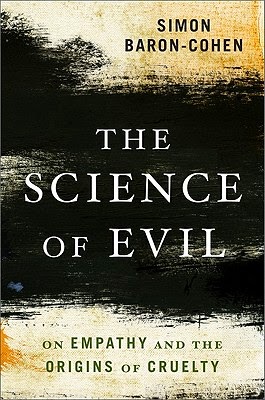
In "The Science of Evil: On Empathy and the Origins of Cruelty", Professor Simon Baron-Cohen explores an idea I found very interesting - the idea that what we call "evil" is caused by a lack of empathy. He believes that because of this lack of empathy, people who do evil things objectify the people they do evil to - they do not see them as persons, and this protects them from the guilt they would otherwise feel as a result of the cruel things they do to these objectified persons.
Professor Baron-Cohen defines empathy in this manner:
Empathy is our ability to identify what someone else is thinking or feeling and to respond to their thoughts and feelings with an appropriate emotion. This suggests there are at least two stages in empathy: recognition and response. Both are needed, since if you have the former without the latter you haven’t empathized at all. If I can see in your face that you are struggling to lift your suitcase onto the overhead rack on the train and I just sit there and watch, then I have failed to respond to your feelings (of frustration).
 |
| The Empathy Circuit |
In the second chapter of his book, he explores the various parts of the brain that are involved in "the empathy circuit" - and it is interesting to note how there are 10 regions of the brain that he names as playing a part in this "empathy circuit". Baron-Cohen explains how each part contributes, or how our empathy can be damaged if these parts do not function correctly. For example, Professor Baron-Cohen explains the part played by the medial prefrontal cortex (MPFC) - the hub for social information processing (where we think about how others might think or feel, as well as where we develop self-awareness).
Baron-Cohen goes on to note that the famous case of Phineas Gage - a railroad construction foreman who survived an accident where a metal rod impaled his brain - demonstrates how this part of the brain contributes to empathy. Gage's MPFC was damaged, and whereas before the accident he was said to be a very polite individual, after his accident he was reported to be childish, rude, and prone to profanity and a lack of social inhibition (all signs of a lack of empathy towards others).
Understanding how his brain damage caused his lack of empathy makes it harder to directly blame him for his "evil" - doesn't it?
 |
| Phineas Gage |
Professor Baron-Cohen goes on to explore three types of personalities which exhibit a lack of empathy - or more specifically, three types which have a negative form of this lack of empathy. Interestingly enough, he goes on later in the book to explore a positive form of lack of empathy - Asperger's - where the tendency to systematize seems to balance out the lack of empathy and, rather than causing immorality, the overactive systematizing mechanism causes a form of super-morality (characterized by a lack of ability to understand nuance - rules have no exceptions). The positive benefits of this combination of lack of empathy and high tendency to systematize is that people with Asperger's are often Savants who tend to discover patterns that most people overlook - reaping huge scientific benefit. Note that calling this a positive form of a lack of empathy doesn't mean that it never causes harm - a person with Asperger's can be brutally honest, for example, and will see nothing wrong with telling you that your haircut is ugly (they simply do not understand how this is wrong, and in fact, their high standards of truth seem to make it right in their mind). It simply means that a positive form of lack of empathy is one where there is not a tendency to cause physical harm, and where there seem to be side benefits.
This positive form of lack of empathy is very interesting to note and has its own nuances, but exploring the concept in more detail is outside of the purposes of this post, so I will leave the topic as it stands and return to exploring the negative forms.
Type B
The first personality type with negative lack of empathy is referred to in psychology as borderline personality disorder - Type B. Baron-Cohen explains this disorder in this way:
The hallmark of borderlines is a constant fear of abandonment, emotional pain and loneliness, hatred (of others and of themselves), impulsivity, and self-destructive, highly inconsistent behavior.
The first thing one might note is what a miserable existence people with borderline personality disorder seem to have - they are constantly in a world of conflicting emotions, where they cannot be alone, and yet they oscillate between either pushing people who get close away or desperately clinging to them in a way that becomes off-putting. But more importantly, Baron-Cohen explores the causes of this disorder. Borderlines almost always have a history of parental dysfunction - one or both of the parents was either abusive or neglectful (abandoning the child and withholding affection). And when scientists have studied the brains of people with borderline personality disorder, they have discovered abnormalities in many of the areas of the brain that Baron-Cohen writes about in chapter 2 of his book. He states:
One interpretation of all this evidence is that early negative experiences of abuse and neglect change how the brain turns out. But the key point is that the zero degrees of empathy in borderlines arises from abnormalities in the empathy circuit of the brain.
Type P
The second type of personality which exhibits a lack of empathy is the psychopath - Type P (this is often referred to as antisocial personality disorder). Psyhchopaths exhibit a total preoccupation with self very similar to borderlines, but in their case it is characterized by a willingness to do whatever it takes to satisfy their desires - Baron-Cohen writes:
This might take the form of a hair-trigger violent reaction to the smallest thing that thwarts the person. Or it might take the form of cold, calculated cruelty. Sometimes the mindless aggression is not triggered by a perceived threat but by a need to dominate, to get what one wants, a complete detachment from another person’s feelings, and possibly even some pleasure at seeing someone else suffer.
Later on, Baron-Cohen gives this list of characteristics that are indicative of psychopathic personality disorder:
- superficial charm
- lack of anxiety or guilt
- undependability and dishonesty
- egocentricity
- inability to form lasting intimate relationships
- failure to learn from punishment
- poverty of emotions
- lack of insight into the impact of their behavior
- failure to plan ahead
Many of these are easy to spot as signs of - or a result of - a lack of empathy. For example, the second characteristic - a lack of anxiety or guilt - is a key feature, as a person without empathy will not feel guilt when they hurt others. Additionally, a lack of insight and egocentricity are easy to spot as coming from a lack of empathy.
Much like the case of borderline personality disorder, an important factor in the development of psychopathic personality disorder seems to be parental rejection. During their development, a child that develops psychopathic personality disorder silently rages inside at the parental alienation, and this develops into full blown hate. Eventually, these feelings build up (like steam in a pressure cooker) until they cannot be contained, and they are released as violent acts (see the story of Matthew Murray).
Doctors who have studied psychopaths have found that because of an insecure parental relationship, these children go on to be unable to form anything but superficial relationships with anyone else as well. Secure relationships are needed for both social and language development, and so these children end up developing abnormally without them. Even more disturbing is the fact that often, these individuals grow up to be parents who are harsh and abusive, and the cycle continues across generations.
On the opposite side of this, parents who give affection and security to their children fill them with good feelings - sort of like an inner pot of gold - which seems to immunize them against falling into negativity when bad circumstances come into their lives later on. Baron-Cohen mentions a friend of his - Peter Fonagy, who is a professor of psychoanalysis at University College London and director of the Anna Freud Centre in Hampstead in London - who theorizes that during the attachment phase of a child's development, they try to "mentalize" the caregiver's mind, imagining what the caregiver thinks and feels, which is especially important in relation to the child as far as the development of self-image goes. If the relationship is not safe - that is, if the child has reason to think that their caregiver hates them or wishes they didn't exist - they are unable to develop good empathy because they shut down their attempts to mentalize the minds of others, and the areas of the brain involved in this type of thought do not develop normally.
Along with a parental rejection, another cause of psychopathy seems to be prolonged stress - which eventually damages the hippocampus. This results is a reactive aggression - rather than "fight or flight", flight is never an option and even the slightest provocation is handled with aggression. When this mechanism is triggered, because of an under-developed frontal cortex - which would otherwise regulate the response - the reaction is uninhibited and an attack is launched.
Perhaps one of the more interesting features of the list of characteristics above is the characteristic of failure to learn from punishment - those with psychopathic personality disorder seem to have developed a defense mechanism as a result of their dysfunctional parental relationships that prevents them from fearing the repercussions of their actions.
Additionally, when scanning the brains of psychopaths, researchers have found brain abnormalities in some of the 10 brain regions I mentioned earlier - once again, psychopaths were not able to develop the capability to empathize during their childhood.
Type N
The third, and final, type of personality which exhibits a lack of empathy is the narcissist - Type N (referred to in psychology as narcissistic personality disorder). Narcissists exhibit a tendency to entitlement - they feel that they have an automatic right to be treated well, regardless of how they've treated others. Additionally, they have a tendency to overstate their own strengths and achievements. Other people's opinions do not factor in to this equation, but it is as if the sole purpose of others is to exist as an audience that agrees with and admires the narcissist. But narcissists live in a very fragile world - their mood often plummets into depression, because of their need for constant affirmation. People who develop relationships with narcissists often feel that they can never give enough, and will often withdraw - this withdrawal does not go unnoticed, and a narcissist often responds with negativity, which only drives their friends and loved ones further away.
Narcissists do not usually display cruelty, however - Baron-Cohen writes:
Rather, in the absence of any humility, narcissists think they are much better than other people, as if they have special gifts that others lack. Indeed, the continuous boastfulness and self-promotion are partly what others find offensive, not because they are jealous, but because they see these as indicators of the narcissist’s total self-preoccupation. Narcissists, like the other Zero-Negative forms, fail to recognize the importance of relationships being two way. For those who have zero degrees of empathy, relationships are not really relationships because they are one way. This is even evident in how much narcissists talk. There is no attempt to make space in the conversation for the other person or to find out about the other person. Narcissists simply lecture, holding forth about him or herself, and they decide when to end the conversation. They have monologues, not dialogues.
As to the causes of narcissism, Professor Baron-Cohen writes:
Like Types P and B, early emotional abuse has been suggested as a possible cause of Type N, again reminding us of the importance of that internal pot of gold. But unlike the other Zero-Negative types, it is speculated that Type N may also derive from excessive admiration, excessive praise for their good looks or talents, overindulgence, and being over-valued in the absence of realistic feedback (by parents).
He notes that, unfortunately, there has not been very much research into Type N - unlike the other two types - and this may perhaps be explained by the fact that narcissists do not tend to be violent like the other two types. But despite the differences between these three types of personality disorders, he notes, the glaringly obvious connection between them all is a lack of empathy. In fact, the research indicates that these types of people are not capable of experiencing empathy in the way most people are, because of abnormalities in the areas of the brain outlined in chapter 2 of Baron-Cohen's book. And it seems that in most cases, these abnormalities can be traced to an impoverished childhood rearing - an environment where the child was not supplied with the experiences necessary to develop empathy.
Up until now, I've discussed the environmental factors which contribute to low empathy. But Professor Baron-Cohen also discusses the fact that genes contribute as well, to complicate things. Professor Baron-Cohen gives the example of a friend of his who grew up in an environment with an unusually high percentage of criminals - but this friend grew up to be a noteworthy and talented psychologist against all odds. Additionally, studies have shown that there is a higher chance of Type P and Type B amongst brothers, sisters, children, and parents (there is, yet again, not enough research into Type N to form conclusions in this area). To summarize his conclusions at this point, Baron-Cohen states:
While it is tempting to blame zero degrees of empathy on either genes or environment, a mix of factors is clearly causal.
My Conclusions
So why did I find this book so interesting? First off, I felt affirmed by the fact that the conclusions presented in this book harmonize quite well with the concept of privatio boni, which I explored in one of my posts in my series on Satan. This theory that the cause of what we call "evil" is a lack of empathy - and thus is a "nothing" rather than a "something" - aligns well with my own thoughts on evil as an absence of good. And I think it draws out an interesting connotation on a quote by Karl Barth I had used in my series:
That which God renounces and abandons in virtue of his decision [i.e., to freely elect what he will] is not merely nothing. It is nothingness. . . . Nothingness is that which God does not will. It lives only by the fact that it is that which God does not will. But it does live by this fact. For not only what God wills, but what he does not will, is potent, and must have a real correspondence. What really corresponds to that which God does not will is nothingness.
But along with this, the knowledge that genes and environment produce what we call evil must lead one to wonder how much we can blame people for their own sin? I don't know about you, but for me, knowing that some people simply can't help their lack of empathy makes me want to extend empathy and mercy towards them all the more.
This also ties into the concept of hell (see my series, Checkmate For Hell). In "God's Final Victory", authors John Kronen and Eric Reitan made an interesting argument related to this, which Reitan summarized on his blog like so:
Here is, for me, the big problem: God’s preordaining some sinners for reprobation is supposed to reflect God’s justice, which tempers His mercy and love (or the other way around?). The idea is that sin is such an intolerable affront to God’s holiness and majesty that divine justice demands that it be repudiated. And so God casts some sinners away forever as a display of His just wrath against sin, even as he elects others for salvation to display His mercy and benevolence.
The problem is this: In casting sinners away from His presence, He casts them away from the only thing that (according to the very theology underlying this theory) can overcome sin. Thus, God guarantees that this intolerable affront to His majesty continues eternally in the souls of the damned. In short, the view essentially amounts to this: sin is so terrible that God decisively acts to guarantee that this intolerable thing continue in all its intolerability forever and ever. “What you’re doing is so inconceivably unacceptable that I am going to make absolutely sure that there is no way for you to ever stop doing it!”
And making sure that this intolerable affront to His holiness never stops is supposed to be God’s justifying reason for not electing all, and so for truncating the scope of his benevolence? Is that a coherent understanding of divine justice?
The Bible says in I John 4:8 and 16 that God is love - the original Greek word used here connotes a selfless form of love, very similar to empathy. So if we accept that sin or evil comes from a lack of empathy - as the scientific evidence suggests - then Reitan's argument states the problem with eternal hell very well.
This causes problems for Calvinists and Arminians alike - because for Calvinists, God withholds the only thing that could fix the problem of evil simply for His own glory (which doesn't sound very empathetic to me - sounds more like the description of a psychopath).
And for the Arminian side, if God gives up and stops trying to extend His empathy to the lost, we have the same problem - God has withdrawn the only thing that could fix the problem because He gives up on them, and this doesn't sound very empathetic either. It would essentially require God to shut off of the very characteristic that is supposed to define Himeself, and this is a very strange idea when you think about it: God has to stop acting like God in order for there to be Hell.
Additionally, there is a strange irony to this - God acts un-empathetic towards the un-empathetic in order to punish them for their lack of empathy. In other words, God does the very thing the evil were doing in order to "make things right". One might also wonder about the irony of the State when it commands executioners to shut off their empathy towards those who have committed crimes that were a result of a lack of empathy - in essence, turning the executioner into a mirror image of the executee in the moment of the execution.
I'd also like to echo something Professor Simon Baron-Cohen said in the final chapter of his book:
[E]mpathy itself is the most valuable resource in our world. Given this assertion, it is puzzling that in school or parenting curricula empathy figures hardly at all, and in politics, business, the courts, or policing it is rarely, if ever, on the agenda.
Along with this, I wonder (sorrowfully) why our churches do not expend more efforts in methods of empathy training? Why is it that our theology is so centered around conceptualizing ideas about the afterlife, invisible personalities, and the eschaton, rather than centering around the practice of empathy?
And finally, it should be noted that quite often, the acts of history that we would qualify as evil are performed by men and women whom are quite empathetic at home, with their own group of loved ones. But the difference here is that these individuals harbored beliefs that encouraged them not to extend that empathy to other groups, or to shut off their empathy circuit when it came to these outsiders. So I have to ask - are our doctrinal systems sacralizing beliefs that encourage a lack of empathy towards certain types or groups of people? I think some are, and so I have to ask: why is it so hard to get people to challenge these beliefs? Shouldn't the job of the church of Christ include challenging people to extend empathy to people they have a hard time empathizing with? Shouldn't the whole point of faith be to cultivate empathy?
Matthew 5:43-48 NRSV
"You have heard that it was said, ‘You shall love your neighbor and hate your enemy.’ But I say to you, Love your enemies and pray for those who persecute you, so that you may be children of your Father in heaven; for he makes his sun rise on the evil and on the good, and sends rain on the righteous and on the unrighteous. For if you love those who love you, what reward do you have? Do not even the tax collectors do the same? And if you greet only your brothers and sisters, what more are you doing than others? Do not even the Gentiles do the same? Be perfect, therefore, as your heavenly Father is perfect."
"I ask not only on behalf of these, but also on behalf of those who will believe in me through their word, that they may all be One. As you, Father, are in me and I am in you, may they also be in us, so that the world may believe that you have sent me. The glory that you have given me I have given them, so that they may be One, as we are One."
- Jesus in John 17:20-22
"We will never find God until we learn that He exists in every living being, including ourselves."
- Swami Vivekananda, Vedanta Hindu
"There is one body and one Spirit, just as you were called to the one hope of your calling, one Lord, one faith, one baptism, one God and Father of all, who is above all and through all and in all."
- Paul in Ephesians 4:4-6
"I seek only One thing: the All that exists in everything. All things are born of the One. All things flow from the One. The One is not just in all things, but above all things. This God holds me within my own heart."
- Dame Catherine Gascoigne, Roman Catholic
"All that is, is One Mind. It is eternal and clear. It embraces all realities - both the visible and the invisible."
- Padmasambhava, Tibetan Buddhist
"How does one seek union with God?
The harder you seek, the more distance you create between Him and you.
So what does one do about the distance?
Understand or recognize that it isn't there.
Does that mean that God and I are one?
Not one. Not two.
How is that possible?
The sun and its light, the ocean and the wave, the singer and his song. --
Not one. Not two."
- Anthony de Mello, Jesuit Priest and Psychotherapist
"Walking upon my path, I found that my former friends had become enemies. But I received solace from the One True Friend. When I realized Oneness, I became free of the many. Now I am His and He is mine."
- Sarmad, Sufi, Jewish
"Be joyful and behold the One in all things."
- Mother Julian of Norwich, Roman Catholic
"One master asked his teacher: 'Where can Tao be found?' The teacher replied: 'Where can't Tao be found?'"
- Chan Buddhist Story
"'Do not I fill heaven and earth?' declares the Lord."
- Jeremiah 23:24
"Where is Tao? If you look for it, you won't see it. It comes in and goes out, but doesn't use doors. It is the very smallest of all things, yet it is everywhere. If you fail to recognize it, you will meet it without knowing."
- Han Shan, Taoist, Chan Buddhist
"I repent me of the ignorance wherein I ever said that God made man out of nothing: there is no nothing out of which to make anything; God is all in all."
- George MacDonald, Christian minister and author
"For from him and through him and to him are all things."
- Paul in Romans 11:36
"Having examined all religions, I have realized that God is the Whole and I am His part. We are One. He manifests Himself in never-ending forms to fulfill the desires of those devoted to Him. But He, Himself, is formless. He cannot be divided because He is the Absolute."
- Sri Ramakrishna, Vedanta (Hindu)
"You have no beginning or end, yet have become He who preserves and protects us. You are the All, beyond comparison, beyond limits, without visual essence, without attributes, beyond division, beyond description, beyond understanding. You are imperishable. You may only be seen by those with spiritual eyes, even though you are everywhere and within everything - both manifest and un-manifest simultaneously. No one can see you without divine eyesight, even though You are everywhere and in everything. You are both manifest and un-manifest. You are infinite power and bliss. You are the Knower and that which is known. You are Truth, Bliss, Love. You are beyond the beyond."
- Meher Baba, Sufi
"He is the knowledge, the knower, and that which is known. All things are united in Him, and are imbued with His essence. He is Being - in which all things have their existence and perfection."
- Moses Cordovero, Jewish
"What we are looking for is what is looking."
- St. Francis of Assisi, Roman Catholic
"God is love, and those who abide in love abide in God, and God abides in them."
- I John 4:16
"Only that which is in you - which is also in me - can hear what I'm saying."
- Ram Dass, Vedanta (Hindu)
"For ‘In him we live and move and have our being’; as even some of your own poets have said, ‘For we too are his offspring.’"
- Paul at Mars Hill in Acts 17:28
"God does not exist. He is being-itself beyond essence and existence. To argue that God exists is to deny him."
- Paul Tillich, Christian Theologian
"The many do not exist; there is only the One. At-one-ment is the realization that duality is an illusion."
- Padmasambhava, Tibetan Buddhist
"The nature of God is a circle of which the center is everywhere and the circumference is nowhere."
- Plotinus, Greek Philosopher
"At the center of our being is a point of nothingness which is untouched by sin and by illusion, a point of pure truth, a point or spark which belongs entirely to God, which is never at our disposal, from which God disposes of our lives, which is inaccessible to the fantasies of our own mind or the brutalities of our own will. This little point of nothingness and of absolute poverty is the pure glory of God in us. It is so to speak His name written in us, as our poverty, as our indigence, as our dependence, as our sonship. It is like a pure diamond, blazing with the invisible light of heaven. It is in everybody, and if we could see it we would see these billions of points of light coming together in the face and blaze of a sun that would make all the darkness and cruelty of life vanish completely ... I have no program for this seeing. It is only given. But the gate of heaven is every-where."
- Thomas Merton, Roman Catholic (Trappist)
"The eye through which I see God is the same eye through which God sees me; my eye and God's eye are one eye, one seeing, one knowing, one love."
- Meister Ekhart, Roman Catholic
"Wherever I wander, there is only You. Whatever I think about, it is You. Everywhere, there is only You. In the sky, upon the earth, above us and below us, in the beginning and at the end, there is only You!"
- Levi Yitzchak, Jewish
"I sang with You during the day, and we slept together at night. But I am confused; I thought I was I, but it was You."
- Jalal ad-Din Muhammad Rumi, Sufi
"Studying Buddha nature is the same as studying yourself. Studying yourself requires forgetting yourself. To become enlightened is to become free - which means being free of one's own mind and body as well as the minds and bodies of others. Once achieved, even this enlightenment disappears, and cannot be found anywhere even though it exists forever."
- Dogen, Zen Buddhist
"When self-love ceases, and love of goodness takes its place, then you will be One with the Beloved. Loving Him, He must also love you. That love draws you to Him and Him to You. And the two become One. In such union there is no division."
- Jacopone Da Todi, Roman Catholic
"I have been crucified with Christ and I no longer live, but Christ lives in me."
- Paul in Galatians 2:20
"The only thing that God expects from you is that you leave yourself behind and realize that you are made of Him."
- Meister Ekhart, Roman Catholic
"You are the absolute Light which can see with pure eyes beyond the haze of our limitations. Your light is hidden everywhere in the world, and the world reveals Your beauty. Your gift to me was to become one with You. It is Your blood that runs through my veins. I have become one with Your pure body - transparent, holy and filled with light."
- Symeon the New Theologian, Eastern Orthodox
"Where can I find you Lord? Your place is grand and undisclosed. And where can I find You not? Your glory is everywhere upon the earth."
- Judah Halevi, Jewish
"We could say many things and never say enough. The final word is: The Lord is 'the All'."
- Sirach 43:27
"This world is not merely a thing which God hath made, subjecting it to laws; but it is an expression of the thought, the feeling, the heart of God himself."
- George MacDonald, Christian minister and author
"Throughout eternity, that which we call Mind has never been born and has never died. Changeless, it has no past or future. It is not subject to cause and effect. It is not good or evil, true or false, male or female. Mind is no one's property and it does not seek liberation. It is formless and hard to perceive since it is not subject to the senses. Many are those who seek It, yet they do not realize that it already lies within themselves. It is what gives them life."
- Bodhidharma, Zen Buddhist
"Our lives are in God, as God is within us. He nurtures all creatures, and even though His splendor is often hidden from us, it abides in all life. God is the life of all that exists."
- Hildegard of Bingen, Roman Catholic
"That which dwells in all creatures - the Self - is that which controls the universe. He is manifest in all objects and creatures, and those who find it within themselves have eternal Bliss."
- The Katha Upanishad, Vedanta (Hindu)
"Don’t you know that you yourselves are God’s temple and that God’s Spirit dwells in your midst?"
- Paul in I Corinthians 3:16
"I will know that I am free from bondage on the day when I can finally see God in every human being, and every being as the temple of God, When I stand in reverence of the One in all, all else will vanish and I will be free."
- Swami Vivekananda, Vedanta (Hindu)
"When you perceive that the two are One, that the outer is the same as the inner, that which is above is the same as that which is below, that the male and the female are one and the same - then you will enter the kingdom of God."
- Jesus, The Gospel of Thomas saying 22
"If one does not recognize God, the barrier lies within his own mind. For God is all things, and has become all things within the individual."
- Meister Ekhart, Roman Catholic
"God is in you and God is in me. He is hidden in all things, so let go of your pride and vanity and seek Him within yourself."
- Kabir, Sufi
"I am you and you are me. We exist interdependently. As we work on ourselves personally, others benefit at the same time."
- Thích Nhất Hạnh, Zen Buddhist
"Abide in me as I abide in you."
- Jesus in John 15:4
"The most beautiful and most profound emotion we can experience is the sensation of the mystical. It is the sower of all true science. He to whom this emotion is a stranger, who can no longer wonder and stand rapt in awe, is as good as dead. To know that what is impenetrable to us really exists, manifesting itself as the highest wisdom and the most radiant beauty which our dull faculties can comprehend only in their most primitive forms - this knowledge, this feeling, is at the center of true religiousness."
- Albert Einstein
"I am he as you are he as you are me and we are all together...I am the walrus, goo goo goo joob."
- John Lennon
Additional reading:
Love is Like the Wind
Paul and the Greek Poets
Table of Contents:
Part 1: Introduction
Part 2: Two Case Studies
Part 3: Serpent = Satan?
Part 4: What is Satan's Real Name?
Part 5: Accuser
Part 6: A Son of God?
Part 7: God's State Prosecutor
Part 8: God’s Sifter
Part 9: Azazel
Part 10: Desert Temptation
Part 11: What Does a Jewish Messiah Look Like?
Part 12: Bow Down to the Domination System
Part 13: Proclaiming Jubilee
Part 14: The Evil One
Part 15: The Angels of the Nations
Part 16: The Gerasene Demoniac
Part 17: Further Lessons on Exorcism in the Bible
Part 18: Driving Satan from Heaven
Part 19: The Unveiling of the Beast of Rome
Part 20: Unveiling the Beast Today
Part 21: Jesus and the Domination System
Part 22: Violence
Part 23: Death
Part 24: The Advocate
Part 25: Conclusions?
--------------------------------------
What is a Revelation?

I'd like you to try to imagine a scenario with me. Let's imagine that you were part of a new religion - one that had started just a few decades ago (as far as religions go, that's pretty new). Every religion needs a collection of sacred writings, right? So you've got this collection of writings...but it hasn't quite reached a stage yet where everyone agrees on which ones are sacred or not. That's still in development. But it's starting to take shape.
Now imagine, if you will, that a brilliantly creative writer who is also part of this religion has published a new book that very creatively pulls imagery which would be familiar to people from your country and time. He puts together political images (think: talking donkeys and elephants), images from pop culture (maybe a captain who wears the American flag, an army commander named "Joe", and perhaps we'll throw in some characters from popular works of fiction like...Harry Potter), and works these images in with bits and pieces from many of the books that have already been declared to be sacred by your new religion. And this author creatively reworks these images - for example, let's imagine that he takes Captain America and depicts him as a stubborn, selfish man who is driven by greed and a desire for world domination, and has a porn addiction while at the same time is obsessed with condemning other people's sex lives.

Of course you'd understand that the point of the book is not that the author believes that there really are talking donkeys and elephants, or that he believes there really is a man named Captain America. You'd understand that he's revealing the faults of your society and critiquing them. You'd understand that his ingenious work of creative fiction is highly symbolic. You'd realize that - rather than predicting an unavoidable future - it functions as a warning for your society: he's saying that the destructive behaviors of your modern time lead only to destruction, and warning of what will happen if you persist while also presenting a message of hope that says that society can change and can find a healthier way of life.
But let's just say that this book made it into the collection of sacred writings - it was canonized. And let's imagine that two thousand years later, people really thought that the point of the book was that it was predicting things that would happen in the future, and that there was really going to be donkeys and elephants that talked, as well as a literal man who would resemble Captain America very much. And let's imagine that all the while, this future society was engaging in the very same behaviors that this brilliant work of writing was supposed to function as a warning against! If you could go into the future and witness this, you'd probably want to take these people by both shoulders, shake them, and shout into their faces: "you're missing the point!" Right?
It might be quite difficult to convince anyone of this, though - especially if the collection of sacred writings did not include any of the books that this ingenious author had drawn from for his imagery. But what if it did? What if you could point to the other books and prove that this author had taken literary images from them in order to creatively rework them and present a message to his audience that critiqued the societal structures of his time?
Parallels With Other Apocalyptic Images
Everything I just described applies to the book of Revelation. John of Patmos has ingeniously woven images from 24 of the canonized books of the Hebrew Bible (basically the Old Testament minus a few) with familiar political images of his day. Dr. Merrill C. Tenney has identified 348 allusions (or indirect quotes) to Old Testament scriptures - drawing especially from the books of Isaiah, Ezekiel, Daniel, and the Psalms.
Let's look at a few examples. For starters, scholars have noticed a number of parallels between Isaiah 60 and Revelation 21. To get a picture of how they relate, compare Rev. 21:1 to Isa. 60:5 (also compare this to Rev 21:26), Rev. 21:3 to Isa. 60:16, Rev. 21:4 to Isa. 60:20, Rev. 21:7 to Isa. 60:7, and Rev. 21:8 to Isa 60:12, Rev. 21:23 to Isa. 60:19-20 - and these are just a few of the examples of the parallels between these two chapters.
Then you'll want to compare a few parallels between Revelation and Ezekiel:
- The Throne-vision (Rev. 4/Ez. 1)
- The Book (Rev. 5/Ez. 2-3)
- The Four Plagues (Rev. 6:1-8/Ez. 5)
- The Slain under the Altar (Rev. 6:9-11/Ez. 6)
- The Wrath of God (Rev. 6:12-17/Ez. 7)
- The Seal on the Saint’s Foreheads (Rev. 7/Ez. 9)
- The Coals from the Altar (Rev. 8/Ez. 10)
- No More Delay (Rev. 10:1-7/Ez. 12)
- The Eating of the Book (Rev. 10:8-11/Ez. 2)
- The Measuring of the Temple (Rev. 11:1-2/Ez. 40-43)
- Jerusalem and Sodom (Rev. 11:8/Ez. 16)
- The Cup of Wrath (Rev. 14/Ez. 23)
- The Vine of the Land (Rev. 14:18-20/Ez. 15)
- The Great Harlot (Rev. 17-18/Ez. 16, 23)
- The Lament over the City (Rev. 18/Ez. 27)
- The Scavengers’ Feast (Rev. 19/Ez. 39)
- The First Resurrection (Rev. 20:4-6/Ez. 37)
- The Battle with Gog and Magog (Rev. 20:7-9/Ez. 38-39)
- The New Jerusalem (Rev. 21/Ez. 40-48)
- The River of Life (Rev. 22/Ez. 47)
In addition to these examples, there are many other images that are paralleled in other Old Testament books - the description of the angel in Revelation 1:13-15 derives from Daniel 10:5–6; the four horsemen of Revelation 6 derive from Zechariah 6:1–8; the images in Revelation 1:10-12 and Revelation 11 of the lamp-stands and olive trees derive from Zechariah 4:1–14; the four living beings in Revelation 4 derive from Ezekiel 1 and Ezekiel 10; the edible scroll in Revelation 10 derives from Ezekiel 2:8–3:2; the marking of people on the forehead in Revelation 7:3 derives from Ezekiel 9:3–6; and the locusts that look like horses and have teeth like those of lions in Revelation 9 derive from the book of Joel (see Joel 1:6 and 2:5).
For a more in depth look at Old Testament references in Revelation, you might want to check out this document.
Unveiling the Beast of Rome
In addition to alluding to so much of the Jewish apocalyptic and poetic literature, John's revelation teases at political images. This is not so obvious to our modern eyes, but you have to keep in mind that it would have been dangerous to speak openly against Rome - so the author had to cloak his subversive ideas within elaborate and elusive imagery. But he did this by taking images from a long tradition of Jewish apocalyptic writing that had always been used to speak of kings and empires.

The very first vision of Revelation recalls imagery that would have been familiar to John's audience. As depicted above, a denarius, minted in 88-96 A.D., depicted Emperor Domitian's son sitting on top of the world, reaching out towards seven stars, with the inscription: "Divine Caesar Emperor Domitian's Son". Revelation 1, verses 16 and 20 subverts this image by depicting the one slain by Rome - the "one like the Son of Man" (Rev. 1:13), using a phrase Jesus often used himself - as the one holding these seven stars.
In Revelation 17:8-13, the writer speaks of seven hills. Rome was known as the city of seven hills. The empire of Rome was fond of depicting herself as a goddess holding the globe of the earth in her hand - the goddess Roma. There is to this day a statue of this goddess in the city of Rome. Another image of the goddess Roma is found on a sestertius (shown above) depicting the goddess sitting on the seven hills of Rome. But the writer of
Revelation subverts this imagery - referring directly to the image of Roma on the seven hills in verse 9 - by depicting Rome as a whore "with whom the kings of the earth have
committed fornication", and whom is "drunk with the blood of the saints
and the blood of the witnesses to Jesus".
 |
| The goddess Roma |
Also, the image of the beast in this passage - which is described in more detail in Revelation 13 as terrifying and boastful, it rises out of the ocean, and has many horns which represent kings - is derived from a clever combination of the characteristics of the four beasts which represent four kingdoms described in Daniel 7 (see this link for some commentary on these images). In addition, the ten horns may have represented emperors of Rome. Myra Nagels writes that "By John’s time, Jews had often reinterpreted this beast to signify the Roman Empire."
There is additional evidence to suggest that Daniel 7 was meant to be an indictment against empire - I will provide two more examples for demonstration. First, in the Antiquities, Josephus writes that "when the book of Daniel was shown to him [Alexander the Great], in which he had declared that one of the Greeks would destroy the empire of the Persians, he believed himself to be the one indicated...." Secondly, and more importantly, there is reason to believe that Daniel 7 very cleverly used ancient literature that would have been popular in Babylon to subversively criticize Babylon. Professor John J. Collins writes in his commentary on Daniel:
Many scholars have accepted the view that the imagery of the chapter is derived ultimately from Canaanite mythology, as exemplified in the Ugaritic myth of Baal's struggle with Yamm (Sea).
Scholarship has revealed that in much of the ancient Near Eastern literature, the sea was often used as a symbol of chaos (which helps us to make sense of why Rev. 21:1 would picture the New Heaven and Earth as a place where "there is no longer any sea" - this is not meant to be taken literally, but rather a symbol telling us that there will be no more chaos). So when Daniel reuses this mythology as a symbol for Babylon, he is subversively turning Babylon into a symbol of chaos. Revelation makes this connection more explicit when the beast is said to have seven heads, as the Ugaritic texts have Baal, who is often called the "rider on the clouds" (see Daniel 7:13), defeating a seven headed chaos monster named Leviathan:
[F]or all that you smote Leviathan the slippery serpent (and) made an end of the wriggling serpent, the tyrant with seven heads?
There are references to political complaints throughout the book of Revelation - for one example, in Revelation 6:5-6, one of the creatures speaks of the exorbitant prices on wheat and barley (staples in this time period), but warns the hearer not to damage the oil or wine - this alluded to an issue that had grown within the empire where wealthy land owners would cease the production of staple foods in order to produce more expensive items (such as oil and wine) which would be valued and prized by the wealthy classes. And the result of this practice is that the prices on the necessities would rise to backbreaking levels due to their scarcity - causing mass starvation throughout the empire.
In Rev. 12:1-7, John has a vision of a red dragon with seven heads and ten horns - once again alluding to the city of seven hills and the succession of its emperors. And the progression of this vision summarizes Jesus’ birth, death, and resurrection - Satan/the Dragon symbolizes the governmental authorities who opposed Jesus’ mission of peace! Thus Rome is unveiled as an incarnation or embodiment of the Accuser himself!
Note also that the image in Rev. 12 presents the dragon hovering over the woman waiting to devour her child as soon as it is born - this echoes a very familiar myth for the Romans. The myth of the god Apollo's birth tells the story of Python - a great dragon that spread death and chaos - chasing Zeus' lover Leto so that she could not settle anywhere to give birth. In "The Lives of the
Caesars", Seutonius writes down the myth that Caesar Augustus had descended from Apollo in his own virgin birth tale. Additionally, Apollo represented the bringer of light or enlightenment. Thus the image of Rev. 12 functions as a dramatic reversal - a counter-myth that reverses the role of Empire as bringer of light, and reveals it as a false image. Here, John of Patmos casts empire in the role of the dragon - the bringer of darkness, death, and chaos - trying to devour the bringer of light.
One quick thought before I move
on - on the first anniversary of the terrorist attacks on the World
Trade Center on 9/11/2001, President George W. Bush spoke of America as
the "light shining in the darkness" - is this all that different from Rome's claim to being the light-bringer Apollo?
 Now, if you have a problem with the symbolic interpretation of this book after all of this, then I have one question for you: ignoring the scientific problems with the images of stars falling to the earth like figs (Rev. 6:13), how is it that they ended up right back in the sky two chapters later (Rev. 8:12)? And then we find a third of them being swiped out of the sky by the dragon's tail again in Rev. 12:4!
The symbolism of the chaos within creation in the book of Revelation is a stark contrast to the visions of order in Virgil's Fourth Eclogue where he describes the results of Augustus' reign through earthly images of bounteous harvests - and even the order of the movements of the stars was seen as a sign of Caesar's might! So the image of the stars falling from the sky is not meant to be taken literally, but rather to make a mockery of Caesar's supposed power - the chaos in these scenes represents a complete nullification of the might of Caesar! It is as if God is saying "oh really? You order the stars? Well, let's see what happens when I give their control to you. Oh look...they're falling from the sky now. Nice job. Would you like me to help with things again?"
Now, a word of caution: perhaps Revelations is the one text that definitively puts a body on Satan, but to take that as proof would be dangerous, as there is so much symbolism within this writing. However, after our exploration of this character, is it so hard to imagine that the person of Satan is incarnated through the structures of empire - could the Accuser be the personality of the Domination System itself?
We must be careful to realize, however, that people cannot be reduced to society and society cannot be reduced to individuals. The systems are made by us, but they begin to take on their own personality - how many managers would have to be replaced before a company would take on a new personality? A new manager need not be greedy - the company is greedy on his/her behalf. Often the greed of the system is self-sustaining - new advancements that cause better productivity become necessary in order to remain competitive, and the system continues to spiral out of control. Consider the development of mechanized farming techniques, more effective pesticides, and hybrid corn and how the debt of farmers has increased eighty-fold in the last seventy years as they are forced to adopt these more expensive techniques in order to remain competitive. And then, ironically, as the price of corn drops as a result of the higher yield, the farmers are not able to pay their debts and the banks foreclose.
Now, it is important to note that volumes could be written about the context of Revelation and how this ingenious book points to events of the time period it is set within. But as the purpose of this series is to explore the concept of Satan, I must stop here. If any of my readers are interested in learning more about this book, I would highly recommend "Unveiling Empire: Reading Revelation Then and Now", as well as checking out this three part series by Dr. Greg Boyd:
Is God a Pacifist? Part I
Is God a Pacifist? Part II
Is God a Pacifist? Part III
A Few Conclusions on the Beast of Rome
Before we break, I would simply like to note that all throughout this book we find the author engaging in political critique - as well as throughout the entire Bible! There has been a recent effort within some sects of Christianity to de-politicize Jesus, but to do so would be to ignore verses like Ephesians 6:12, where Paul tells us that our struggle is against rulers, authorities, and world systems within this present darkness. This verse shows us that the demonic refers to the interior spirituality of earthly institutions and structures. And we are called to struggle against this inner spiritual dimension when it becomes corrupted - to work towards its redemption. The gospel is not the story of personal salvation from the powers, but a message of a world transfigured through the redemption of all things - including the powers themselves (Col. 1:20, Acts 3:21, Eph. 1:10, Eph. 1:22, Eph. 3:10, I Cor. 15:24-27, Heb. 10:12-13). For as we see in the end of the book of Revelation, the nations and kings will bring their glory into the New Jerusalem (Rev. 21:24) and be healed (Rev. 22:2).
The imagery of the New Jerusalem hints at Universalism - this is something that even those who deny Universalism cannot help but pick up on, as N.T. Wright demonstrates in "Surprised By Hope":
Likewise, the majestic but mysterious ending of the Revelation of John leaves us with fascinating and perhaps frustrating hints of future purposes, further work of which the eventual new creation is just the beginning. The description of the New Jerusalem in chapters 21 and 22 is quite clear that some categories of people are “outside”: the dogs, the fornicators, those who speak and make lies. But then, just when we have in our minds a picture of two nice, tidy categories, the insiders and the outsiders, we find that the river of the water of life flows out of the city; that growing on either bank is the tree of life, not a single tree but a great many; and that “the leaves of the tree are for the healing of the nations.” There is a great mystery here, and all our speaking about God’s eventual future must make room for it. This is not at all to cast doubt on the reality of final judgment for those who have resolutely worshiped and served the idols that dehumanize us and deface God’s world. It is to say that God is always the God of surprises.
In addition to this, Jürgen Moltmann notes an interesting translation issue in "The Coming of God: Christian Eschatology" regarding Rev. 21:3:
In
the new Jerusalem, John sees God's covenant with human beings, and uses
for the nations the word laos, which otherwise is used only for the
people of God. Curiously enough most translators miss this point. But it
means: 'Now that the covenant people have fulfilled their role of being
a light to the nations, all nations will share in the privileges and
promises of the covenant people.'
And one final question I would like to raise - in Rev. 20:10 we find that the devil is being thrown into a lake of fire. I would ask: could this be the same sea of glass mingled with fire that is in the presence of God in Rev. 4:6 and 15:2? And Rev. 14:10 declares that Satan "will be tormented with fire and brimstone in the presence of the holy angels and in the presence of the Lamb." What does this mean?
If we look backwards to from Rev. 20:10 to Rev. 20:3, we see that this was the second attempt to bind Satan - and perhaps here we may find the clue that leads us to the answer. Because, as we've learned before, trying to repress parts of our humanity - out of sight and out of mind - does not work, but only ends up turning them into gods which possess us and dominate us relentlessly. Rather, we must bring our Accuser to heel in the presence of perfect love itself so that he may be refined in the fire just as every Christian is (see Ps. 66:10, Mal. 3:3, I Cor. 3:11-15, I Pet. 1:7, Heb. 12:29 for a few examples of this oft used imagery). Perhaps the only way to truly bind the devil is to bring “him” into the presence of a radically inclusive love? Perhaps transformation does not come from repressing our dark side, but by naming it, owning up to it, and bringing it to the throne of God?
At this point, I am going to break once more. In the next section, we will explore the ways in which the Domination System shows its face today.
--------------------------------------
Table of Contents:
Part 1: Introduction
Part 2: Two Case Studies
Part 3: Serpent = Satan?
Part 4: What is Satan's Real Name?
Part 5: Accuser
Part 6: A Son of God?
Part 7: God's State Prosecutor
Part 8: God’s Sifter
Part 9: Azazel
Part 10: Desert Temptation
Part 11: What Does a Jewish Messiah Look Like?
Part 12: Bow Down to the Domination System
Part 13: Proclaiming Jubilee
Part 14: The Evil One
Part 15: The Angels of the Nations
Part 16: The Gerasene Demoniac
Part 17: Further Lessons on Exorcism in the Bible
Part 18: Driving Satan from Heaven
Part 19: The Unveiling of the Beast of Rome
Part 20: Unveiling the Beast Today
Part 21: Jesus and the Domination System
Part 22: Violence
Part 23: Death
Part 24: The Advocate
Part 25: Conclusions?