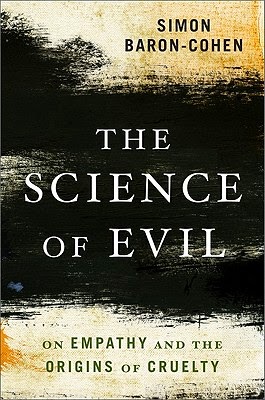
In "The Science of Evil: On Empathy and the Origins of Cruelty", Professor Simon Baron-Cohen explores an idea I found very interesting - the idea that what we call "evil" is caused by a lack of empathy. He believes that because of this lack of empathy, people who do evil things objectify the people they do evil to - they do not see them as persons, and this protects them from the guilt they would otherwise feel as a result of the cruel things they do to these objectified persons.
Professor Baron-Cohen defines empathy in this manner:
Empathy is our ability to identify what someone else is thinking or feeling and to respond to their thoughts and feelings with an appropriate emotion. This suggests there are at least two stages in empathy: recognition and response. Both are needed, since if you have the former without the latter you haven’t empathized at all. If I can see in your face that you are struggling to lift your suitcase onto the overhead rack on the train and I just sit there and watch, then I have failed to respond to your feelings (of frustration).
 |
| The Empathy Circuit |
Baron-Cohen goes on to note that the famous case of Phineas Gage - a railroad construction foreman who survived an accident where a metal rod impaled his brain - demonstrates how this part of the brain contributes to empathy. Gage's MPFC was damaged, and whereas before the accident he was said to be a very polite individual, after his accident he was reported to be childish, rude, and prone to profanity and a lack of social inhibition (all signs of a lack of empathy towards others).
Understanding how his brain damage caused his lack of empathy makes it harder to directly blame him for his "evil" - doesn't it?
 |
| Phineas Gage |
This positive form of lack of empathy is very interesting to note and has its own nuances, but exploring the concept in more detail is outside of the purposes of this post, so I will leave the topic as it stands and return to exploring the negative forms.
Type B
The first personality type with negative lack of empathy is referred to in psychology as borderline personality disorder - Type B. Baron-Cohen explains this disorder in this way:
The hallmark of borderlines is a constant fear of abandonment, emotional pain and loneliness, hatred (of others and of themselves), impulsivity, and self-destructive, highly inconsistent behavior.The first thing one might note is what a miserable existence people with borderline personality disorder seem to have - they are constantly in a world of conflicting emotions, where they cannot be alone, and yet they oscillate between either pushing people who get close away or desperately clinging to them in a way that becomes off-putting. But more importantly, Baron-Cohen explores the causes of this disorder. Borderlines almost always have a history of parental dysfunction - one or both of the parents was either abusive or neglectful (abandoning the child and withholding affection). And when scientists have studied the brains of people with borderline personality disorder, they have discovered abnormalities in many of the areas of the brain that Baron-Cohen writes about in chapter 2 of his book. He states:
One interpretation of all this evidence is that early negative experiences of abuse and neglect change how the brain turns out. But the key point is that the zero degrees of empathy in borderlines arises from abnormalities in the empathy circuit of the brain.Type P
The second type of personality which exhibits a lack of empathy is the psychopath - Type P (this is often referred to as antisocial personality disorder). Psyhchopaths exhibit a total preoccupation with self very similar to borderlines, but in their case it is characterized by a willingness to do whatever it takes to satisfy their desires - Baron-Cohen writes:
This might take the form of a hair-trigger violent reaction to the smallest thing that thwarts the person. Or it might take the form of cold, calculated cruelty. Sometimes the mindless aggression is not triggered by a perceived threat but by a need to dominate, to get what one wants, a complete detachment from another person’s feelings, and possibly even some pleasure at seeing someone else suffer.Later on, Baron-Cohen gives this list of characteristics that are indicative of psychopathic personality disorder:
- superficial charm
- lack of anxiety or guilt
- undependability and dishonesty
- egocentricity
- inability to form lasting intimate relationships
- failure to learn from punishment
- poverty of emotions
- lack of insight into the impact of their behavior
- failure to plan ahead
Much like the case of borderline personality disorder, an important factor in the development of psychopathic personality disorder seems to be parental rejection. During their development, a child that develops psychopathic personality disorder silently rages inside at the parental alienation, and this develops into full blown hate. Eventually, these feelings build up (like steam in a pressure cooker) until they cannot be contained, and they are released as violent acts (see the story of Matthew Murray).
Doctors who have studied psychopaths have found that because of an insecure parental relationship, these children go on to be unable to form anything but superficial relationships with anyone else as well. Secure relationships are needed for both social and language development, and so these children end up developing abnormally without them. Even more disturbing is the fact that often, these individuals grow up to be parents who are harsh and abusive, and the cycle continues across generations.
On the opposite side of this, parents who give affection and security to their children fill them with good feelings - sort of like an inner pot of gold - which seems to immunize them against falling into negativity when bad circumstances come into their lives later on. Baron-Cohen mentions a friend of his - Peter Fonagy, who is a professor of psychoanalysis at University College London and director of the Anna Freud Centre in Hampstead in London - who theorizes that during the attachment phase of a child's development, they try to "mentalize" the caregiver's mind, imagining what the caregiver thinks and feels, which is especially important in relation to the child as far as the development of self-image goes. If the relationship is not safe - that is, if the child has reason to think that their caregiver hates them or wishes they didn't exist - they are unable to develop good empathy because they shut down their attempts to mentalize the minds of others, and the areas of the brain involved in this type of thought do not develop normally.
Along with a parental rejection, another cause of psychopathy seems to be prolonged stress - which eventually damages the hippocampus. This results is a reactive aggression - rather than "fight or flight", flight is never an option and even the slightest provocation is handled with aggression. When this mechanism is triggered, because of an under-developed frontal cortex - which would otherwise regulate the response - the reaction is uninhibited and an attack is launched.
Perhaps one of the more interesting features of the list of characteristics above is the characteristic of failure to learn from punishment - those with psychopathic personality disorder seem to have developed a defense mechanism as a result of their dysfunctional parental relationships that prevents them from fearing the repercussions of their actions.
Additionally, when scanning the brains of psychopaths, researchers have found brain abnormalities in some of the 10 brain regions I mentioned earlier - once again, psychopaths were not able to develop the capability to empathize during their childhood.
Type N
The third, and final, type of personality which exhibits a lack of empathy is the narcissist - Type N (referred to in psychology as narcissistic personality disorder). Narcissists exhibit a tendency to entitlement - they feel that they have an automatic right to be treated well, regardless of how they've treated others. Additionally, they have a tendency to overstate their own strengths and achievements. Other people's opinions do not factor in to this equation, but it is as if the sole purpose of others is to exist as an audience that agrees with and admires the narcissist. But narcissists live in a very fragile world - their mood often plummets into depression, because of their need for constant affirmation. People who develop relationships with narcissists often feel that they can never give enough, and will often withdraw - this withdrawal does not go unnoticed, and a narcissist often responds with negativity, which only drives their friends and loved ones further away.
Narcissists do not usually display cruelty, however - Baron-Cohen writes:
Rather, in the absence of any humility, narcissists think they are much better than other people, as if they have special gifts that others lack. Indeed, the continuous boastfulness and self-promotion are partly what others find offensive, not because they are jealous, but because they see these as indicators of the narcissist’s total self-preoccupation. Narcissists, like the other Zero-Negative forms, fail to recognize the importance of relationships being two way. For those who have zero degrees of empathy, relationships are not really relationships because they are one way. This is even evident in how much narcissists talk. There is no attempt to make space in the conversation for the other person or to find out about the other person. Narcissists simply lecture, holding forth about him or herself, and they decide when to end the conversation. They have monologues, not dialogues.As to the causes of narcissism, Professor Baron-Cohen writes:
Like Types P and B, early emotional abuse has been suggested as a possible cause of Type N, again reminding us of the importance of that internal pot of gold. But unlike the other Zero-Negative types, it is speculated that Type N may also derive from excessive admiration, excessive praise for their good looks or talents, overindulgence, and being over-valued in the absence of realistic feedback (by parents).He notes that, unfortunately, there has not been very much research into Type N - unlike the other two types - and this may perhaps be explained by the fact that narcissists do not tend to be violent like the other two types. But despite the differences between these three types of personality disorders, he notes, the glaringly obvious connection between them all is a lack of empathy. In fact, the research indicates that these types of people are not capable of experiencing empathy in the way most people are, because of abnormalities in the areas of the brain outlined in chapter 2 of Baron-Cohen's book. And it seems that in most cases, these abnormalities can be traced to an impoverished childhood rearing - an environment where the child was not supplied with the experiences necessary to develop empathy.
Up until now, I've discussed the environmental factors which contribute to low empathy. But Professor Baron-Cohen also discusses the fact that genes contribute as well, to complicate things. Professor Baron-Cohen gives the example of a friend of his who grew up in an environment with an unusually high percentage of criminals - but this friend grew up to be a noteworthy and talented psychologist against all odds. Additionally, studies have shown that there is a higher chance of Type P and Type B amongst brothers, sisters, children, and parents (there is, yet again, not enough research into Type N to form conclusions in this area). To summarize his conclusions at this point, Baron-Cohen states:
While it is tempting to blame zero degrees of empathy on either genes or environment, a mix of factors is clearly causal.My Conclusions
So why did I find this book so interesting? First off, I felt affirmed by the fact that the conclusions presented in this book harmonize quite well with the concept of privatio boni, which I explored in one of my posts in my series on Satan. This theory that the cause of what we call "evil" is a lack of empathy - and thus is a "nothing" rather than a "something" - aligns well with my own thoughts on evil as an absence of good. And I think it draws out an interesting connotation on a quote by Karl Barth I had used in my series:
That which God renounces and abandons in virtue of his decision [i.e., to freely elect what he will] is not merely nothing. It is nothingness. . . . Nothingness is that which God does not will. It lives only by the fact that it is that which God does not will. But it does live by this fact. For not only what God wills, but what he does not will, is potent, and must have a real correspondence. What really corresponds to that which God does not will is nothingness.But along with this, the knowledge that genes and environment produce what we call evil must lead one to wonder how much we can blame people for their own sin? I don't know about you, but for me, knowing that some people simply can't help their lack of empathy makes me want to extend empathy and mercy towards them all the more.
This also ties into the concept of hell (see my series, Checkmate For Hell). In "God's Final Victory", authors John Kronen and Eric Reitan made an interesting argument related to this, which Reitan summarized on his blog like so:
Here is, for me, the big problem: God’s preordaining some sinners for reprobation is supposed to reflect God’s justice, which tempers His mercy and love (or the other way around?). The idea is that sin is such an intolerable affront to God’s holiness and majesty that divine justice demands that it be repudiated. And so God casts some sinners away forever as a display of His just wrath against sin, even as he elects others for salvation to display His mercy and benevolence.The Bible says in I John 4:8 and 16 that God is love - the original Greek word used here connotes a selfless form of love, very similar to empathy. So if we accept that sin or evil comes from a lack of empathy - as the scientific evidence suggests - then Reitan's argument states the problem with eternal hell very well.
The problem is this: In casting sinners away from His presence, He casts them away from the only thing that (according to the very theology underlying this theory) can overcome sin. Thus, God guarantees that this intolerable affront to His majesty continues eternally in the souls of the damned. In short, the view essentially amounts to this: sin is so terrible that God decisively acts to guarantee that this intolerable thing continue in all its intolerability forever and ever. “What you’re doing is so inconceivably unacceptable that I am going to make absolutely sure that there is no way for you to ever stop doing it!”
And making sure that this intolerable affront to His holiness never stops is supposed to be God’s justifying reason for not electing all, and so for truncating the scope of his benevolence? Is that a coherent understanding of divine justice?
This causes problems for Calvinists and Arminians alike - because for Calvinists, God withholds the only thing that could fix the problem of evil simply for His own glory (which doesn't sound very empathetic to me - sounds more like the description of a psychopath).
And for the Arminian side, if God gives up and stops trying to extend His empathy to the lost, we have the same problem - God has withdrawn the only thing that could fix the problem because He gives up on them, and this doesn't sound very empathetic either. It would essentially require God to shut off of the very characteristic that is supposed to define Himeself, and this is a very strange idea when you think about it: God has to stop acting like God in order for there to be Hell.
Additionally, there is a strange irony to this - God acts un-empathetic towards the un-empathetic in order to punish them for their lack of empathy. In other words, God does the very thing the evil were doing in order to "make things right". One might also wonder about the irony of the State when it commands executioners to shut off their empathy towards those who have committed crimes that were a result of a lack of empathy - in essence, turning the executioner into a mirror image of the executee in the moment of the execution.
I'd also like to echo something Professor Simon Baron-Cohen said in the final chapter of his book:
[E]mpathy itself is the most valuable resource in our world. Given this assertion, it is puzzling that in school or parenting curricula empathy figures hardly at all, and in politics, business, the courts, or policing it is rarely, if ever, on the agenda.Along with this, I wonder (sorrowfully) why our churches do not expend more efforts in methods of empathy training? Why is it that our theology is so centered around conceptualizing ideas about the afterlife, invisible personalities, and the eschaton, rather than centering around the practice of empathy?
And finally, it should be noted that quite often, the acts of history that we would qualify as evil are performed by men and women whom are quite empathetic at home, with their own group of loved ones. But the difference here is that these individuals harbored beliefs that encouraged them not to extend that empathy to other groups, or to shut off their empathy circuit when it came to these outsiders. So I have to ask - are our doctrinal systems sacralizing beliefs that encourage a lack of empathy towards certain types or groups of people? I think some are, and so I have to ask: why is it so hard to get people to challenge these beliefs? Shouldn't the job of the church of Christ include challenging people to extend empathy to people they have a hard time empathizing with? Shouldn't the whole point of faith be to cultivate empathy?
Matthew 5:43-48 NRSV
"You have heard that it was said, ‘You shall love your neighbor and hate your enemy.’ But I say to you, Love your enemies and pray for those who persecute you, so that you may be children of your Father in heaven; for he makes his sun rise on the evil and on the good, and sends rain on the righteous and on the unrighteous. For if you love those who love you, what reward do you have? Do not even the tax collectors do the same? And if you greet only your brothers and sisters, what more are you doing than others? Do not even the Gentiles do the same? Be perfect, therefore, as your heavenly Father is perfect."


