Showing posts with label Panentheism. Show all posts

Wednesday, March 25, 2026

What the Bible Talks About When It Talks About God (part 10)

Note: This post is meant to be read after reading part 1 of this series, where I lay some groundwork and introduce some important concepts. I would also advise reading the other preceding parts, but this is not completely necessary.

The Trinity

As we've been exploring the way the concept of God develops and changes throughout the Biblical texts, I wonder if there have been audience members sitting in their office chairs with sullen looks, wondering when, oh when will I talk about the Trinity?

And I wondered if I even should talk about it. Because I'm no longer convinced that it even appears anywhere in the Bible - at least not in the way tradition insists it does.

This is a subject that the popular Bible scholar Dan McClellan has repeatedly returned to in his videos - such as this one, or this one. In one of my favorite videos of his where he talks about this, he points out that there is a "fundamental incoherence" of the Trinity, and he explains what this incoherence is with the illustration of a math problem. And in this math problem, it is like saying:

a is the Father
b is the Son
c is the Holy Spirit
g is God
a + b + c = g
a = g
b = g
c = g
≠ b
≠ c
≠ c 

And this does not make mathematical sense, nor does it make sense in light of the way persons or substance have ever been understood. 

https://s3.amazonaws.com/cms.ipressroom.com/173/files/20179/59e81c942cfac2292708892b_Simpsons+math+photo+3/Simpsons+math+photo+3_6f8b3fe5-7397-4424-a441-9013b7d556d8-prv.jpg 

And I can recall wrestling with this concept as a child, and questioning elders about it, and these sorts of conversations would always seem to end with something along the lines of "well, this is just one of those mysteries that you have to accept through faith."

Or, hear me out here, what if it's one of those things that authoritarian men came up with after the Bible was written and then enforced when the Church got in bed with empire in the days of Constantine and started using governmental authority to punish heresy?

But some of you will insist: the Trinity is in the Bible. Except many of the "proofs" for this concept are based on fundamental misunderstandings of what the original author was trying to say in the language in which these passages were originally written.

One of the passages people often point to as "proof" of the Trinity is John 1:1-5, which I discussed in part 8 of this series as part of my discussion on "Logos" and the connections to the Jewish literature on Lady Wisdom. And hopefully, through that discussion, some of my readers have already caught on to the fact that modern Christians who are unfamiliar with the connections between this passage and some of the things Philo said about Logos will already be seeing how taking this passage as equating Jesus with God misunderstands the passage. Because for John, Logos is the Wisdom of God, the argument of God, the reason behind the order of the universe, and it was the first creation, which means that equating it with God is a misunderstanding of what John is saying. 

But oh, you say, verse 1 of the passage says that "the Logos was with God and the Logos was God." Except that people who make this argument don't understand the original Greek and what is going on here. Because you have to understand that in Greek, there are definite articles but there are not indefinite articles. Meaning: in English, we have definite articles like "the", and we have indefinite articles like "a book" or "a tree". Greek does not have indefinite articles. So when we read John 1 in the original Greek, it says that "the Logos was with the God [ton theon] and the Logos was divine [theos]." Now, note here - theon and theos are the same word, but different cases - theon is the form used when the word is the direct object in a sentence, and theos is the form used when the word is the subject of the sentence. And Bible scholars have noted that when they look at the ways this word is used in this time period by many different authors, it can mean "God" or it can simply mean "divine" - as in, "a god", or someone or something that is godly/god-like. So it is important that in this verse, the author switches from using the definite article ton when referring to God in the first part of the verse, and leaving out the definite article in the second part of the verse.

So then some people will retort: well Jesus definitely claims to be God in John 8:58 when he says "before Abraham was, I am." And here they are interpreting this as Jesus using the divine name that was revealed to Moses in Exodus 3:14. But there's a big problem with this - when Jesus says "I am" here, it's just a commonly used Greek phrase for saying things like "that's me", or "that was me" - ego eimi. And furthermore, when you examine the first known Greek translation of the Hebrew Bible - the Septuagint - and look at Exodus 3:14, you see God telling Moses that his name is "I am who I am", and the Greek here is ego eimi ho on. And then later in the verse, when God says "tell them I am sent you", the words used here are not ego eimi but are ho on. So here, God seems to be telling Moses that the divine name Moses should use is not ego eimi, but is ho on. And Jesus does not use the words ho on, he just uses a very common Greek phrase that identifies oneself as the one who did a thing or was in a place. And to illustrate how important this is, when Jesus heals a blind man in the next chapter of John, and the people in his town are asking "isn't this that blind man who sits and begs?" The blind man replies in verse 9 "ego eimi", translated as "I am he", and no one ever seems to argue that this means that the blind man is God.

So then, some may come back to John 8:58 and say that because Jesus seems to be claiming eternality or preexistence, it implies he is God. But that is not necessarily the case. Again, returning to part 8 of this series, recall that Philo claims that the High Priest is the preexisting Logos, "by means of whom the universe arrived at creation." And this does not mean that Philo believes every High Priest who has ever lived was a person of the Trinity, with the same being/substance (homoousion) as God. But also, this verse doesn't necessarily imply preexistence, either - because if we go back to the context, we see that in verse 56, Jesus is arguing that the prophecy that the messiah would come from Abraham's line was about him (Jesus) - so this statement may simply be a statement that Jesus as messiah was preordained since the beginning of time, and is not a statement of eternal existence on Jesus' part.

So then some will continue the argument by turning to the story in John 10:22-40, where Jesus says that "the Father and I are one" in verse 30, and then verse 31 it says that the Jews responded by picking up stones to stone him. Surely [they argue] this proves that he was claiming to be God, since the Jews responded this way? 

But what about the way Jesus responds to this? Because after the Jews pick up the stones to kill him, and then explain that they feel that Jesus is committing blasphemy and making himself God, it says in verses 34-36:

Jesus answered, “Is it not written in your law, ‘I said, you are gods’? If those to whom the word of God came were called ‘gods’—and the scripture cannot be annulled—can you say that the one whom the Father has sanctified and sent into the world is blaspheming because I said, ‘I am God’s Son’?

Note two things about this response - first, Jesus quotes Psalm 82 here, which we covered as a proof for polytheistic thought within Judaism in part 2 of this series. And secondly, note how Jesus clarifies here that he has never "made himself God" as the Jews are accusing him of in this passage, but rather - Jesus argues - he has only claimed to be God's Son. Note that this demonstrates that for the writer of John, while being "God's Son" implies a special relationship with God that includes "one-ness" with God, it is not the same thing as being equal to God.

Furthermore, if "the Father and I are one" is indeed a claim of being one of the members of the Trinity, then what does it mean when Jesus prays in John 17:21-22 "that they may all be one... [a]s you, Father, are in me and I am in you, may they also be in us", and then repeats the request that "they may be one, as we are one"? Does this mean that Jesus is praying that the disciples would become members of the Trinity [thus making the Trinity the Quadrinity and then the Quintinity and so on and so forth]?

Or is it possible that the writer of John simply has a different conception of divinity - perhaps one closer to the panentheistic formulation that we discussed in the last section of this series?

Perhaps, when considering formulaic language such as the Trinity, one should hold these words and concepts loosely - recognizing that if one is trying to talk about the infinite, sacred, and holy ground of all Being that has existed before time itself, then one must recognize that all language one uses to attempt to explain such a thing fails? Because if the divine is limitless, then surely any limited language one tries to use will fail to capture such a thing?

I remember years ago, I had a co-worker that I thought I would witness to - I thought I would try to bring him to salvation. This happened just as I was only beginning to ask some questions about my own faith that were starting to reshape it. And I remember that I had a conversation with him about faith, and in response, he lent me a copy of Living Buddha, Living Christ, by the Tibetan monk Thich Nhat Hanh. And there is a chapter in the book where he writes about the Holy Spirit - and this had been a concept I had never really grasped as a child. But for the first time in my life, I felt like I understood the Holy Spirit - all because of a Buddhist monk. And in this chapter of the book, Thich Nhat Hanh talks about breathing exercises and meditative phrases used to help the practitioner develop a sense of living in the present moment, and compassion for others and for all of nature around us. And I think back on the concept we talked about in the last part of this series where I mentioned that the Hebrew word for "spirit" is ruach and the Greek is pneuma (from which we get English words like pneumatic), both words which mean "breath" or "wind". 

https://twirlingjen.wordpress.com/wp-content/uploads/2016/09/breath-of-life.jpg
https://lisagawlas.wordpress.com/2014/08/05/your-breath-of-life/

In this chapter, Thich Nhat Hanh writes:

The most precious gift we can offer others is our presence. When our mindfulness embraces those we love, they will bloom like flowers. If you love someone but rarely make yourself available to him or her, that is not true love. When your beloved is suffering, you need to recognize her suffering, anxiety, and worries, and just by doing that, you already offer some relief. Mindfulness relieves suffering because it is filled with understanding and compassion. When you are really there, showing your loving-kindness and understanding, the energy of the Holy Spirit is in you.

And later on in the same chapter, he writes:

Discussing God is not the best use of our energy. If we touch the Holy Spirit, we touch God not as a concept but as a living reality. 

And then, near the end of the chapter, he writes:

Our true home is in the present moment. The miracle is not to walk on water. The miracle is to walk on the green earth in the present moment. Peace is all around us—in the world and in nature—and within us—in our bodies and our spirits. Once we learn to touch this peace, we will be healed and transformed. It is not a matter of faith; it is a matter of practice. We need only to bring our body and mind into the present moment, and we will touch what is refreshing, healing, and wondrous.

What if, instead of turning Trinity into a credal statement that Christians must bow before and recite whether it makes sense to them or not, the real point of it all was for Jesus to show his disciples a Way - the Way of compassion, through which the presence of the Divine becomes a living reality in the present moment?

Tuesday, March 24, 2026

What the Bible Talks About When It Talks About God (part 9)

Note: This post is meant to be read after reading part 1 of this series, where I lay some groundwork and introduce some important concepts. I would also advise reading the other preceding parts, but this is not completely necessary.

Panentheism 

We are coming close to the end of this series, and some of my readers might be thinking: when is he going to talk about the Trinity? And we're going to do that. But I think that before we do, we should talk about a concept that some Trinitarians may never have thought about. They may not have even heard this term before. And the term that this concept goes by is panentheism: the belief that what is called "God" is present in every part of the universe - that all is in God and God is in all, but that God also transcends the universe. Or to put it another way, panentheism is the belief that whatever it is that we call God is more than a thing which exists, but is rather the ground of existence itself. As the Christian theologian and philosopher Paul Tillich put it:

God does not exist. He is being-itself beyond essence and existence. To argue that God exists is to deny him.

And some might protest: but that's not a Biblical view of God! And at one point in my life, I would have agreed. But then I found that I had been trained to read right past many statements from Paul the apostle.

A depiction of Paul preaching on Mars Hill in Acts 17

One of the most fascinating examples of Paul's panentheism comes from a story about him in Acts - so he might not have even said this. But in Acts 17:16-34 there is an account in which Paul was in Athens, where he argued in the Synagogue and with "Epicurean and Stoic philosophers". And in verse 28 he quotes their own philosophers, drawing from the Cretan philosopher Epimenides in the first half of the verse, and the Cilician Stoic philosopher Aratus in the second half of the verse. And he uses their words to describe the God that Paul saw through Jesus:

In him we live and move and have our being...[f]or we, too, are his offspring."

And as I said, we don't know for sure if Paul actually said those things or if the writer of Acts put those words in his mouth. But they are not unlike statements from Paul's own epistles, such as this statement from Romans 11:36:

For from him and through him and to him are all things.

Here Paul describes the presence of God as not only the origin of all things, but the animator of all things.

And in Colossians 3, Paul writes about the concept of the death of the false self, resulting in being raised with Christ. And in verse 11 he describes the result of this as being raised to a state where the separation that we experience through the various societal labels and categories are erased - he says that "there is no longer Greek and Jew, circumcised and uncircumcised, barbarian, Scythian, enslaved and free", and goes on to state that "Christ is all and in all." 

Earlier in the book of Colossians, Paul writes (Colossians 1:16-17):

[I]n him all things in heaven and on earth were created, things visible and invisible, whether thrones or dominions or rulers or powers—all things have been created through him and for him. He himself is before all things, and in him all things hold together.

Here Paul states that not only does he believe that all things were created by Christ, but that all things are held together by Christ. 

And while I feel I must note that some scholars do not think Paul actually wrote this, we find another similar statement in Ephesians 4:4-6:

[T]here is one body and one Spirit, just as you were called to the one hope of your calling, one Lord, one faith, one baptism, one God and Father of all, who is above all and through all and in all.

Note here that the formulation of these various statements ought to challenge certain views of Christianity, because Paul doesn't say that Christ/God are through and in just the Christians or the things Christians do. Paul says, simply: all. God is simply over all things, in all things, and through all things. For Paul, God is in and through the nonbelievers as well, and they are also his offspring, and they are for Him, and held together by Him.

Once you begin to see the panentheistic thought patterns in Paul's writing, you may begin to even see this way of thinking through more subtle statements, such as when Paul writes in I Corinthians 3:16 that "you are God's temple and [...] God's Spirit dwells in you." In ancient thought, temples were necessary dwellings for the gods they worshiped - this is why the Hebrews worried and mourned over their exile from Jerusalem and the destruction of the temple, and why it was necessary for the prophet Ezekiel to write about a vision of YHWH departing from the temple in Jerusalem in Ezekiel 10. This vision was a sign to Ezekiel's readers that YHWH's presence was no longer limited to the space within the temple, but was now accessible to them wherever they were. And Paul extends this thought by stating that we are the temple, and that God's spirit dwells in us.

And later on in I Corinthians, Paul writes about the concept of spiritual bodies in I Corinthians 15:35-49. And it should be noted that when Paul wrote this, there was no concept of a separation between earthly and spiritual planes of existence like many people have today. They didn't think of the idea of "spirit" being something that existed outside of normal space and time - rather, the word "spirit" comes from is also the word for "breath" or "wind". It is this way in both Hebrew and Greek - the Hebrew word being ruach and the Greek word being pneuma (from which we get English words like pneumatic). And when Paul talks about "spiritual bodies" in this passage, it should also be noted that in the original Greek, this did not carry the sense of "bodies made out of spirit", but rather, the original Greek word - pneumatikos - carried the sense of bodies which were animated by spirit, as the suffix ikos has to do with what animates or powers the thing it is speaking of. So for Paul, he wants the Christian to undergo a death of ego and be crucified with Christ (as he writes in Galatians 2:20) so that they will then be animated purely by the wind or the breath of God/Christ. Only through this metaphorical death of ego can we eliminate the societal religious and economical categorizations that we use to label and separate people like he talks about in Colossians 3:11.

And we see a similar thought pattern in the gospel of John as well as in the first epistle that is attributed to John. In John 17:21-22, Jesus prays for his disciples, "that they may all be one... [a]s you, Father, are in me and I am in you, may they also be in us", and then repeats the request that "they may be one, as we are one." And as I pointed out in the last post when I talked about the Logos, this challenges traditional concepts of Trinity. Because traditional Trinitarians hold that Jesus is One with God in a way that no human could ever be, but here Jesus is praying that we would be One with God and "in us" in the very same way that the Father is in Jesus and Jesus in the Father he prays to. 

My favorite passage in the Bible is like this as well - the writer of I John (who may or may not be the same writer who wrote the gospel of John) writes in I John 4:7-21 writes that "everyone who loves is born of God and knows God" and that "[w]hoever does not love does not know God, for God is love." He speaks of living in Christ, and says that "[n]o one has ever seen God; if we love one another, God abides in us, and his love is perfected in us." And he repeats these thoughts, writing that "God is love, and those who abide in love abide in God, and God abides in them."

For the writer of the epistle of I John, Christianity is not a system of belief statements. It is an experience that is only accessible through selfless love - and this kind of love does not seek to condemn others who do not make the same belief statements, but also live lives full of compassion and kindness. Rather, it sees the presence of God in them. For the writer of this epistle, Christians do not need to condemn followers of other religions who love, because "everyone who loves is born of God and knows God." And this way of thinking about the mark of a disciple is affirmed in statements of Jesus, such as John 13:35, where Jesus says that love for one another is the mark of a disciple, not a system of belief statements. Or when Jesus told the parable of the sheep and the goats in Matthew 25:31-46, where the defining mark that distinguishes the sheep from the goats is not their belief statements, but how they treated other people. And this is how one learns to experience God in all things, as Paul writes about - because when we believe that people who do not belong to the artificial label of "Christian" are not also bearers of the presence of God, we limit the presence of God.

The subject of panentheism is one I have written in other posts, and if you would like to read more, I invite you to read these older posts:

Paul and the Greek Poets 
Love is Like the Wind
Oneness: A Collection of Quotes Illustrating a Common Theme  

In the next, and final post of the series, we will explore the development of the concept of Trinity, and how one might conceptualize this way of thinking in a healthy way in our time. 

Part 10 - The Trinity 

Monday, March 23, 2026

What the Bible Talks About When It Talks About God (part 8)

Note: This post is meant to be read after reading part 1 of this series, where I lay some groundwork and introduce some important concepts. I would also advise reading the other preceding parts, but this is not completely necessary.

Up until this point in the series, I've been talking about various depictions of "God" in the Bible that we could say were anthropomorphic. To put it in pejorative terms, you may hear people outside of Christianity making fun of Christians for worshiping "sky daddy", or something along those lines - and this portrayal of the god-concept is really not far off from the portrayals we've seen thus far in the series.

But later on, the Hebrew writers began to be uncomfortable with anthropomorphism - they began to seek ways of removing anthropomorphism from the picture, and ways to talk about God in more abstract terminology. We are going to explore that in this post.

The Angel of the Lord

In previous posts in this series, we've discussed some anthropomorphic portrays of God - such as when God got down in the dirt and formed man out of the clay like a potter, and then planted the garden of Eden like a farmer in Genesis 2. Or when YHWH eats with Abraham in Genesis 18. Another example we did not discuss would be Exodus 33:18-23, where Moses asks to see YHWH's glory, and YHWH informs him that to see his face would kill Moses, so Moses hides in the rocks and YHWH covers Moses with his hand, and Moses sees YHWH's backside. And we could give many other examples, such a when God is described walking, talking, laughing, or resting, or when human emotions like jealousy, anger, or regret are attributed to God. 

But at some point, the Hebrew writers began to try to offset anthropomorphism within the old stories. And the way they did this was to replace references to YHWH directly with references to the angel of the Lord (literally: malak YHWH). And what's interesting is that you can often see the signs of this by the fact that stories will switch back and forth between referencing YHWH and referencing malek YHWH

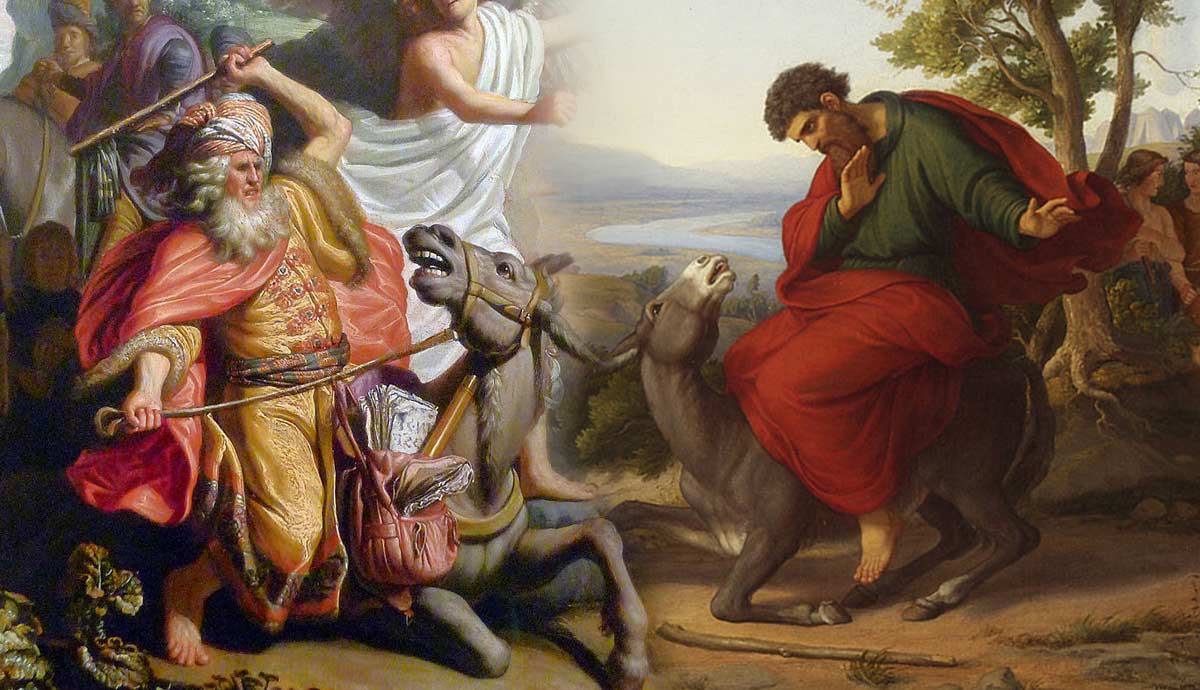
For example, we can look at the story of Balaam and his talking donkey, which I mentioned in part 1 of this series. After YHWH gets mad at Balaam for going with the Midianites (which, as I pointed out, is what YHWH told him to do), it says in Numbers 22:22 that the angel of the Lord (the malak YHWH - and note that malak literally means "messenger") stood in the road as Balaam's adversary (literally: satan). Then it says that the donkey saw the malak standing there with a sword in his hand in verse 23. And as the story progresses, it continues to mention the malak YHWH, but then it switched back to referencing YHWH directly when it says in verse 28 that YHWH opened the donkey's mouth, and then later on it says that YHWH opened Balaam's eyes in verse 31. But then it switched right back to referencing the malak YHWH, whom it says was standing there with sword drawn. And then there's some dialogue between Balaam and the malak YHWH.

https://woforgmedia.wordonfire.org/wp-content/uploads/2007/03/15105345/bhthe-burning-bush.jpg 

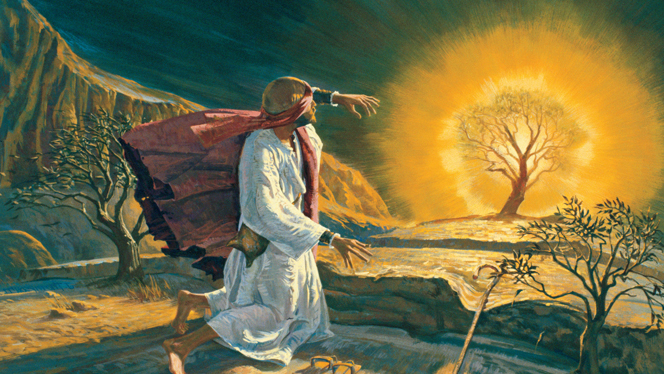
A more striking example of this is found in the story of the burning bush, in Exodus 3. Note how, in this story, the malak YHWH is what appears to Moses in the "flame of fire out of a bush" (verse 2), but then in verse 4 it is YHWH who speaks to Moses directly, and for the rest of this story it seems to be YHWH speaking directly to Moses. For this reason, many scholars believe that what is happening here (and in other instances where we see the story switching between "malak YHWH" and "YHWH") is that either: 1) a scribe has come along and edited an older story, replacing direct references to YHWH with malak YHWH, or 2) we are seeing how two separate versions of the same story were combined.

The Wisdom of God

At the beginning of the book of Proverbs, we see a personification of Lady Wisdom:

Wisdom cries out in the street; in the squares she raises her voice. (Proverbs 1:20)

This is a theme that Proverbs returns to in chapter 8 and continues in chapter 9. In Hebrew, the word for wisdom, chochmah, is grammatically feminine. When these passages are translated into Greek, the word for wisdom is a word that becomes a name: Sophia. A personified wisdom - as a she - is also found in some apocryphal books. For example, the book of Baruch, which is used in Catholic and Orthodox churches, has a personified Lady Wisdom in Baruch 3:9-4:4. And Wisdom of Solomon 7:7-14 also contains a reference to Lady Wisdom (Wisdom of Solomon is considered canonical by some traditions). 

Proverbs 8:22-31 refers to Lady Wisdom in ways that might remind one of the malak YHWH - saying that YHWH "created me at the beginning [or as the beginning] of his work, the first of his acts of long ago", that she was created "before the beginning of the earth", and that she was there "[w]hen he established the heavens, [...] when he drew a circle on the face of the deep, [...] when he made firm the skies above, when he established the fountains of the deep, when he assigned to the sea its limit", and finally stating "when he marked out the foundations of the earth, then I was beside him, like a master worker." Likewise, Wisdom of Solomon 9:9 states that Lady Wisdom "was present when you made the world". This all seems to imply that Lady Wisdom was a collaborator in the act of creation.

We then see a striking development when we compare a certain passage in the non-canonical Book of Enoch to a certain passage in the canonical scriptures. But before I make that comparison, I'd like to note - while Enoch is not canonical, it was popular in early Christianity and even included in some early canon attempts. It fell out of favor as early Christians would debate Greek philosophers, who would point out that Enoch couldn't have written the book, because how would it have survived the flood of Noah if he had? But despite it being excluded from most canons, the Ethiopian Orthodox church still considers it canon, Matthew 22:29-30 seems to be alluding to a section of the Book of Enoch, and Jude 1:14-15 calls Enoch a prophet and then quotes this book. 

Keeping that in mind, examine the following statements from Enoch 42:1-2:

Wisdom found no place where she might dwell [...] Wisdom went forth to make her dwelling among the children of men, and found no dwelling-place...

Now compare this to John 1:10-11:

He was in the world, and the world came into being through him, yet the world did not know him. He came to what was his own, and his own people did not accept him. 

And at this point, I need to introduce a New Testament concept that is deeply connected to the concept of Lady Wisdom.

Logos

In the first verses of the gospel of John, the writer uses the word "logos". Most English Bible translators render this as "Word" - people familiar with this passage would usually recite it as "in the beginning was the Word...." But, unfortunately, this translation doesn't nearly capture the concept behind this word.

The concept of logos begins with the Greek philosopher Heraclitus. We don't know much about this pre-Socratic Greek philosopher, and only have fragments of his writing. But for Heraclitus, logos is an underlying intelligence in the Universe that governs all. In the fragments we have, he writes:

Although this Logos is eternally valid, yet men are unable to understand it – not only before hearing it, but even after they have heard it for the first time [...] though all things come to pass in accordance with this Logos, men seem to be quite without any experience of it... 

Later on, Aristotle wrote in Rhetoric about three appeals one must make in order to persuade another person. These three were ethos (or appeals to credibility and character), pathos (appeals to emotion), and logos. Logos was the appeal to reason, logic, and facts. 

This concept is then merged with the Biblical writings on Lady Wisdom by the Jewish philosopher Philo, who lived between 20BCE and 50CE. In "De Somniis", he writes: 

For there are, as is evident, two temples of God: one of them this universe, in which there is also as High Priest his firstborn, the divine Logos...

 He further develops this connection between High Priest and Logos in "Flight and Finding":

For we say that the high priest is not a man, but is the Logos of God... God being his father, who is also the father of all things, and wisdom being his mother, by means of whom the universe arrived at creation....

 In "Confusion of Tongues", he writes:

And even if there be not as yet any one who is worthy to be called a son of God, nevertheless let him labour earnestly to be adorned according to his first-born logos, the eldest of his angels, as the great archangel of many names; for he is called, the authority, and the name of God, and the Logos, and man according to God's image, and he who sees Israel... for the image of God is his most ancient Logos

When we compare this to the opening verses of John 1, we see similar concepts of the Logos being the firstborn, and the one through whom God created the Universe - John writes that the Logos was "in the beginning with God", and that "all things came into being through him." John ties the Logos to Jesus, and so if we're following, we could say that, according to John, Jesus was the argument of God. He was God's appeal to reason. He was the image of God. And, as when Heraclitus said that "men are unable to understanding - not only before hearing it, but even after they have heard it for the first time", John writes in verses 10-11 that "the world did not know him", and that "his own people did not accept him."

And we can make further connections between the Wisdom of God, the Logos, and Jesus if we turn to Paul's writing in Colossians 1:15-20, where he writes that Jesus is the "firstborn of all creation", that "in him all things in heaven and on earth were created", that "in him all things hold together", and finally that "through him God was pleased to reconcile to himself all things, whether on earth or in heaven."

Note here also: these connections between the Jewish Wisdom literature, Logos, and Jesus challenge traditional ways of thinking about the Trinity, rather than affirm them. One must ask: If Philo says that the High Priest is the Logos of God, the first born, the eldest of angels, and divine, does this mean Philo believes every High Priest is a part of the trinity? And if not, this ought to challenge how we read John, as his own Logos statements clearly draw from this same tradition and are also likely inspired by Philo's own writings. 

Part 9: Panentheism 

Monday, March 9, 2026

What the Bible Talks About When It Talks About God (part 1)


Recently, I've had a few conversations with people about how there is a progression of ideas represented in the Bible - how the idea of what is called "God" is an idea that developed and changed over time. This is, of course, controversial with people who make certain assumptions about the Bible - people who usually describe this collection of assumptions by the title "Inerrancy". And quite often, part of what is meant by the term inerrant is the idea that it is also univocal - that every author of any piece of the Bible agreed completely and totally with every other author represented in the Bible. That every author described every idea in the Bible in exactly the same way - despite all evidence to the contrary. 
 
And this idea is very demonstrably false. There is a great wealth of evidence against it. But unfortunately, any time someone like me comes along and challenges this idea, what usually happens is that we come up against what I call "whack-a-mole". We come up against an attitude where inerrantists will fight hard against every single piece of evidence we bring up - and what I'd really like them to do is to take a step back, stop focusing on the trees, and see the forest. I want them to see that there is a large collection of data that contradicts their view.  
 
https://cdn.prod.website-files.com/6940c17b29401f45fd5c6e50/6941b47f6ffeabe38616745a_673eac6fdea5b3c4275baa00_AD_4nXcfseEGieDuN_kfKbt2SY0gafMDzEUUIfiuYWUbUZUYJ70LAhVjqUD22X40ugkhj1FeNIS8r8vaS72VzIyghMJ5tUbQzgDQT--EDHOl3yGqZIBPWWwwV5mgpHfGYHoJqoP6ktP_Jw.png
 
And one of the things you have to understand about "whack-a-mole" is that when you fight against one piece of evidence, you can usually make a good case that there is a certain percentage of a chance that your way of interpreting that piece of evidence is right. But if I bring up another piece of evidence that contradicts your view, and you fight hard to show that there is a certain percentage of a chance that you can accurately interpret that piece of evidence in a way that is not contradictory to your views, the problem is that the chance you are right about both pieces of evidence is much smaller than the chance that you are right about each individual piece of evidence. Let's say that for the first piece of evidence, we calculate that your probability of being right is 40%. That's not excellent, but it's not too bad either. And then, let's say your probability of being right about the second piece of evidence is 50%. That's even better! But the problem is that the probability that you are right about both pieces of evidence is now 20%. And you can check my math with this calculator. And the biggest problem with inerrancy is that someone like me can continue to bring up contradiction after contradiction, and the inerrantist will fight and fight (playing whack-a-mole), all the while ignoring that the probability that they are right about inerrancy is getting smaller and smaller.
 
I recently watched a podcast episode where Dr. Joshua Bowen describes his own process of slowly leaving Christianity. And in one part of this episode, he gives this analogy of dating someone who is having an affair (link should go to the 50:28 mark of the video where he gives this analogy). And he describes this idea of something "feeling off", and the girlfriend saying "I'm not sure if you're being faithful to me - you're coming home late." And in his analogy, the boyfriend says "oh no, I know it might seem that way, but I've had to work late because something is going on at the office." But then later on, he comes home and smells like perfume - and yet again, he has an explanation: "oh yeah, I know, I get it - it would make sense for you to think I was having an affair. But you have to understand, there's this woman who sits in the cubicle next to me and she wears so much perfume, and that's why I smell that way." And then next week, there's lipstick on his collar: "yeah, I know, but look, my mother came to visit and she got some lipstick on my collar when she was hugging me." I think this is another good example of what I call "whack-a-mole".
 
I'm not interested in playing whack-a-mole with anyone. Especially since my plan for this series of posts is to try to keep each one smaller than my usual post (since I get a lot of complaints of my posts being too long).

The Historical Progression

So for the purposes of keeping this post shorter, at this point I'm just going to give an outline of this progression of ideas about God that I'm describing. And I think what I will do is to periodically come back to this post and update it with links to the other posts to serve as a table of contents.
First of all, there is a progression in the Bible that goes like this:
  • Polytheism (the Hebrews worship more than one god, and believe in other gods they don't worship) 
  • Monolatrism (the Hebrews worship one god as their patron deity, but still believe there are other gods - but those gods are the gods of other nations) 
  • Henotheism (the Hebrews acknowledge the existence of other gods, but worship one god that they believe is the supreme deity - the most powerful god) 
  • Panentheism (the belief that what is called "God" is present in every part of the universe - that all is in God and God is in all, but that God also transcends the universe) 
At the same time this progression is going on, there is a progression from describing the gods of the Hebrews in ways that demonstrate character flaws to becoming uncomfortable with these character flaws and trying to get away from them so that they can describe what is called "God" as perfect and flawless. And not only that, but there is also a progression from describing God in anthropomorphic terms (a fancy term meaning to describe something in ways that look/sound human) to describing God in much more abstract terms, and trying to shuffle these anthropomorphisms onto "the angel of the Lord" instead. For example - Genesis 2 has a very agrarian view of God that describes God planting the garden of Eden like a farmer and forming man from dirt like a potter. This God gets dirty. But later writers are uncomfortable with this way of describing God, and one of the ways they try to get past that is to use the term "the angel of the Lord" to describe any direct interaction with the world.

Source Criticism 101

And at this point I need to reiterate an idea that I introduce in a post I wrote in another forum (about Genocide in the Bible): modern scholarship holds that the Pentateuch was not written by Moses. Rather, the Pentateuch (as well as most other books in the Hebrew Bible) came about by a process where there were original, distinct sources - smaller writings - that over time were collected together into an omnibus by scribes. The scholarly theories on this subject start with the Documentary Hypothesis, but today, there is the Neo-Documentary Hypothesis, the Supplementary Hypothesis, and there are other newer theories as well (such as the Fragmentary Hypothesis, which I cannot find an article about at this time). And while these theories disagree on the details, they all agree on the idea of multiple sources coming together over time.
 
https://cdn.thecollector.com/wp-content/uploads/2026/02/balaam-talking-donkey.jpg?width=2560&height=1440&quality=100&dpr=2
Balaam and his ass
 
 
And one of my favorite examples to demonstrate this is the strange story of Balaam and his talking donkey. You may remember this one from Sunday School. The story is found in Numbers 22, but something very strange happens in a sequence of 3 verses that they probably never pointed out to you in Sunday School. In verses 20-22, the following progression occurs within the story:
 
  1. (verse 20) God comes to Balaam in a dream and says "go with the Midianites, but only tell them what I tell you to tell them." 
  2. (verse 21) Balaam wakes up and goes with the Midianites. 
  3. (verse 22) God gets angry at Balaam for doing what God told him to do. 
And this makes absolutely no sense at all...unless you understand that what likely happened here is that there were two different stories about Balaam - one that was written at an earlier time and had a positive view of Balaam, and another that was written later and had a negative view of Balaam. And at some point in time, a scribe had the desire to preserve both stories within his version of the omnibus, and mashed them together into one story, but this resulted in some strange contradictions.

Now as a side note, I originally posted this article in another forum. And in that forum, one user tried to argue with me about what I just said about the story of Balaam. His argument was that God told Balaam to go with the Midianites if they summoned him. So, this user argued, God was mad because Balaam went without being summoned. But this is such a good example of the "whack-a-mole" attitude I described, and in no small part because if you read verses 15-19 of this same story, you see that the Midianites were already there to summon him, and Balaam had told them to stay overnight with him.

But back to the concept of these writings coming from different sources - you need to understand this concept because scholars can see perspectives from different points of the progression I have described above represented in different places within the same stories at times, and it can be confusing. Sometimes these views are separated into different stories - such as when "the angel of the Lord" visits Hagar in Genesis 16, and then God seems to talk to Abram directly in the next chapter, and then in Genesis 18, three men visit Abraham directly and eat with him. And at one point in the story (verse 13), it simply says that YHWH said something to Abraham - seemingly indicating that one of the three men was YHWH in the flesh. But then there are other stories that can be very messy, and it seems like multiple perspectives are represented within the same story, indicating a process similar to the one I outlined with the story of Balaam.

But at this point I am going to stop. And like I said earlier, I plan to come back to this post periodically and update it with links to the rest of the posts so that this post can serve as a table of contents.
 

Table of Contents


Monday, November 17, 2014

Oneness: A Collection of Quotes Illustrating a Common Theme

"I ask not only on behalf of these, but also on behalf of those who will believe in me through their word, that they may all be One. As you, Father, are in me and I am in you, may they also be in us, so that the world may believe that you have sent me.  The glory that you have given me I have given them, so that they may be One, as we are One."
- Jesus in
John 17:20-22

"We will never find God until we learn that He exists in every living being, including ourselves."
- Swami Vivekananda, Vedanta Hindu


"There is one body and one Spirit, just as you were called to the one hope of your calling, one Lord, one faith, one baptism, one God and Father of all, who is above all and through all and in all."
- Paul in Ephesians 4:4-6

"I seek only One thing: the All that exists in everything. All things are born of the One. All things flow from the One. The One is not just in all things, but above all things. This God holds me within my own heart."
- Dame Catherine Gascoigne, Roman Catholic


"All that is, is One Mind. It is eternal and clear. It embraces all realities - both the visible and the invisible."
- Padmasambhava, Tibetan Buddhist

"How does one seek union with God?
The harder you seek, the more distance you create between Him and you.
So what does one do about the distance?
Understand or recognize that it isn't there.
Does that mean that God and I are one?
Not one. Not two.
How is that possible?
The sun and its light, the ocean and the wave, the singer and his song. --
Not one. Not two.
"
- Anthony de Mello, Jesuit Priest and Psychotherapist


"Walking upon my path, I found that my former friends had become enemies. But I received solace from the One True Friend. When I realized Oneness, I became free of the many. Now I am His and He is mine."
- Sarmad, Sufi, Jewish


"Be joyful and behold the One in all things."
- Mother Julian of Norwich, Roman Catholic


"One master asked his teacher: 'Where can Tao be found?' The teacher replied: 'Where can't Tao be found?'"
- Chan Buddhist Story


"'Do not I fill heaven and earth?' declares the Lord."
- Jeremiah 23:24

"Where is Tao? If you look for it, you won't see it. It comes in and goes out, but doesn't use doors. It is the very smallest of all things, yet it is everywhere. If you fail to recognize it, you will meet it without knowing."
- Han Shan, Taoist, Chan Buddhist


"I repent me of the ignorance wherein I ever said that God made man out of nothing: there is no nothing out of which to make anything; God is all in all."
- George MacDonald, Christian minister and author


"For from him and through him and to him are all things."
- Paul in Romans 11:36

"Having examined all religions, I have realized that God is the Whole and I am His part. We are One. He manifests Himself in never-ending forms to fulfill the desires of those devoted to Him. But He, Himself, is formless. He cannot be divided because He is the Absolute."
-
Sri Ramakrishna, Vedanta (Hindu)

"You have no beginning or end, yet have become He who preserves and protects us. You are the All, beyond comparison, beyond limits, without visual essence, without attributes, beyond division, beyond description, beyond understanding. You are imperishable. You may only be seen by those with spiritual eyes, even though you are everywhere and within everything - both manifest and un-manifest simultaneously. No one can see you without divine eyesight, even though You are everywhere and in everything. You are both manifest and un-manifest. You are infinite power and bliss. You are the Knower and that which is known. You are Truth, Bliss, Love. You are beyond the beyond."
- Meher Baba, Sufi


"He is the knowledge, the knower, and that which is known. All things are united in Him, and are imbued with His essence. He is Being - in which all things have their existence and perfection."
- Moses Cordovero, Jewish

"What we are looking for is what is looking."
- St. Francis of Assisi, Roman Catholic


"God is love, and those who abide in love abide in God, and God abides in them."
-
I John 4:16

"Only that which is in you - which is also in me - can hear what I'm saying."
- Ram Dass
, Vedanta (Hindu)

"For ‘In him we live and move and have our being’; as even some of your own poets have said, ‘For we too are his offspring.’"
- Paul at Mars Hill in Acts 17:28


"God does not exist. He is being-itself beyond essence and existence. To argue that God exists is to deny him."
- Paul Tillich, Christian Theologian


"The many do not exist; there is only the One. At-one-ment is the realization that duality is an illusion."
- Padmasambhava, Tibetan Buddhist

"The nature of God is a circle of which the center is everywhere and the circumference is nowhere."
- Plotinus, Greek Philosopher


"At the center of our being is a point of nothingness which is untouched by sin and by illusion, a point of pure truth, a point or spark which belongs entirely to God, which is never at our disposal, from which God disposes of our lives, which is inaccessible to the fantasies of our own mind or the brutalities of our own will. This little point of nothingness and of absolute poverty is the pure glory of God in us. It is so to speak His name written in us, as our poverty, as our indigence, as our dependence, as our sonship. It is like a pure diamond, blazing with the invisible light of heaven. It is in everybody, and if we could see it we would see these billions of points of light coming together in the face and blaze of a sun that would make all the darkness and cruelty of life vanish completely ... I have no program for this seeing. It is only given. But the gate of heaven is every-where."
- Thomas Merton, Roman Catholic (Trappist)

"The eye through which I see God is the same eye through which God sees me; my eye and God's eye are one eye, one seeing, one knowing, one love."
- Meister Ekhart, Roman Catholic


"Wherever I wander, there is only You. Whatever I think about, it is You. Everywhere, there is only You. In the sky, upon the earth, above us and below us, in the beginning and at the end, there is only You!"
- Levi Yitzchak, Jewish


"I sang with You during the day, and we slept together at night. But I am confused; I thought I was I, but it was You."
- Jalal ad-Din Muhammad Rumi, Sufi


"Studying Buddha nature is the same as studying yourself. Studying yourself requires forgetting yourself. To become enlightened is to become free - which means being free of one's own mind and body as well as the minds and bodies of others. Once achieved, even this enlightenment disappears, and cannot be found anywhere even though it exists forever."
- Dogen, Zen Buddhist


"When self-love ceases, and love of goodness takes its place, then you will be One with the Beloved. Loving Him, He must also love you. That love draws you to Him and Him to You. And the two become One. In such union there is no division."
- Jacopone Da Todi, Roman Catholic


"I have been crucified with Christ and I no longer live, but Christ lives in me."
- Paul in Galatians 2:20

"The only thing that God expects from you is that you leave yourself behind and realize that you are made of Him."
- Meister Ekhart, Roman Catholic

"You are the absolute Light which can see with pure eyes beyond the haze of our limitations. Your light is hidden everywhere in the world, and the world reveals Your beauty. Your gift to me was to become one with You. It is Your blood that runs through my veins. I have become one with Your pure body - transparent, holy and filled with light."
- Symeon the New Theologian, Eastern Orthodox


"Where can I find you Lord? Your place is grand and undisclosed. And where can I find You not? Your glory is everywhere upon the earth."
- Judah Halevi, Jewish

"We could say many things and never say enough. The final word is: The Lord is 'the All'."
- Sirach 43:27

"This world is not merely a thing which God hath made, subjecting it to laws; but it is an expression of the thought, the feeling, the heart of God himself."
- George MacDonald, Christian minister and author


"Throughout eternity, that which we call Mind has never been born and has never died. Changeless, it has no past or future. It is not subject to cause and effect. It is not good or evil, true or false, male or female. Mind is no one's property and it does not seek liberation. It is formless and hard to perceive since it is not subject to the senses. Many are those who seek It, yet they do not realize that it already lies within themselves. It is what gives them life."
- Bodhidharma, Zen Buddhist


"Our lives are in God, as God is within us. He nurtures all creatures, and even though His splendor is often hidden from us, it abides in all life. God is the life of all that exists."
- Hildegard of Bingen, Roman Catholic


"That which dwells in all creatures - the Self - is that which controls the universe. He is manifest in all objects and creatures, and those who find it within themselves have eternal Bliss."
- The Katha Upanishad, Vedanta (Hindu)


"Don’t you know that you yourselves are God’s temple and that God’s Spirit dwells in your midst?
- Paul in I Corinthians 3:16

"I will know that I am free from bondage on the day when I can finally see God in every human being, and every being as the temple of God, When I stand in reverence of the One in all, all else will vanish and I will be free."
- Swami Vivekananda, Vedanta (Hindu)


"When you perceive that the two are One, that the outer is the same as the inner, that which is above is the same as that which is below, that the male and the female are one and the same - then you will enter the kingdom of God."
- Jesus, The Gospel of Thomas saying 22


"If one does not recognize God, the barrier lies within his own mind. For God is all things, and has become all things within the individual."
- Meister Ekhart, Roman Catholic


"God is in you and God is in me. He is hidden in all things, so let go of your pride and vanity and seek Him within yourself."
- Kabir, Sufi

"I am you and you are me. We exist interdependently. As we work on ourselves personally, others benefit at the same time."
- Thích Nhất Hạnh, Zen Buddhist


"Abide in me as I abide in you."
- Jesus in John 15:4

"The most beautiful and most profound emotion we can experience is the sensation of the mystical.  It is the sower of all true science.  He to whom this emotion is a stranger, who can no longer wonder and stand rapt in awe, is as good as dead.  To know that what is impenetrable to us really exists, manifesting itself as the highest wisdom and the most radiant beauty which our dull faculties can comprehend only in their most primitive forms - this knowledge, this feeling, is at the center of true religiousness."
- Albert Einstein

"I am he as you are he as you are me and we are all together...I am the walrus, goo goo goo joob."
- John Lennon


Additional reading:
Love is Like the Wind
Paul and the Greek Poets

Wednesday, January 15, 2014

The Idolatry of Our Age - Part VI: Love is Like the Wind

I have been writing on the subject of how the concept of idolatry applies in our modern age.  This post is a continuation on this theme - if you have not done so already, you might want to read the beginning of the series:
  • Part I explores the idea that God is not like an idol which can be manipulated to fulfill our desires
  • Part II explores how our limitations prevent us from understanding infinite reality
  • Part III explores how the Bible is worshiped over the person of Christ
  • Part IV explores the hero's journey
  • Part V explores how the resurrection applies to our present life

Love Is Like the Wind

In today’s world, it is hard to imagine what Spirit means any more.  We have pushed out the world of Spirit from most areas of thought.  At best, Spirit is “out there”.  But this is not how the writers of the Bible thought of things.  In Greek, the word used for Spirit was “pnuema” - which we get “pneumatic” (as in pneumatic tire) from.  Yup, you guessed it - the word has a double meaning.  It was not only used to speak about “Spirit”, but also “breath” and “air”.
 

What’s interesting about this is that when you think about how an ancient culture would know about the existence of air, you realize that they couldn’t know this by observing the air itself.  The only way they could know about the existence of air would be by observing the effect it has on other objects.  It is the same way with Spirit - we cannot know what Spirit is by observing it directly, only by observing the effects it has on other entities.

In the ancient world, they thought of the world as being charged with Spirit.  One of the most greatly misunderstood passages of the New Testament is I Corinthians 15:35-49, where Paul speaks of “spiritual bodies”.  But the original Greek word - pneumatikos - didn’t carry the sense that the body was made out of spiritual matter, but rather, the suffix ikos had to do with what animated the body - what powered it.  The goal of the Christian life in a certain sense is to become animated by “Spirit”.  And Paul contrasts this
pneumatikos body with a psychikos body - a body animated by psyche.  This passage carries the sense that we will be trading our ego-driven lives for a Spirit-driven life.
 

Many of the ancient cultures had a metaphor for describing certain holy places such as temples - the navel of the earth.  The belief of the ancient Jews and Christians was that this world was surrounded by and nourished by the world of the Spirit, much as a baby is surrounded by and nourished by her mother.  And there were these places on earth where the separation between this material reality and the spiritual reality was thin - the navel of the earth.

This image of the "navel of the earth" is reinforced by the feminine imagery of God in the Bible.  For example, Deuteronomy 32:11 says that "[God cared for them] like an eagle that stirs up its nest and hovers over its young, that spreads its wings to catch them and carries them aloft."  Deuteronomy 32:18 says "you forgot the God who gave you birth."  In Isaiah 49:15 God says that just as a mother will not forget her child, neither will He (might "She" be appropriate here?) forget the reader.  In Isaiah 66:12-13, God says "you will nurse and be carried on her arm and dandled on her knees.  As a mother comforts her child, so will I comfort you; and you will be comforted over Jerusalem."  And in Matthew 23:37, Jesus speaks prophetically of how God wishes to gather the children of Jerusalem as a mother hen who gathers her children under her wings


The Jews believed that the "navel of the earth" was located at the temple in Jerusalem.  But with Jesus, the idea of temples as the only place to connect to Spirit was done away with.  Anyone could have access to Spirit, anywhere.  Paul says in I Corinthians 3:16 that we are God’s temple and His Spirit dwells in our midst.  This “dwelling in our midst” can be called immanence, and it presents a great paradox as Spirit is also transcendent.  Spirit is immanently transcendent.


Jesus had a way of talking about the immanent transcendence - the kingdom of God.  In Luke 17:21 Jesus says that the kingdom cannot be observed through normal human means, but that it is within you.  I personally love the way the apocryphal Gospel of Thomas puts it:
If those who lead you say, “See, the Kingdom is in the sky,” then the birds of the sky will precede you.  If they say to you, “It is in the sea,” then the fish will precede you.  Rather, the Kingdom is inside of you, and it is outside of you.

The Kingdom is within
But what is this mysterious Spirit?

I think the writer of I John gives us a major clue when he writes (in I John 4:8 and later in verse 16) that God is love.


The Greeks had three different words for love - one spoke of a fondness or brotherly love, and another spoke of romantic love.  But the word used for the love that Jesus taught about was agape - a perfect, unconditional love.  And I believe that when we learn how to live a life grounded in this kind of love, we can experience the presence of God.  This presence has been described as a peace that transcends all understanding in Philippians 4:7.


Humans have a way of becoming easily bored.  What we once found compelling fades and ceases to amaze.  But when you experience an unconditional love for someone, it has a way of changing your perspective.  I remember that when my first son was born, the world took on a new sense of wonder.  And I can remember finding wonder in mundane things because my son found wonder in them.  He loved bubbles - that was actually his first word.  We actually bought a machine that blew bubbles all over the living room, and we would sit and watch as he excitedly chased them around.  We found wonder in the mundane because of our love for our son.
 

Love has a way of filling the world with meaning.  Often when a person feels unloved, there seems to be nothing in the world that can excite them - the world seems empty and meaningless to them.  But a person who is in love cannot help but experience everything as deeply meaningful - smells are more poignant, colors seem to be more radiant, and music has a profound effect on them.  Love fills the world with beauty and meaning in a way that is completely irrational and impossible to explain.
 

And love is such a wispy concept - we cannot seem to objectify and define it.  You can't see love, but you can see its effect on someone.  And love causes others to stand out as special.  It is the humblest of things, not calling any attention upon its own beauty but rather calling attention to the beauty of the beloved while filling the world around with beauty as well.  Love does not seek its own pleasure, but finds pleasure in the fulfillment of the beloved.  Love has no meaning of its own but gives meaning to all things
 

I close with this thought: I believe that the Spirit of God - the very Spirit of perfect Love itself - is like the wind.  The ancient Chinese Taoist philosopher Zhuangzi (also known as Chuang Tzu) wrote this poem:
When great Nature sighs, we hear the winds
Which, noiseless in themselves,
Awaken voices from other beings,
Blowing on them.
From every opening
Loud voices sound. Have you not heard
This rush of tones?

There stands the overhanging wood
On the steep mountain:
Old trees with holes and cracks
Like snouts, maw, and ears,
Like beam-sockets, like goblets,
Grooves in the wood. hollows full of water:
You hear mooing and roaring, whistling,
Shouts of command, grumblings,
Deep drones, sad flutes.
One call awakens another in dialogue.
Gentle winds sing timidly,
Strong ones blast on without restraint.
Then the wind dies down. The openings
Empty out their last sound.
Have you not observes how all then trembles and subsides?

Yu replied: I understand:
The music of earth sings through a thousand holes.
The music of man is made on flutes and instruments.
What makes the music of heaven?

Master Ki said:
Something is blowing on a thousand different holes.
Some power stands behind all this and makes the sounds die down.
What is this power?
This poem does not end with a definition of God, and I believe this is absolutely appropriate.  Because infinite cannot be contained in finite words or concepts.  Rather, the poem simply leaves the open question.  And while we can dare to speak of the infinite being of God, we should always leave the question open, as no words can do infinite justice.