Showing posts with label Satan. Show all posts

Wednesday, March 11, 2026

What the Bible Talks About When It Talks About God (part 3)

Note: This post is meant to be read after reading part 1 of this series, where I lay some groundwork and introduce some important concepts.

Yesterday's post explored the language in the Bible regarding the Most High God - the head of the pantheon of gods, El Elyon. Today I am going to explore some concepts that are all related - El, Elohim, and the bene elohim.

El

Scholars believe that the original Hebrew deity was El - a name which eventually became a generic word for "god". And in Genesis 33:20 we are told that when Jacob arrived in the city of Shechem, which is in Canaan, "he erected an altar and called it El-Elohe-Israel [which means "God, the god of Israel" or "El, the god of Israel"] ." And this shows corroborating evidence that what we call "Israelites" are originally descended from Canaanites - because here, Jacob is in a Canaanite city erecting an alter that references a Canaanite god, but claiming it as the god of Israel. 

https://upload.wikimedia.org/wikipedia/commons/thumb/6/62/%E3%82%A4%E3%83%AB%E7%A5%9E%E3%81%AE%E5%9D%90%E5%83%8F.jpg/330px-%E3%82%A4%E3%83%AB%E7%A5%9E%E3%81%AE%E5%9D%90%E5%83%8F.jpg
A statue of El from Ugarit

Archaeology has discovered evidence that a people group known as "Israel" occupied the land of Canaan as early as 1208BCE, in the form of an inscription on the Merneptah Stele. And there is no archaeological evidence of the existence of YHWH as an Israelite deity until about 300 years later, when we find inscriptions on the Mesha Stele, the Tel Dan Stele, and the Black Obelisk of Shalmaneser III, which reference Kings that have forms of "YHWH" in their names, as well as some mention of YHWH as the god of Israel.

But it is important to note that the very name Israel - meaning "strives with El" or "El strives" or even "El rules" - is a name containing the name of this Canaanite deity. And so scholars believe that El-worship by the Hebrew people predates YHWH worship. 

El was originally a Canaanite god, but there are forms of the name "El" in Ugaritic, Phoenician, Aramaic, and Akkadian. He was viewed as the father of the gods, the creator of humanity, and the head of the pantheon - much like El Elyon in later Hebrew literature.

El eventually starts to become conflated with YHWH in Biblical literature - and this is part of the development I mentioned in part 1 of this series where the Hebrew polytheism starts to become monolatrism (belief in many gods but worshiping only one) and eventually henotheism (almost the same thing as monolatrism, but believing that the god you worship is the supreme deity). 

Elohim and the Bene Elohim

As I mentioned before, "El" becomes a generic word for "god". But later on, "elohim", which is a plural-form word, becomes a word that is not only used for "gods", but is also generically used to speak of "God" - even as a name. Elohim is the way the entire chapter of Genesis 1 refers to God, which you can see if you switch over to the "Names of God" translation of the Bible. And this is one of the reasons scholars believe that Genesis 1 through Genesis 2 verse 4a was written after Genesis 2:4b-25, as the tendency for the priestly class to discard anthropomorphism and use more abstract language about God is a development that is observed in later writings. Whereas Genesis 2:4b-25 has YHWH Elohim (literally: YHWH God) getting down in the dirt and forming man like a potter, and planting the garden of Eden like a farmer, Genesis 1 has Elohim creating through divine decree, like a king or emperor.

And as I mentioned in the last post, we sometimes see Elohim being used to talk about gods, plural. One example I gave was Psalm 82:1, which talks about the Most High (Elyon) ruling over the divine council of elohim (gods). But there are also references to the bene elohim - the sons of God. And this shows evidence of a theology that involves a divine hierarchy of greater and lesser gods. 

One interesting reference to the bene elohim is in the beginning of Genesis chapter 6 - Genesis 6:1-4:

When people began to multiply on the face of the ground, and daughters were born to them, the sons of God [bene elohim] saw that they were fair, and they took wives for themselves of all that they chose. Then the Lord [YHWH] said, “My spirit shall not abide in mortals forever, for they are flesh; their days shall be one hundred twenty years.” The Nephilim were on the earth in those days—and also afterward—when the sons of God [bene elohim] went in to the daughters of humans, who bore children to them. These were the heroes that were of old, warriors of renown.

Here we see an interesting picture of lesser gods impregnating human women - which might feel similar to Greek mythology. And, also similar to Greek mythology, the resulting spawn of these acts were giants, and were great warriors.  

A depiction of the Nephilim

Another passage of note regarding the bene elohim is found in Job 1:6-12. In this passage, we find that an unnamed deity which is referred to by the title of ha satan (literally: the accuser, and this is the way to refer to a prosecuting attorney or a state prosecutor, like a district attorney) enters the courtroom of God among the bene elohim. Note how in verse 6, he simply waltzes into the courtroom - he doesn't sneak in or beat up any guards to do so:

One day the bene elohim came to present themselves before the Lord, and ha satan [literally: the accuser] also came among them.

The verse implies that this ha satan - which again, is not a name, indicating that this unnamed deity is no more than a plot device - was among the sons of god - the bene elohim - and was therefore another one of them. 

And I have argued at great length that, much like the way the ideas regarding God changed and developed over time, the ideas regarding ha satan also developed over time. In one part of a series of posts I wrote about Satan, I argue that Job was written during Persian captivity, and that this depiction of ha satan is answering and arguing with the dualism of Zoroastrianism, which believed in dualing gods: Ahura Mazda (the good deity) and Angra Mainyu (the bad deity). In Zoroastrianism, this was an effort to take blame for suffering off of the good deity and place it on the bad deity, but rather than affirm this, Job does not allow the reader this luxury, as ha satan has to request permission of YHWH to inflict suffering, and then seems to disappear from the story and become absent when YHWH is answering Job regarding his suffering.

And if you'd like to read some more summarized versions of that series of posts on Satan, I wrote some shorter posts about the development of the ideas of Satan and Demons in the following posts: 

Most modern, popular Christian ideas about Satan are not Biblical, part 1

Most modern, popular Christian ideas about Satan are not Biblical, part 2

A discussion on the language of demons

Symbolism and Metaphor in Revelation (wherein I demonstrate that Satan is shown by the author to be the personality of the Roman empire) 

I'm going to stop here, and in the next post, we're going to talk about a feminine deity in the Bible. 

Part 4 - El Shaddai 

Sunday, January 11, 2026

Why I Deconstructed (Part of a Larger Discussion on Satan and Demons)

Introduction 

Hello readers - it's been quite a while since I've written on this blog. I haven't shared links from this blog in a long time, because my "deconstruction" journey continued, as one might imagine, and I continued to change my mind on certain subjects. Sometimes those changes were subtle, and sometimes they were bigger. And because of the way I'd changed my mind, I found myself not really wanting to share some of these writings because I either don't feel the same way I once did, or in some cases I felt I would at least argue for these issues in a different way.

But more recently, I've really felt like I wanted to share some of my ideas that I'd put so much effort into developing. I had spent so much time reading and thinking about these things, and it seemed such a waste for me to keep these ideas to myself. So I have been writing, just not on this blog. And in one online forum, I was having a discussion on Satan and demons. This is a subject I have written at length on in this blog in the past, and more recently I have written in other places about it, though I've been trying to develop my arguments on these subjects in newer, perhaps more effective ways.

As I was having this discussion on Satan and demons, it struck me that perhaps it would be helpful if I shared my story - the story of why I felt it necessary to deconstruct my old beliefs in this area. Before I go too far into the past, I feel that maybe I should go full disclosure before you think I am in some way being dishonest with you and mention that these days, I don't even use the term "Christian" in regards to myself, but I just come out and say I'm agnostic. Now, I've had some people chastise me and tell me I should say "agnostic atheist" and I'd like to explain why they say that and why I don't use those terms. Apologists seem to want to say that atheism is a belief system, but it is really not - it is like if someone were to say "there's a giant teapot in space." If someone said that to me, I'd simply say "show me the evidence." I wouldn't believe that this teapot existed until I saw that evidence, and if they showed me some fuzzy image that sort of resembled a teapot in space, I'd probably say something like "that's more likely to be a nebula that just happens to be shaped somewhat like a teapot if you look at it from the right angle." Note that my disbelief in the giant teapot in space is not an active disbelief - it is fully willing to change if I am given the right kind of evidence. So I realize I should probably say "agnostic atheist", but I don't because I'm trying to avoid cultural stigmas around the terminology of "atheist".  

https://c02.purpledshub.com/uploads/sites/48/2024/05/stars-lagoon-nebula.jpg?fit=800%2C533&webp=1&w=1200
Ooh, I think I see the teapot!

And before I go any further, I want to mention that my goals in writing about subjects such as Satan and demons are not to convert all Christians to agnosticism or atheism. Rather, I feel that certain forms of Christianity are healthier ways of thinking than other forms of Christianity. I feel that certain beliefs can be said to be life-giving - they can lead people away from fear and shame and towards loving your neighbor - even your enemy - as yourself. And other beliefs lead towards fear and shame and lead people to shun people who think differently. And I would also mention that it has been said at times that "there is no hate like Christian love" - now why would people say this? Well, if you really examine how certain Christians "love" people who are different than themselves, you find that what they are calling "love" is really an attempt to control and convert - to fashion other people into their own image and lead them to compliance. And that's not love - love accepts and seeks to understand.

And one other thing I'd like to mention is that I don't want Christian readers to think that the way I changed my mind on subjects such as Satan and demons is the reason I am agnostic - I want you to understand that when I went through my deconstruction phase and was reading obsessively, and I was actually more "on fire" for my faith than I'd ever been in my life during that phase. I was excited about my faith in ways I'd never been before. But I met a lot of resistance when I tried to share that with other people. And over time I felt like I was losing friends. 

My agnosticism really came about during the COVID quarantine. More and more, during Trump's first term, I'd been struggling with the problem of evil, or the problem of suffering. So when COVID shut everything down, and we weren't attending church at all any more, those questions just got much louder for me. And so I just don't feel like I can honestly say I "believe" in any form of God-belief any more - I'd love it if certain forms were true, and because I know so much about the Bible and actually enjoy talking about it, I try to push other Christians in those directions.

So I know that's a long intro, but let me try to tell my story and along the way explain why I started questioning the ideas of Satan and demons that I'd grown up with.

Calvinism

I grew up as a Fundamentalist Evangelical Conservative Calvinist Christian. Some of those terms are not terms I would have used about myself at the time - for example, I think that for a long time, my parents and I had no idea what a "Fundamentalist" was, but as the terminology became more popular and widely circulated, we became aware of it and sort of wore it as a badge of pride - like "of course we believe in and emphasize the Fundamentals!" And I don't want to explain every one of those labels at this time and take a lot of time doing so, but let me just explain that Calvinism was a big part of my journey. Calvinism teaches that God has no intention to even try to save some people - that some people are "predestined" for Heaven and some people are "predestined" for Hell. That from the beginning of time, God said "I'm going to make Tommy...hmm...Tommy's going to Hell. Now I'm going to make Susie...hmm...ok, I'm going to save her and she'll go to Heaven." Calvinism also teaches that if you are in the "elect", you  will not be able to resist God and you will end up in Heaven, and if you are not in the "elect", there is absolutely nothing you can do to save yourself. 

Now, I was worried about my salvation. Because here's the thing - I never really loved God, and I knew it deep in my heart. I could go to church and sing my heart out (even though I didn't really like the hymns all that much), and I could put on a great act, but I always knew deep inside that I didn't really love God. And how could I? I believed that my sweet old Grandma was going to hell because she didn't believe the right things, and I knew deep inside that Grandma was a sweet kind lady who didn't deserve eternal torment. So I really didn't love God. And I would ask my faith leaders: "how do I know I'm saved? How do I know I'm one of the elect?" And I'd get this circular reasoning that went like "well you know because you believe orthodox beliefs." "But how do I know my beliefs are orthodox and correct?" "Don't worry about that, you're one of the elect because you're with us." Now, occasionally someone might talk about fruits of the spirit and such, and then my questioning would go along the lines of "I try to be kind and loving, but my little brother annoys me so much and I get mad at him" or something like that, and then I'd once again get this explanation that was really an exercise in circular reasoning.

https://img.buzzfeed.com/buzzfeed-static/static/2020-08/12/21/asset/b6e5612abbb1/sub-buzz-2595-1597268217-10.jpg?downsize=600:*&output-format=auto&output-quality=auto
Jennifer Carpenter as Emily Rose


Now this in itself is a longer story, but in my 20s, I was struggling with my faith and stopped going to church for a while. I told my parents, and others, that I was agnostic. But at the time, I wasn't, really - I still believed God existed. I just believed God hadn't elected me - hadn't chosen me for heaven. And so I had a lot of fear. I remember I did something really dumb and went with a friend to see the movie "The Exorcism of Emily Rose" in the theaters, and it terrified me. There's a concept in the movie where bad things happen at 3am or something (I can't remember if it might have been a bit more specific - like maybe 3:30am or something) because this is the "witching hour", and it is the "witching hour" because it is, supposedly, the inverse of the time that Jesus died on the cross. Well, I have this strange ability - I have a really in-tune internal clock. I almost never get woken up by an alarm clock - even if it's outside my normal time to wake up, I usually will wake up 10-15 minutes before my alarm goes off. So for months after that movie, I'd wake up, and I'd be lying there, terrified to look at the clock for fear that it was "the witching hour". And when I finally looked, sure enough it would be that time of the night.

I didn't know it at the time, but this was one of the first steps in my journey to questioning my beliefs regarding Satan and demons - because later in life, I felt I needed to confront this terror.

The Vineyard

Later on in life, I went back to church. And when I was 30, I ended up in a Vineyard church. And this was an important part of my deconstruction journey, because when I was in the Vineyard, I was introduced to some new ideas that excited me and challenged certain aspects of my earlier faith. In order to understand what makes the Vineyard unique and why I liked it, you have to understand that the founder, John Wimbur, was a Quaker who later on became part of the Charismatic movement. So the Vineyard has some Evangelicalism (which means they didn't challenge my faith too much at the time, which was probably good), but they also have the Quaker attitude that being a Christian means being dedicated to non-violence, which I found incredibly refreshing at this time in my life. And another part of my faith that was challenged while I was in the Vineyard - another important part of my deconstruction - was a result of the fact that the Vineyard tends to challenge the idea of "going to Heaven when you die" because of John Wimbur's emphasis on "Kingdom theology", grounded in the idea that Jesus came to establish the Kingdom of God, not escape everyone to Heaven when they die. 

But perhaps the most important thing about the Vineyard that really challenged me and kicked off my deconstruction was the fact that the Vineyard really seemed to influence Jesus' teachings on loving your neighbor as yourself, and even loving enemies. And I became involved in various outreach efforts because of this. So I would meet atheists and agnostics, and in my efforts to "love my neighbor", they would challenge me. And I recall going back to some of my friends at the Vineyard church and telling them about how I was starting to change my mind on certain subjects. What would always seem to happen in these scenarios is that these Christian friends of mine would say that my changing my mind on these subjects was the result of me allowing the Devil - Satan - to manipulate me, and that I needed to submit to God and allow the Holy Spirit to lead me. But I would push back on them and point out that they really didn't seem to have any real, solid standard for distinguishing whether something was coming from Satan or the Holy Spirit - rather, it seemed like Satan was just a scapegoat for them to pin the blame on for anything they didn't like, and the Holy Spirit was talking to you if you happened to agree with them

Perfect Love Casts Out Fear 

As I began to seriously deconstruct my beliefs, I was dealing with a lot of this rhetoric that was designed to scare me away from questioning. But one thing that strengthened my resolve at the time was that a certain chapter of the Bible had really begun to be very important to me - I John 4. There were some very powerful statements in that chapter that gave me strength. Such as when verse 7 of this chapter says that "love is from God" and that "everyone who loves is born of God and knows God." And later on in verse 12 is says that "if we love one another, God abides in us.So when my friends would tell me that I was changing my mind because I was being manipulated by Satan, I would retort: but I'm changing my mind because I am trying to love my neighbor, and so what if this is actually coming from God? 

But one thing in that chapter that especially gave me strength and inspired me to question was the fact that I John 4:18 says that "there is no fear in love, but perfect love casts out fear." This drove me especially to question my beliefs on Satan and demons, and in no small part because I realized just how much fear those beliefs had caused in my life. And I recognized right away that when I was trying to use logic and data to demonstrate why I had started to change my mind in other areas, my friends were trying to use fear of Satan to manipulate me and dissuade me from this. And so the very ideas of Satan and demons began to become very suspicious to me.

As I began to think about this, it was also very interesting to me that I John 4:18 says that love casts out fear. I found this very interesting, because this is the same language used to talk about demons. The verse says that love casts out fear - the Greek is exō ballei, and is very similar to a case in Mark 16:17 when it uses a grammatical form of this - ekbalousin - to describe casting out demons. 

You Will Know Them By Their Fruits 

When I realized that the beliefs I had inherited about Satan and demons were not casting out fear, but were instilling and affirming fear, I realized that this was a problem. Because another passage of the Bible that strengthened my resolve to question at this time in my life was Matthew 7:15-20, where Jesus tells his followers that they can discern whether they are dealing with a false teacher by examining their fruits. And if you flip over to one of Paul's writings in Galatians 5:22-23, he says that "the fruit of the Spirit is love, joy, peace, patience, kindness, generosity, faithfulness, gentleness, and self-control." So if the fruit of a teaching is not love, as Galatians mentions in its list, but is instead something that love is supposed to "cast out", as I John 4:18 says, this is a problem.

In other words, there are teachings - ways of thinking - that lead someone to love their neighbor unconditionally rather than to recoil in fear from people who are different. And there are other teachings and ways of thinking which do the opposite - ideas that cause people to shun people who are different, to cast them out and condemn them to hell. Some ideas may even lead to violence. During my deconstruction phase, one book I read early on was called "Good Goats: Healing Our Image of God", and in one part of the book, the authors quote a section from another book called “No Fire Burning in Hell”, by Thomas and Gertrude Sartory:

No religion in the world (not a single one in the history of humanity) has on its conscience so many millions of people who thought differently, believed differently.  Christianity is the most murderous religion there has ever been.  Christians today have to live with this; they have to "overcome" this sort of past....  If someone is convinced that God condemns a person to hell for all eternity for no other reason than because he is a heathen, a Jew, or a heretic, he cannot for his own part fail to regard all heathens, Jews and heretics as good for nothing, as unfit to exist and unworthy of life.  Seen from this viewpoint, the almost complete extermination of the North and South American Indians by the "Christian" conquerors is quite consistent.  From the aspect of the dogma of hell "baptism or death" is an understandable motto. 

In conclusion, I want to restate that my goals for this discussion are not to convert anyone to agnosticism or atheism - rather, I still believe that there are certain ways of thinking about God and other religious ideas that are life-giving and that lead to loving your neighbor as yourself. But there are other ways of thinking about God and other religious ideas that lead people to accuse, to scapegoat, to shun, and even to excuse or even commit violence. If a belief is challenging you to love all people unconditionally, I will affirm this belief, not challenge it. But if a belief ends up being used to excuse attempts to stamp out diversity, or to shun people, or to even commit violence, I see that as a toxic belief that must be challenged.

Friday, March 6, 2015

Find Me A Victim


I've been reading "A Farewell to Mars: An Evangelical Pastor's Journey Toward the Biblical Gospel of Peace", by Brian Zahnd.  It's a wonderfully written book - not difficult to read, and yet it gets its point across very well.  And the point of the book is one that is so important for the Church today - especially the Church in America.  The point being to challenge our sacred violence, especially within the context of our religious and political systems, which all too often serve to legitimate and sacralize our violence.

I found Chapter 5 of this book to be particularly insightful, and it inspired me to write my own thoughts.  The chapter is an in depth look at John chapter 8.  Before I get into this passage, I would like to lay out some groundwork.

The Bible As Constitution

One of the worst things to happen to Christianity, in my opinion, is when the Bible was divided into chapter and verse.  Oh, of course this makes certain things much easier - I benefit from this every time I write a blog, because without this divisional system I would not be able to call attention to statements and stories so quickly and easily.  But the division causes us to be lazy readers.  We all too easily forget that the original readers of these passages did not have chapter and verse, and would read the entire thing all at once - and thus the passages and verses were naturally contextualized within the whole "book" they were within.

But when we remove verses and passages from their context, we all too often fall into a pattern of reading the Bible - as Brian McClaren puts it in his book "A New Kind of Christianity: Ten Questions That Are Transforming the Faith" - like a constitutional lawyer.  I think that this analogy of McClaren's is brilliant, but I would want to further clarify it - because we do it like a bad constitutional lawyer.

One of the best examples of this comes in the form of the gun debate.  There was an article on Mother Jones that demonstrated how, historically, the 2nd amendment of the constitution has never been interpreted to mean that anyone can have any kind of weapon and in any quantity and they can purchase them without any kind of check to make sure they are not mentally disturbed (or anything of the kind).  And in fact, as the article demonstrates, the purpose of the NRA used to be to encourage people to be more safe with their guns - but more recently, it has transformed into a lobbying group whose purpose is to radically change the perspective on the 2nd amendment to mean "anyone can have any kind of weapon and in any quantity and they can purchase them without any kind of check to make sure they are not mentally disturbed (or anything of the kind)."

This redefinition of the 2nd Amendment is accomplished by focusing very heavily on certain phrases within the 2nd amendment while at the same time blatantly ignoring their context (both literal and historical).  Those who push for this reading of the amendment will emphasize the phrases "Congress shall make no law" and "right to bear arms" - but when they do so, they have to ignore the fact that the amendment starts out with the phrase: "a well regulated militia being necessary to the security of a free state".  Notice the terminology: "well regulated militia".  This means that if you wish to bear arms, you must be part of a well regulated militia - it seems pretty clear from this phrase that the purpose of the amendment was not to mean that the government can never regulate arms.

But if this doesn't make it clear enough, we can check Article I, Section  8 of the Constitution itself for the definition of a militia, which states that Congress (ahem…the Federal Government…) shall have the power:

Clause 15:
To provide for calling forth the Militia to execute the Laws of the Union, suppress Insurrections and repel Invasions;
Clause 16:
To provide for organizing, arming, and disciplining, the Militia, and for governing such Part of them as may be employed in the Service of the United States, reserving to the States respectively, the Appointment of the Officers, and the Authority of training the Militia according to the discipline prescribed by Congress;
The fact that the purpose of a militia - according to this passage of the constitution - is to be a force that the Federal government can call upon to suppress insurrections and repel invasions, and which the government can organize and discipline, makes it pretty clear that the purpose of the 2nd amendment was never to mean "anyone can have any kind of weapon and in any quantity and they can purchase them without any kind of check to make sure they are not mentally disturbed (or anything of the kind)."

Just like the bad constitutional lawyer who emphasizes the phrases "Congress shall make no law" and "right to bear arms" while ignoring the rest of the amendment and Article I, Section 8 of the Constitution itself, we do the same thing with the Bible all the time - we take phrases out of context and form theologies out of them, and then no matter what other sections of the Bible are called to our attention we argue and fight for our perspective.  I've actually written about how the 2nd amendment ties in to this bad form of Biblical interpretation before, and that post is relevant to this one in more ways than one - but for the purpose of this post I would like to now move on to another analogy before I begin to tie this all in to John chapter 8.

The Scapegoat Mechanism
In another one of my posts I wrote about how the atonement of the cross is connected to scapegoating, and I summarized Rene Girard's brilliant theory on mimesis and the scapegoat mechanism.  This theory also plays out in John chapter 8, so I'd like to once more summarize Girard's theory, which consists of 6 steps:

  1. Mimetic Desire
    Mimesis is our human tendency to learn by imitating each other.  This tendency starts the moment we exit the womb - as has been demonstrated by one study, conducted on 74 newborn babies, that found that the mean age at which these babies began to demonstrate the ability to imitate facial expressions was 36 hours.  This mimesis is how we learn - and thus it is one of our greatest strengths.  Without it, we would not even learn how to talk.  But, it comes with a weakness - we not only learn good habits and behaviors, but bad habits and behaviors as well.  And not only this, but it is through mimesis that we learn what to desire - and so often these learned desires are harmful desires.
  2. Mimetic Rivalry
    This learned desire often turns into a rivalry when we end up desiring the same things as the ones we imitate - when we all desire the same things, but there is a limited quantity of these things, we end up preventing each other from obtaining these things.  So this turns into a vicious cycle - the ones we imitate first said “be like me: value this object.”  But when we reach out to take it, the ones we imitate say “Do not be like me - the object is mine, and you can't have it!”  This rivalry is demonstrated at a very early age - my own children are wonderful examples of this.  I have two daughters who share a bedroom.  The older of the two has many stuffed animals - most of which she never plays with.  The younger - who is now 2 - has begun taking these dolls, which are otherwise never played with, and she will play with them.  But the older child is then incensed - "those are mine!"  The older child takes these dolls from the younger forcefully, and then we scold her for doing so.  So then she waits for the moment that the younger child puts the doll down so that she can scoop it up and pretend that she is very interested in playing with the doll - but she has never played with this doll before.  You see, the doll becomes much more desirable to my older daughter because someone else wants it.
  3. The Crisis of Distinctions
    Our societies so often distinguish classes of people according to "haves" and "have-nots".  In this way, we tend to sacralize the desires spoken of in steps 1 and 2, and we distinguish the value of people by how much of these resources they have obtained.  But when everyone wants the same things, what often happens is that we end up causing a shortage of the resource - sometimes because we have used the resource up, sometimes because of a natural disaster (which could be a weather event, a disease, a famine, etc.).  When this happens, the distinctions that formerly separated persons and groups of persons into classes disappear.  Walter Wink summarizes what happens next in "Engaging the Powers: Discernment and Resistance in a World of Domination":
    Students seize the administration building, demanding a share in decision-making power that has previously been the sole prerogative of the administrators. Mill workers shut down the plant, insisting on a voice in shaping their new contract. The hierarchical barriers that society has so carefully erected, unjust as they may be, dike society against the flood of anarchy. When these distinctions collapse (as when soldiers in Vietnam refused to obey orders from their officers), that social system faces the possibility of collapse. Collapse can be averted, however, if society can find a scapegoat.
    At this stage, society threatens to tear itself apart because we've got people fighting over these commonly desired resources.  If the fighting does not stop somehow, our societal structures will collapse.  This brings us to the next step:
  4. The Necessary Victim
    In order to “save” society from the chaos that results from steps 1-3, a victim must be found - towards which all the violence of that society is then directed and released upon.  In order to do this, the society must find a victim which they can all agree is guilty, and this victim needs to be incapable of defending themselves against the mob.  So this victim often ends up being one which has features distinguishing himself/herself/themselves from the "norm" - the average citizen.  Once society has found such a victim - and one that they can all agree is guilty - the blame for all of society's problems is pinned on this victim, and they are punished by that society.  This victim then serves as a release valve - releasing the “steam” of the society’s violence.  What makes the scapegoat mechanism so insidious is that it works - after we've destroyed our victim, for a time the violence of our society disappears.  We feel good - we've taken out our anger on this scapegoat, and now people who were once enemies are friends because they've been united against a common enemy. 
    The fact that the mechanism seems to have worked leads to the next step:
  5. Sacralizing the Victim
    The scapegoat is made sacred by being simultaneously regarded as cursed and life-bringing - the victim is cursed, because they were (according to our myths) to blame for all our problems, but they are life-bringing because destroying them caused the cathartic release from step 4.  Because the chaos within step 4 was survived and released through the scapegoat, the story of the scapegoat becomes sacred and cannot be challenged - a challenge to our scapegoat mechanism is a threat to society itself.  In other words, it becomes very difficult to challenge the guilt of the scapegoat, because society knows that if the scapegoat is not truly guilty, that means society shares in the blame - so if you stand up for a scapegoat, this often results in turning you into the next scapegoat.
    But this is not the final step of the cycle - because the scapegoat was not truly the problem.  Our mimetic rivalry and the fact that we never challenged our learned desires (do I really need this stuffed animal I've never played with before?) was always the issue.  So this leads to step 6:
  6. Sacrificial Repetition
    The violence directed towards a scapegoat releases pressure on society, but only for a time.  And so the type of person who was made the scapegoat in step 4 must be repeatedly victimized and used as a release valve in order to control society’s violence.  This becomes a religious structure of organized violence in the interest of social tranquility.
This cycle is illustrated in the flow of John chapter 8 - but before I move on to demonstrate this, I would like to bring in just one more analogy.  Bear with me, and I promise I will tie all of this together.

Find Me A Victim

Find me a victim, or you'll be the victim!
When I was a child, one of my favorite things was Looney Tunes - Bugs Bunny, Sylvester and Tweety, Speedy Gonzales....  My family and I can quote entire scenes from some of these cartoons.  There is one particular episode that chapter 5 of Brian Zahnd's book reminded me of - it's called "Roman Legion-Hare" (you can watch it here if you like, though I will warn you that there are pop up ads).  The episode begins with a crowd at a Colosseum, awaiting the spectacle of a victim being thrown to a lion.  But after Emperor Nero announces the command to throw out the first victim, one soldier replies in a nasally voice "but sire, we're all out of victims!"  So Nero calls Yosemite Sam, and tells him to "get me a victim right away, or you'll be the victim!"  

Already, I would argue, we see a prophetic picture of the violence of Rome - as history shows us, Rome was so murderously violent that they could never find enough victims, and in the end the empire is so divided by its own competition and inner violence that they are defeated by an opponent which would seem to be weaker then their mighty empire.  So the picture in this cartoon is actually a great way for understanding how the supposed guilt of the scapegoat is really just a foil to mask our insane desire to take our violence out on someone, and this is why anyone who gets in between us and our victim often ends up being the next victim.

But back to the cartoon - after being told that if he does not find a victim, he'll be the next victim, Yosemite Sam scrambles off to find one and save his neck.  And of course, quite predictably, he runs into the wily trickster himself, Bugs Bunny.  As Sam repeatedly tries to capture Bugs, over and over he ends up being attacked by the lions which were intended for the victim.  At the end of the episode, both Yosemite Sam and Nero are standing on top of a pillar as these lions - intended for the sacred victim Sam was supposed to bring - are clawing after the victimizers.  As the old cliché goes - what goes around comes around. 

This is actually a great metaphor for how the scapegoat mechanism works!  Because if we're completely honest, it never fixes our problems, and in the end, those problems - our consuming desires and the rivalry that results from them, represented powerfully by the lions in the cartoon - end up devouring us!  We thought that by throwing a victim to our lions, we would be saved - but the lions are never satisfied!  This is because the solution to our mimetic desire and rivalry is not to find a victim - it is the realization that we don't really need the doll to be happy, and in fact if we'd just share this doll with our sister, we'd receive something much more valuable than a doll: a friend!

And now I will tie this all together, as promised.

The Truth Will Set You Free
In chapter 5 of "A Farewell to Mars: An Evangelical Pastor's Journey Toward the Biblical Gospel of Peace", Zahnd talks about how we've stripped a certain saying of Jesus from John chapter 8 of its meaning and turned it into a meaningless cliché - that saying is "the truth will set you free."  It is because we don't pay attention to the whole chapter that we've done this - just like the bad constitutional lawyer.  Because we haven't paid careful attention to the context this saying is set within, we've made "the truth" of this saying into an arbitrary thing - "the truth" can be anything!  Or more specifically, "the truth" that "sets you free" is always whatever I say it is - and not what Jesus means by "the truth".  And so the saying becomes meaningless.


But if we really want to understand what Jesus is talking about when he mentions "the truth", we ought to pay careful attention to the entire chapter this saying is set within.  And when Zahnd did this, he discovered that the saying is bracketed by two attempted stonings - and so he feels that we should interpret the saying within their context.  This bracketing, by the way, actually seems to be a commonly used literary device in Jewish writing - it is used quite often in the Gospel of Mark, and without realizing that this is what is happening, certain stories can seem quite odd.  A great example of this is when Mark brackets the "cleansing of the temple" with the cursing and subsequent withering of the fig tree - if we don't understand that the fig tree is meant to help us interpret the "cleansing of the temple", it might seem very odd that Jesus has cursed a fig tree for not bearing fruit in the middle of a season in which no fig tree would have been bearing fruit in the first place (and thus, this would seem a misuse of Jesus' power).  But if we understand that the fig tree is meant to be a metaphorical aid for understanding what happens in the temple, the problems disappear.

Likewise, in John chapter 8, "the truth will set you free" is bracketed by two attempted stonings.  At the beginning of the chapter, "the scribes and Pharisees" - or the "religious industrial complex" of their day - bring Jesus a victim (think back to Yosemite Sam and the Scapegoat Mechanism).  This victim is clearly guilty, according to them - she has been "caught in the act of committing adultery"!  Never-mind the fact that one might question the circumstances in which one would catch this act happening (what were you doing sneaking around someone else's house?), or the absence of the other party in this accusation (hey, it takes two to commit adultery).  We have a sacrificial victim here, to satisfy our need to take out our violence on someone.  So the religious leaders demand that Jesus allow them to turn this woman into a scapegoat and stone her.


Now, we should pay careful attention to the fact that this is a stoning that they are demanding.  Zahnd highlights the importance of this by pointing out how stoning is not a very efficient way to kill someone - there are far more efficient ways to do this, and ones that could have been performed by the scribes and Pharisees without seeking the cooperation of a crowd.  So why is stoning the approved form of execution in Jewish law?

Notice how other forms of execution appoint a certain member of society to carry out the execution - the ruling authorities of society are never the ones to perform the act of execution that they demand, and thus they are able to avoid the guilt.  But no matter the circumstances - even when the victim is known to be guilty without a shadow of a doubt in the mind of the executioner and thus to be "deserving" of the execution - the executioner cannot help but feel guilty for this act.  This is why so often executioners have employed various coping mechanisms - such as wearing a hood or mask in order to, as it were, pretend that it is not them doing this thing.  Modern executioners have to repeatedly tell themselves that they are performing their duty - in essence they are displacing the guilt of the execution upon the government.

But stoning is a unique method of execution in that it is a communal form of execution - the whole society joins in the ceremony, and thus all members are able to release their need for violence upon this victim!  Not only that, but they are simultaneously able to lie to themselves about the hand they have played in killing this victim.  In a stoning, each person throws a stone - an act which, alone, would not kill the victim but merely bruise them.  Collectively, however, these stones are effective for killing the victim.  In this way, each member of the society is able to deny the hand they played in killing their victim while simultaneously satisfying their need for violence. 

So the religious authorities bring their scapegoat to Jesus and demand that he let them perform their sacred violence - but Jesus unmasks this mechanism and exposes it by demanding that the first stone be thrown by someone who is without sin!  This is a brilliant move on Jesus' part, because he is exposing the scapegoat mechanism as a way for fooling ourselves into thinking we've solved the problems that are tearing apart our society through killing a victim!  This context should not be ignored when we read Jesus saying, immediately after releasing their scapegoat:

I am the light of the world. Whoever follows me will never walk in darkness but will have the light of life.
Jesus has just acted as light by exposing the scapegoat mechanism as a fraud, and demonstrating mercy - and this demonstration of mercy is the context for the phrase: "whoever follows me".  Jesus is asking us to follow him in the way of mercy - the way of releasing our need to carry out our violence, and to crucify our ego, as it were, so that we can stop fighting amongst ourselves over the same resources!  It is our egoic desire which causes conflict, and this is why Paul said in Acts 20:35 that "it is more blessed to give than to receive" - he is challenging the selfish desires that result in mimetic rivalry!

But going back to John 8 - after Jesus says he is the light of the world, the religious authorities question his testimony.  It really stings when our scapegoating has been invalidated, and so they are now seeking to redirect their violence upon Jesus - but first they need an excuse to do so.  They need to prove to themselves that Jesus is guilty.  In this context, Jesus then makes a powerful statement that is all too often ignored in Christian theology: "You judge by human standards; I judge no one." (John 8:15

It is further on in this same speech by Jesus that he declares (verses 31-32):

If you continue in my word, you are truly my disciples; and you will know the truth, and the truth will make you free.
It is Zahnd's contention in his book - and I would agree with him - that this statement should be contextualized within the events of the whole chapter.  Jesus has just freed a sacrificial victim and exposed the scapegoat mechanism as a fraud - and afterwards he said that he judges no one.  It is this word of non-judgement and mercy that Jesus is speaking of in the first half of the above statement - Jesus is saying that if you want to be his disciples, you must commit to a radically merciful life in which you judge no one.  And if you do this, you will know the truth, and the truth will set you free.

Now watch what happens next - because as I said, the author uses the Jewish literary technique of bracketing here in order to help us understand what is going on in this statement.  After Jesus talks about knowing the truth and being made free, it says in verse 33:

They answered him, “We are descendants of Abraham and have never been slaves to anyone. What do you mean by saying, ‘You will be made free’?”
The fact that Jesus has implied that they are not already free upsets them - they are indignant over this implication!  But Jesus immediately replies in verse 34 that when we commit a sin, we are a slave to that sin.  Is Jesus speaking generally about sin here?  Perhaps.  But I think it would be better to consider the sin he seems to very specifically have within his sights throughout this passage - the sin of judging one another and victimizing; the sin of mimetic violence.  And Jesus delivers the punchline in verse 37:
I know that you are descendants of Abraham; yet you look for an opportunity to kill me, because there is no place in you for my word.
Do you see what's going on here?  These people need a victim.  Just like Jesus pointed out in verse 34, they are slaves to their violent behavior.  As soon as Jesus released their sacred victim, they started looking for another, and so they set their sights on Jesus.  Indeed, the chapter even lets us know this is going on right from the start when it starts the story of the woman they were trying to stone by saying in verse 6 that this whole scenario was a set up "so that they might have some charge to bring against him".

Further on in the story, the Pharisees insist that Abraham is their father - an attempt to proclaim their innocence of Jesus charge against their victimizing.  In Jesus' reply, he states (verse 41) that they are doing what their father does, and then he states in verse 44:

You are from your father the devil, and you choose to do your father’s desires. He was a murderer from the beginning and does not stand in the truth, because there is no truth in him. When he lies, he speaks according to his own nature, for he is a liar and the father of lies.
Now, does Jesus mean that Satan - as a literal being with his/her own person-hood - has literally fathered them?  He has impregnated their mothers in a dark inverse of the virgin birth?  No, I am sure he means this metaphorically - indeed, I have argued in my series "Satan: Lifting the Veil" that ha satan (literally: the accuser) is a metaphor for our accusing nature which causes violence.  So Jesus is saying here that our tendency to accuse each other when we don't get what we want is the cause of violence, and that accusation is always a lie in some form.  Once again we see that the theme of this passage is that Jesus calls his disciples to a radical mercy that refuses to ever judge anyone

But the Pharisees are relentless - they turn right around and accuse Jesus of being a Samaritan and of having a demon in verse 48.  This is an astounding accusation - proving that someone does or does not have a demon is an impossible task, but it could certainly be proven in a verifiable manner that Jesus was not a Samaritan, as this was (in their time) a matter of genetics and place of birth.  But why would they accuse Jesus of being one?  Because Samaritans were one of their favorite scapegoats - the relationship between Samaritans and "mainline Jews" of their day was similar to Christians and Jews, or perhaps Christians and Muslims
(understand that Samaritans had shared the same religious views, but had broken with the "mainline Jews" over the issue of worshiping at the temple in Jerusalem).  In both cases (Jews and Muslims), there is a relationship with Christianity in that much of the same religious literature is shared, and many of the same convictions.  But the members of these religions are seen as "other", and are quite often portrayed by Christians as being violent, scary, without morals, etc., and they are highly resented.  This was very similar to the attitude between mainline Jews and Samaritans in Jesus' day.  The fact that these Pharisees accuse Jesus (quite falsely) of being a Samaritan exposes their pathological need to find a victim, and we see this carried out to the end of the passage in verses 56-59:
Your ancestor Abraham rejoiced that he would see my day; he saw it and was glad.” Then the Jews said to him, “You are not yet fifty years old, and have you seen Abraham?” Jesus said to them, “Very truly, I tell you, before Abraham was, I am.” So they picked up stones to throw at him, but Jesus hid himself and went out of the temple.
This entire chapter is about mimetic violence, and Jesus' call to radical mercy as the only thing which can solve the problems this violence creates.  But when we take a single statement like "the truth will set you free" out of its context, it renders it meaningless and turns it into a cliché.  But if we can see how our violence always comes back to devour us - like the lions in the Bugs Bunny cartoon - we can follow Jesus in the Way of mercy, and we will be set free!

Friday, January 16, 2015

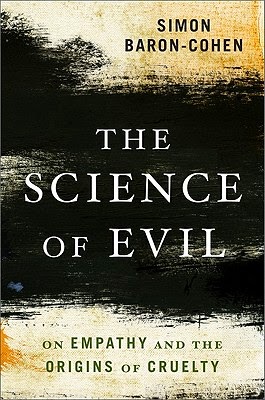
The Science of Evil, Privatio Boni, and Hell


In "The Science of Evil: On Empathy and the Origins of Cruelty", Professor Simon Baron-Cohen explores an idea I found very interesting - the idea that what we call "evil" is caused by a lack of empathy.  He believes that because of this lack of empathy, people who do evil things objectify the people they do evil to - they do not see them as persons, and this protects them from the guilt they would otherwise feel as a result of the cruel things they do to these objectified persons. 

Professor Baron-Cohen defines empathy in this manner:

Empathy is our ability to identify what someone else is thinking or feeling and to respond to their thoughts and feelings with an appropriate emotion. This suggests there are at least two stages in empathy: recognition and response.  Both are needed, since if you have the former without the latter you haven’t empathized at all. If I can see in your face that you are struggling to lift your suitcase onto the overhead rack on the train and I just sit there and watch, then I have failed to respond to your feelings (of frustration).
The Empathy Circuit
In the second chapter of his book, he explores the various parts of the brain that are involved in "the empathy circuit" - and it is interesting to note how there are 10 regions of the brain that he names as playing a part in this "empathy circuit".  Baron-Cohen explains how each part contributes, or how our empathy can be damaged if these parts do not function correctly.  For example, Professor Baron-Cohen explains the part played by the medial prefrontal cortex (MPFC) - the hub for social information processing (where we think about how others might think or feel, as well as where we develop self-awareness).  

Baron-Cohen goes on to note that the famous case of Phineas Gage - a railroad construction foreman who survived an accident where a metal rod impaled his brain - demonstrates how this part of the brain contributes to empathy.  Gage's MPFC was damaged, and whereas before the accident he was said to be a very polite individual, after his accident he was reported to be childish, rude, and prone to profanity and a lack of social inhibition (all signs of a lack of empathy towards others). 

Understanding how his brain damage caused his lack of empathy makes it harder to directly blame him for his "evil" - doesn't it?


Phineas Gage
Professor Baron-Cohen goes on to explore three types of personalities which exhibit a lack of empathy - or more specifically, three types which have a negative form of this lack of empathy.  Interestingly enough, he goes on later in the book to explore a positive form of lack of empathy - Asperger's - where the tendency to systematize seems to balance out the lack of empathy and, rather than causing immorality, the overactive systematizing mechanism causes a form of super-morality (characterized by a lack of ability to understand nuance - rules have no exceptions).  The positive benefits of this combination of lack of empathy and high tendency to systematize is that people with Asperger's are often Savants who tend to discover patterns that most people overlook - reaping huge scientific benefit.  Note that calling this a positive form of a lack of empathy doesn't mean that it never causes harm - a person with Asperger's can be brutally honest, for example, and will see nothing wrong with telling you that your haircut is ugly (they simply do not understand how this is wrong, and in fact, their high standards of truth seem to make it right in their mind).  It simply means that a positive form of lack of empathy is one where there is not a tendency to cause physical harm, and where there seem to be side benefits.

This positive form of lack of empathy is very interesting to note and has its own nuances, but exploring the concept in more detail is outside of the purposes of this post, so I will leave the topic as it stands and return to exploring the negative forms.

Type B
The first personality type with negative lack of empathy is referred to in psychology as borderline personality disorder - Type B.  Baron-Cohen explains this disorder in this way:

The hallmark of borderlines is a constant fear of abandonment, emotional pain and loneliness, hatred (of others and of themselves), impulsivity, and self-destructive, highly inconsistent behavior.
The first thing one might note is what a miserable existence people with borderline personality disorder seem to have - they are constantly in a world of conflicting emotions, where they cannot be alone, and yet they oscillate between either pushing people who get close away or desperately clinging to them in a way that becomes off-putting.  But more importantly, Baron-Cohen explores the causes of this disorder.  Borderlines almost always have a history of parental dysfunction - one or both of the parents was either abusive or neglectful (abandoning the child and withholding affection).  And when scientists have studied the brains of people with borderline personality disorder, they have discovered abnormalities in many of the areas of the brain that Baron-Cohen writes about in chapter 2 of his book.  He states:
One interpretation of all this evidence is that early negative experiences of abuse and neglect change how the brain turns out. But the key point is that the zero degrees of empathy in borderlines arises from abnormalities in the empathy circuit of the brain.
Type P
The second type of personality which exhibits a lack of empathy is the psychopath - Type P (this is often referred to as antisocial personality disorder).  Psyhchopaths exhibit a total preoccupation with self very similar to borderlines, but in their case it is characterized by a willingness to do whatever it takes to satisfy their desires - Baron-Cohen writes:

This might take the form of a hair-trigger violent reaction to the smallest thing that thwarts the person. Or it might take the form of cold, calculated cruelty. Sometimes the mindless aggression is not triggered by a perceived threat but by a need to dominate, to get what one wants, a complete detachment from another person’s feelings, and possibly even some pleasure at seeing someone else suffer.
Later on, Baron-Cohen gives this list of characteristics that are indicative of psychopathic personality disorder:
  • superficial charm
  • lack of anxiety or guilt
  • undependability and dishonesty
  • egocentricity
  • inability to form lasting intimate relationships
  • failure to learn from punishment
  • poverty of emotions
  • lack of insight into the impact of their behavior
  • failure to plan ahead
Many of these are easy to spot as signs of - or a result of - a lack of empathy.  For example, the second characteristic - a lack of anxiety or guilt - is a key feature, as a person without empathy will not feel guilt when they hurt others.  Additionally, a lack of insight and egocentricity are easy to spot as coming from a lack of empathy.

Much like the case of borderline personality disorder, an important factor in the development of psychopathic personality disorder seems to be parental rejection.  During their development, a child that develops psychopathic personality disorder silently rages inside at the parental alienation, and this develops into full blown hate.  Eventually, these feelings build up (like steam in a pressure cooker) until they cannot be contained, and they are released as violent acts
(see the story of Matthew Murray).  

Doctors who have studied psychopaths have found that because of an insecure parental relationship, these children go on to be unable to form anything but superficial relationships with anyone else as well.  Secure relationships are needed for both social and language development, and so these children end up developing abnormally without them.  Even more disturbing is the fact that often, these individuals grow up to be parents who are harsh and abusive, and the cycle continues across generations. 

On the opposite side of this, parents who give affection and security to their children fill them with good feelings - sort of like an inner pot of gold - which seems to immunize them against falling into negativity when bad circumstances come into their lives later on.  Baron-Cohen mentions a friend of his - Peter Fonagy, who is a professor of psychoanalysis at University College London and director of the Anna Freud Centre in Hampstead in London - who theorizes that during the attachment phase of a child's development, they try to "mentalize" the caregiver's mind, imagining what the caregiver thinks and feels, which is especially important in relation to the child as far as the development of self-image goes.  If the relationship is not safe - that is, if the child has reason to think that their caregiver hates them or wishes they didn't exist - they are unable to develop good empathy because they shut down their attempts to mentalize the minds of others, and the areas of the brain involved in this type of thought do not develop normally.

Along with a parental rejection, another cause of psychopathy seems to be prolonged stress - which eventually damages the hippocampus.  This results is a reactive aggression - rather than "fight or flight", flight is never an option and even the slightest provocation is handled with aggression.  When this mechanism is triggered, because of an under-developed frontal cortex - which would otherwise regulate the response - the reaction is uninhibited and an attack is launched.

Perhaps one of the more interesting features of the list of characteristics above is the characteristic of failure to learn from punishment - those with psychopathic personality disorder seem to have developed a defense mechanism as a result of their dysfunctional parental relationships that prevents them from fearing the repercussions of their actions. 

Additionally, when scanning the brains of psychopaths, researchers have found brain abnormalities in some of the 10 brain regions I mentioned earlier - once again, psychopaths were not able to develop the capability to empathize during their childhood.

Type N
The third, and final, type of personality which exhibits a lack of empathy is the narcissist - Type N (referred to in psychology as narcissistic personality disorder).  Narcissists exhibit a tendency to entitlement - they feel that they have an automatic right to be treated well, regardless of how they've treated others.  Additionally, they have a tendency to overstate their own strengths and achievements.  Other people's opinions do not factor in to this equation, but it is as if the sole purpose of others is to exist as an audience that agrees with and admires the narcissist.  But narcissists live in a very fragile world - their mood often plummets into depression, because of their need for constant affirmation.  People who develop relationships with narcissists often feel that they can never give enough, and will often withdraw - this withdrawal does not go unnoticed, and a narcissist often responds with negativity, which only drives their friends and loved ones further away.

Narcissists do not usually display cruelty, however - Baron-Cohen writes:

Rather, in the absence of any humility, narcissists think they are much better than other people, as if they have special gifts that others lack. Indeed, the continuous boastfulness and self-promotion are partly what others find offensive, not because they are jealous, but because they see these as indicators of the narcissist’s total self-preoccupation. Narcissists, like the other Zero-Negative forms, fail to recognize the importance of relationships being two way. For those who have zero degrees of empathy, relationships are not really relationships because they are one way. This is even evident in how much narcissists talk. There is no attempt to make space in the conversation for the other person or to find out about the other person. Narcissists simply lecture, holding forth about him or herself, and they decide when to end the conversation. They have monologues, not dialogues.
As to the causes of narcissism, Professor Baron-Cohen writes:
Like Types P and B, early emotional abuse has been suggested as a possible cause of Type N, again reminding us of the importance of that internal pot of gold. But unlike the other Zero-Negative types, it is speculated that Type N may also derive from excessive admiration, excessive praise for their good looks or talents, overindulgence, and being over-valued in the absence of realistic feedback (by parents).
He notes that, unfortunately, there has not been very much research into Type N - unlike the other two types - and this may perhaps be explained by the fact that narcissists do not tend to be violent like the other two types.  But despite the differences between these three types of personality disorders, he notes, the glaringly obvious connection between them all is a lack of empathy.  In fact, the research indicates that these types of people are not capable of experiencing empathy in the way most people are, because of abnormalities in the areas of the brain outlined in chapter 2 of Baron-Cohen's book.  And it seems that in most cases, these abnormalities can be traced to an impoverished childhood rearing - an environment where the child was not supplied with the experiences necessary to develop empathy.

Up until now, I've discussed the environmental factors which contribute to low empathy.  But Professor Baron-Cohen also discusses the fact that genes contribute as well, to complicate things.  Professor Baron-Cohen gives the example of a friend of his who grew up in an environment with an unusually high percentage of criminals - but this friend grew up to be a noteworthy and talented psychologist against all odds.  Additionally, studies have shown that there is a higher chance of Type P and Type B amongst brothers, sisters, children, and parents (there is, yet again, not enough research into Type N to form conclusions in this area).  To summarize his conclusions at this point, Baron-Cohen states:

While it is tempting to blame zero degrees of empathy on either genes or environment, a mix of factors is clearly causal.
My Conclusions
So why did I find this book so interesting?  First off, I felt affirmed by the fact that the conclusions presented in this book harmonize quite well with the concept of privatio boni, which I explored in one of my posts in my series on Satan.  This theory that the cause of what we call "evil" is a lack of empathy - and thus is a "nothing" rather than a "something" - aligns well with my own thoughts on evil as an absence of good.  And I think it draws out an interesting connotation on a quote by Karl Barth I had used in my series:

That which God renounces and abandons in virtue of his decision [i.e., to freely elect what he will] is not merely nothing. It is nothingness. . . . Nothingness is that which God does not will. It lives only by the fact that it is that which God does not will. But it does live by this fact. For not only what God wills, but what he does not will, is potent, and must have a real correspondence. What really corresponds to that which God does not will is nothingness.
But along with this, the knowledge that genes and environment produce what we call evil must lead one to wonder how much we can blame people for their own sin?  I don't know about you, but for me, knowing that some people simply can't help their lack of empathy makes me want to extend empathy and mercy towards them all the more.

This also ties into the concept of hell (see my series, Checkmate For Hell).  In "God's Final Victory", authors John Kronen and Eric Reitan made an interesting argument related to this, which Reitan summarized on his blog like so:

Here is, for me, the big problem: God’s preordaining some sinners for reprobation is supposed to reflect God’s justice, which tempers His mercy and love (or the other way around?). The idea is that sin is such an intolerable affront to God’s holiness and majesty that divine justice demands that it be repudiated. And so God casts some sinners away forever as a display of His just wrath against sin, even as he elects others for salvation to display His mercy and benevolence.

The problem is this: In casting sinners away from His presence, He casts them away from the only thing that (according to the very theology underlying this theory) can overcome sin. Thus, God guarantees that this intolerable affront to His majesty continues eternally in the souls of the damned. In short, the view essentially amounts to this: sin is so terrible that God decisively acts to guarantee that this intolerable thing continue in all its intolerability forever and ever. “What you’re doing is so inconceivably unacceptable that I am going to make absolutely sure that there is no way for you to ever stop doing it!”

And making sure that this intolerable affront to His holiness never stops is supposed to be God’s justifying reason for not electing all, and so for truncating the scope of his benevolence? Is that a coherent understanding of divine justice?
The Bible says in I John 4:8 and 16 that God is love - the original Greek word used here connotes a selfless form of love, very similar to empathy.  So if we accept that sin or evil comes from a lack of empathy - as the scientific evidence suggests - then Reitan's argument states the problem with eternal hell very well.  

This causes problems for Calvinists and Arminians alike - because for Calvinists, God withholds the only thing that could fix the problem of evil simply for His own glory (which doesn't sound very empathetic to me - sounds more like the description of a psychopath). 

And for the Arminian side, if God gives up and stops trying to extend His empathy to the lost, we have the same problem - God has withdrawn the only thing that could fix the problem because He gives up on them, and this doesn't sound very empathetic either.  It would essentially require God to shut off of the very characteristic that is supposed to define Himeself, and this is a very strange idea when you think about it: God has to stop acting like God in order for there to be Hell.  


Additionally, there is a strange irony to this - God acts un-empathetic towards the un-empathetic in order to punish them for their lack of empathy.  In other words, God does the very thing the evil were doing in order to "make things right".  One might also wonder about the irony of the State when it commands executioners to shut off their empathy towards those who have committed crimes that were a result of a lack of empathy - in essence, turning the executioner into a mirror image of the executee in the moment of the execution.

I'd also like to echo something Professor Simon Baron-Cohen said in the final chapter of his book:

[E]mpathy itself is the most valuable resource in our world. Given this assertion, it is puzzling that in school or parenting curricula empathy figures hardly at all, and in politics, business, the courts, or policing it is rarely, if ever, on the agenda.
Along with this, I wonder (sorrowfully) why our churches do not expend more efforts in methods of empathy training?  Why is it that our theology is so centered around conceptualizing ideas about the afterlife, invisible personalities, and the eschaton, rather than centering around the practice of empathy?

And finally, it should be noted that quite often, the acts of history that we would qualify as evil are performed by men and women whom are quite empathetic at home, with their own group of loved ones.  But the difference here is that these individuals harbored beliefs that encouraged them not to extend that empathy to other groups, or to shut off their empathy circuit when it came to these outsiders.  So I have to ask - are our doctrinal systems sacralizing beliefs that encourage a lack of empathy towards certain types or groups of people?  I think some are, and so I have to ask: why is it so hard to get people to challenge these beliefs?  Shouldn't the job of the church of Christ include challenging people to extend empathy to people they have a hard time empathizing with?  Shouldn't the whole point of faith be to cultivate empathy?

Matthew 5:43-48 NRSV
"You have heard that it was said, ‘You shall love your neighbor and hate your enemy.’  But I say to you, Love your enemies and pray for those who persecute you, so that you may be children of your Father in heaven; for he makes his sun rise on the evil and on the good, and sends rain on the righteous and on the unrighteous.  For if you love those who love you, what reward do you have?  Do not even the tax collectors do the same?  And if you greet only your brothers and sisters, what more are you doing than others?  Do not even the Gentiles do the same?  Be perfect, therefore, as your heavenly Father is perfect."