In my last post, I told a bit of my story of how I came to deconstruct my faith - especially in the matters of hell, Satan, and demons. And I mentioned having attended a Vineyard church. During my time at the Vineyard, I attended the Society of Vineyard Scholars conference. And right before I left the Vineyard, I had thought I might try to throw my hat in the ring and be a presenter at this conference. But this never came to pass. At this time, the US Supreme Court ruled in favor of legalizing gay marriage. Before this event, the Vineyard denomination's stance had been to take no stance on whether it was a sin to be LGBTQ. But afterwards, the denomination decided to be fully non-affirming - Vineyard ministers could not participate in LGBTQ weddings, nor were ordained Vineyard ministers allowed to be LGBTQ unless they were fully celibate. So, while I had taken great pains to write up a paper to submit to the Society of Vineyard Scholars, I never did submit it. I never even published it anywhere - I only sent it to some friends to help me proofread, and occasionally I'd send it to someone if we got onto certain topics of discussion.
So here, finally, I am publishing it. Note that, as I am now agnostic, it does not represent my current way of thinking - though I am still proud of this work, and I still feel that the beliefs it does represent would be good beliefs for a Christian to have.
One final note before I present the paper - I have had considerable difficulty with the formatting of the paper (especially the footnotes) after copying it from Word to Blogger. I apologize for any strange formatting you notice.

The Kingdom of God and the Annihilation of the Kingdom of Darkness
“The tree is known by its fruits. If you want to understand the social and political history of modern man, study hell.”[1]
- Thomas Merton, "New Seeds of Contemplation"
A Logic Problem
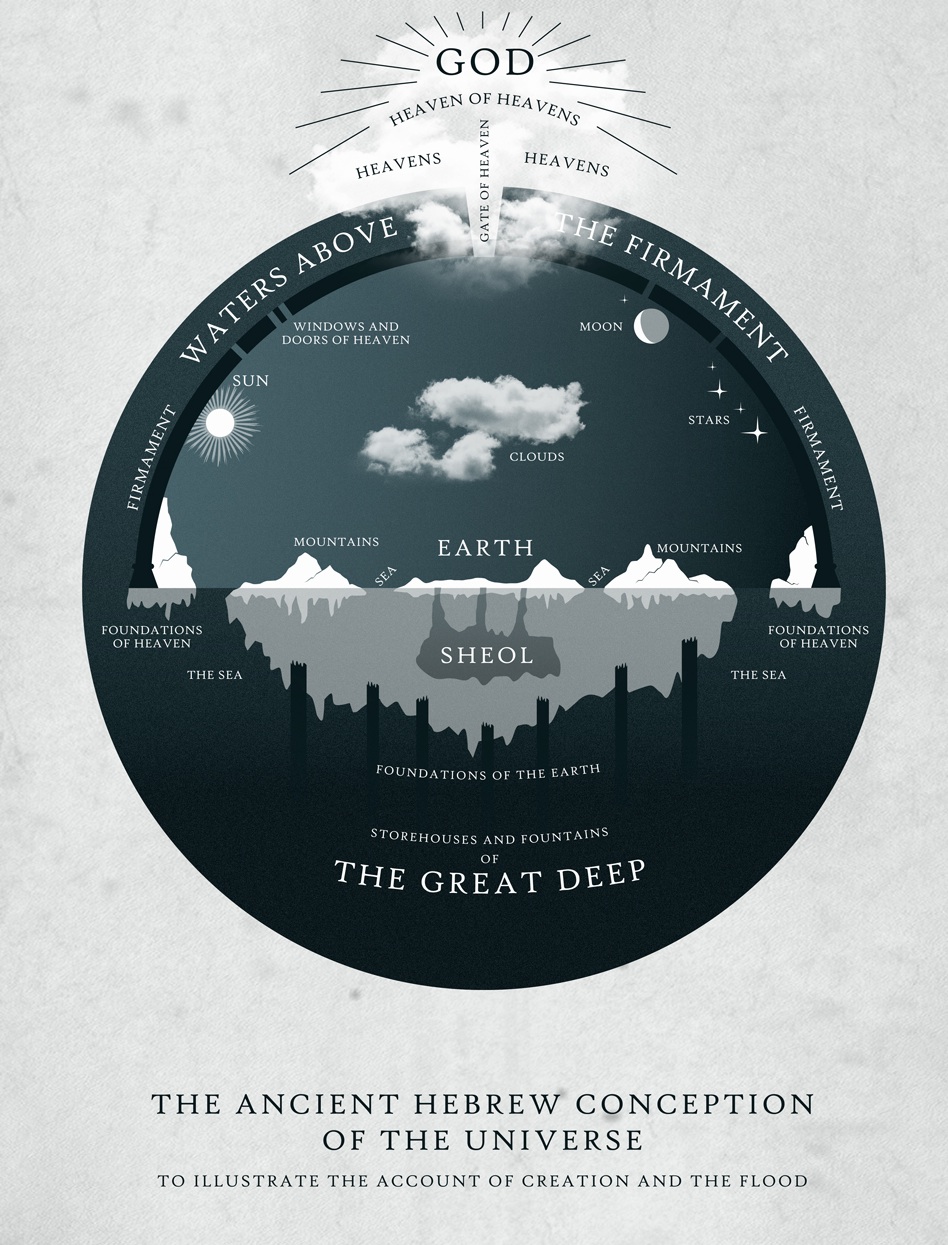
The ancients believed that the world was a flat disc, held up by pillars, hovering over the “waters of the deep”, and with a dome (called the “firmament”) overhead, holding out the waters above the firmament. The realm of heaven - the home of God - was above this.[2] The inerrant view of the authority of the Bible is what prompted the condemnation of heliocentrism as heretical in 1616.[3] But the Church could not prevent the paradigm shift of heliocentrism.
With this in mind, it seems the paradigm shift from “souls ascending to heaven” as the goal of Christianity to “establishing the kingdom of God” - brought into the forefront by the scholarship of George E. Ladd[4] - was long overdue. The Vineyard movement has its roots in this discussion, as Ladd’s work formed the basis for the “kingdom Theology” of its founder, John Wimbur.[5] However, seeing as how “hell” can no longer find its home “under the earth”, it seems that a discussion of the kingdom of darkness is necessary.
I would like to attempt to open this discussion, but before I do, I must point out that crucial to any discussion on theology are two questions: what does this say about God? And: how does this inform practice? To put the second question another way, as Jesus might say: what are the fruits? I hope that what follows will help to bring these questions to the forefront as we think about hell.
For the purpose of the discussion on hell, however, I like to start by laying out the logical problem within the scriptures. To illustrate how this problem is avoided: in "A People's History of the United States", Howard Zinn attempts to paint a picture of how Historians reshape their telling of history in order to support the structures of empire. "One can lie outright about the past. Or one can omit facts which might lead to unacceptable conclusions", he writes. Zinn then goes on to describe how one historian "mentions the truth quickly and goes on to other things more important to him. Outright lying or quiet omission takes the risk of discovery which, when made, might arouse the reader to rebel against the writer. To state the facts, however, and then to bury them in a mass of other information is to say to the reader with a certain infectious calm: yes, mass murder took place, but it’s not that important - it should weigh very little in our final judgments; it should affect very little what we do in the world."[6]
I want to attempt to demonstrate how the process Zinn is describing is also used to support theological frameworks - in this instance, to show how this is done with our concepts of hell. And I will do this by laying out 6 categories of Biblical passages, and how, in order to deal with the logical problems these passages raise, there are three different conclusions[7] that are made, which always employ one of three logical strategies. These logical strategies are what Dr. Thomas Talbott refers to as the “Three Competing Systems of Theology”, and which he demonstrates with this simple formula:
“Consider the following inconsistent set of propositions:
1. God's redemptive love extends to all human sinners equally in the sense that he sincerely wills or desires the redemption of each one of them.
2. Because no one can finally defeat God's redemptive love or resist it forever, God will triumph in the end and successfully accomplish the redemption of everyone whose redemption he sincerely wills or desires.
3. Some human sinners will never be redeemed but will instead be separated from God forever.
If the above set of propositions is logically inconsistent, and it surely is, then at least one of the above propositions is false. But which one?”[8]
One system of theology - which we can either refer to as Calvinism or Augustinianism - accepts propositions 2 and 3 and rejects proposition 1. A second system of theology - which we can refer to as Arminianism - accepts propositions 1 and 3 and rejects proposition 2. A third system of theology - often completely ignored, or perhaps even more often woefully misunderstood - accepts propositions 1 and 2, but rejects proposition 3. This final system more often than not goes by the name “Universalism”, but as the label has led more often than not to misunderstandings and straw man arguments, the ancient word “apocatastasis” and the more modern terminology of “Purgatorial Universalism” are also used.
But to really let the logical problem sink in, we must understand that on a surface level, all three of the above propositions are what we might call biblical. And I wish to illustrate this by not only presenting three categories of scriptures which support each of these propositions, but three additional categories of scriptures which complicate the whole matter. Through this process, I will attempt to demonstrate how, for two of these systems, the only option for defending the system is to suppress some of these categories by a process much like the one Howard Zinn laid out.
The Arminian Proposition
Let’s start with Talbott’s “Proposition 1” - which we might call “The Arminian Proposition”, or “AP” for short. Is this proposition biblical? To support this proposition, Arminians would call forth such passages as I Tim. 2:4, which states that God “desires everyone to be saved and to come to the knowledge of the truth.” A more complete statement of this proposition might be found in 2 Pet. 3:9, which states: “The Lord is not slow about his promise, as some think of slowness, but is patient with you, not wanting any to perish, but all to come to repentance.” Here we see a complete statement covering both the negative - God does not want any to perish - and the positive - God does want all to come to repentance. (cf. Lam. 3:31-33, Ezek. 18:23 and 33:11). In Gen. 12:3, God speaks his intention to reach the whole world through Israel. Over and over we read that God is not a God who shows partiality or favoritism (Deut. 10:17, 2 Chron. 19:7, Job 39:14, Acts 10:34, Rom. 2:11, Eph. 6:9, I Pet. 1:17). Jesus also declared the universal scope of his mission (see Mt. 28:18-20, Jn. 12:32, Acts 1:8).[9]
One of the ways Calvinists try to wriggle out from the natural reading of the scriptures mentioned above is to either add words into the passage - such as when influential Calvinist John Piper states that God wants all sorts of persons to be saved - or to argue that God has “two wills” (another Piper-ism) - one will which decrees what shall come to pass, and one that declares what should come to pass.[10] To the first argument, I say: to add words whenever the Bible makes us uncomfortable is cheating. And the second argument is idiosyncratic, at best, and reeks of a desperate attempt to avoid facing the facts. But let’s examine I Tim. 2:4 in light of this argument. To restate the argument, it is to make it seem as if God's desire is like our desire - as if God wishes for something to happen, but if something gets in the way God won't force the issue. And this might seem like a good way out until you examine the Greek word that is translated “wants” or “desires” in I Tim. 2:4 - the word is “thelo”, which is defined in Thayer's Greek lexicon as: “to will, have in mind, intend, to be resolved or determined, to purpose”.[11] This isn't some wishy washy sort of desire - as in "well, I wish this would happen, but it's not going to." This is something God pursues with resolve and determination - with intention.
Statistically, if we believe that only people who claim Jesus as their savior will escape the eternal conscious torment of hell, then this means that the majority of the population of the world are either already in or will be going to hell – this implies that God is a colossal failure. But let’s move on to some of the other sets of passages related to this issue.
To add a bit of nuance to this problem, Arminians also believe that humans have free will - we can call this “The Freewill Proposition”, or “FP” for short. The argument that is typically used is this: over and over throughout the scriptures we see that God gives people the choice of whether or not to follow God. The language used in Josh. 24:15 is: “choose this day whom you will serve.” Arminians propose that if men do not really have the ability to choose - only the illusion of choice - then they cannot be held responsible for their poor decisions. Furthermore, it could be argued that without the ability to choose, love is not a possibility. As the debate between predestination/sovereignty and free will is a very complicated and nuanced matter all on it’s own, I propose to leave it at this point by simply pointing out that we see this sort of language all over the Bible (e.g., Deut. 11:26-28, 30:15-19; Jer. 7:1-15; 17:9-27; 21:8; 22:1-5; Rom. 10:13).
The Calvinist Proposition
Moving on to Talbott’s “Proposition 2”, which I’ve dubbed “The Calvinist Proposition”, or “CP” for short - Calvinists believe that God’s omnipotence or sovereignty necessitates a belief that every single event must have been preordained by God. R.C. Sproul goes so far as to state that “If there is one single molecule in this universe running around loose, totally free of God’s sovereignty, then we have no guarantee that a single promise of God will ever be fulfilled.”[12] Please note that I find Sproul’s summary of the Calvinist view to be woefully devoid of any form of nuance, and I believe that there are other valid options besides a strict form of determinism or a strict form of libertarian free will.[13] But to support their view on God’s sovereignty, Calvinists do enlist the support of many scriptures. For instance, in Mt. 19:26 Jesus states that “for God all things are possible”, in Job 42:2 Job states that "no purpose of [God’s] can be thwarted", in Isa. 14:24-27 the voice of God declares that whatever He has designed or planned shall come to pass. The Psalmist declares (Ps. 135:6) that whatever pleases God, He does. In Romans 11:36, Paul states that “from him [God] and through him and for him are all things.” And finally, Dan. 4:35 declares: “All the inhabitants of the earth are accounted as nothing, and he does what he wills with the host of heaven and the inhabitants of the earth. There is no one who can stay his hand or say to him, ‘What are you doing?’”[14]
One argument I, personally, have seen used to counter the view that God’s sovereignty means that God’s plans cannot be thwarted is to bring up the story of Adam and Eve, and to state that God obviously did not want or plan for them to eat the fruit of the Tree of the Knowledge of Good and Evil. Curiously enough, this argument was once even used by a Calvinist friend of mine - and in response, I would query: have you read John Calvin?[15] But to answer the objection - if this is the line of reasoning one employs, then I would say you are asking the wrong question. You are operating on human time and asking “does God get what God wants right away, the very instant that God decides God wants it?” It is as if one were to imagine God as an American waiting in line at McDonalds very impatiently. This is the wrong question – the question I feel we should ask could better be stated as “does God get what God wants eventually”, or “does God get what God wants in the end?” To illustrate: it would be as if one were to stop reading the story of Jonah at the point when he gets on a boat going in the other direction of Nineveh, and insisted that this proved that God doesn't get what God wants. But I am insisting that if you keep reading, you will find that you must answer the question in the positive when Jonah ends up at Nineveh and the entire city is saved.
Before I move on to some of the other passages we must consider, I want to point out a few logical problems that are raised when we reject either AP or CP. It boils down to one of two options: either God is not willing to save all men, or He is not able to. If God is not willing to save all men, but God is able to do all things - then this means that God is not good, because God created 2/3's of mankind knowing that they had no hope of salvation and yet God made them merely for the purpose of torturing them for all eternity. Such a God is a sadistic monster and is clearly not worthy of being worshiped. A loving God would not create beings for which there was no hope but eternal torment - so if God is not willing to save all, then God is not loving.
Consider the way this problem is worded by authors John Kronen and Eric Reitan in “God’s Final Victory”:
“God loves every one of His creatures with a profound and unwavering benevolence; and He wills upon some of these creatures the very worst kind of evil conceivable, and He wills that they suffer it for all eternity, even though it cannot possibly do them any good, since it never culminates in anything but more of the same.”[16]
I sincerely hope my readers are able to see the contradiction between the first part of the above statement ("God loves every one of His creatures") and the end ("He wills that they suffer for all eternity").
But the other side has its own problems - because if God is willing to save all men, but not able to, then we cannot have any confidence in the efficacy of God's will. If God's will can be thwarted, then how can we say that God is "sovereign"? Consider the following analogy - the situation is as if a person had the choice between eternal bliss on the one side and thrusting themselves in a fire on the other, and we are saying that after being given this choice repeatedly for all of eternity they still choose to thrust themselves into the fire. That this would continue for all eternity, and that an infinite God with infinite time and resources would not be able to ever tempt these poor souls into choosing eternal bliss over continual burning seems dubious at best - and even if this were possible, I'd question why God either does not allow them to be consumed by the fire or made them so they wouldn't be in the first place?
Once again, I turn to John Kronen and Eric Reitan in “God’s Final Victory”:
“That someone created in the divine image, and hence naturally ordered towards the good, should eternally reject the perfect good strikes us as prima facie unlikely, especially if God continues unremittingly to seek the creature's repentance. Furthermore, that an omnipotent and omniscient God should eternally fail to find a morally legitimate way to transform an unwilling creature's heart strikes us as prima facie dubious.”[17]
So one might argue that God does not continue to unremittingly seek repentance - but if this is the case, then we'd be once again back into the world of the problems with confirming God's goodness: why does God give up on His own creatures, and is it good to give up on any being and allow them to face eternal torture? Do we not have a responsibility to save conscious beings from such a horrible fate? And if love demands that we save conscious beings from a horrible fate such as this, why doesn't it compel the Eternal Being whose very nature is love (I Jn. 4:8 and 16) to continually strive for the salvation of these beings?
Note that what I have been doing in the last few paragraphs is to merely restate a very ancient argument made by the Greek philosopher Epicurus:
“Is God willing to prevent evil, but not able? Then he is not omnipotent.
Is he able, but not willing? Then he is malevolent.
Is he both able and willing? Then whence cometh evil?
Is he neither able nor willing? Then why call him God?”[18]
But as we've seen earlier in this paper, the Bible implies that God is both willing and able to save all. As 2 Pet. 3:9 says, "God is not willing that any man should perish but that all should come to repentance", therefore God is willing that all should be saved. And the Bible implies that God is able to save - Heb. 7:25 says that God "is able to save to the uttermost", 1 Chron. 29:11 says that God is "sovereign over all the sky and earth" and goes on to say: "You have dominion and exalt yourself as the ruler of all." Isa. 46:10 says that God's purpose "will stand" and He "will do all that [He] please[s]"! The Biblical view of evil is that, as Joseph states in Gen. 50:20, “even though you intended to do harm to me, God intended it for good”, and as Paul states in Rom. 8:28, “we know that all things work together for good”.
And so we are led right to the brink of an incredible hope - but do we dare to proceed? Dare we hope that all men might be saved, as Catholic theologian Hans Urs Von Balthasar queries in the title of his famous book?
The Universalism Proposition
Perhaps we should continue to examine the scriptures - and so it is here that I will complicate things for Talbott’s “Proposition 3” by adding what we might call “The Universalism Proposition”, or “UP” for short. As I mentioned before, a typical strategy for getting around the word “all” in I Tim. 2:4 is to state that what is really meant is “all sorts of persons” - so the question is really stated: “what does the word all mean?” To answer that, I reply that we should always allow scripture to interpret scripture, so let’s look at some other verses that talk about “all” to figure out what scripture means when scripture says “all”.
Let me start by asking you this: does a word change meaning to its opposite meaning halfway through a sentence without any contextual clues to show us that it has done so? In other words, we know that “table” can mean more than one thing - I might say “I'm doing my multiplication table at the kitchen table”, and so we know we're talking about two different things there, but we have contextual clues to tell us that, and actually the root meaning of the word, “a flat surface”, hasn't really changed. Well, if a word can change meaning willy nilly without any contextual clues, then it becomes very, very hard to communicate, and if we're going to play by those rules I could probably use them to prove to you that God is a flying spaghetti monster (isn’t that what “love” really means in I Jn. 4:8?). So in order to be able to effectively communicate with each other, we have to have certain rules, one of them being that if we have established a meaning for a word, that word does not change meaning unless there is context around it to indicate that it has done so. So with this rule in mind, let’s read what Paul says in I Cor. 15:22:
“For as in Adam all die, so in Christ all will be made alive.”
In the first half of this verse, it is pretty clear to me that “all” means “every human being who ever lived and whom ever will live.” It is a scientific fact that everyone dies – this has been proven over and over and over again throughout history. So when we approach this verse, we see that Paul is using a method of communication known as a “simile” – he’s making a comparison between one thing and another in order to prove a point. He’s saying “just like ‘a’ is true, so ‘b’ is also true in the same sense.” So when I approach this verse, I think it is logical to say that what Paul is communicating here is that just like every human being who ever lived and ever will live has died or is going to die because we’re “in Adam” (or have inherited his legacy), so because of Christ every human being who ever lived and ever will live will be made alive.
This is not the only place where Paul makes the Adam/Christ comparison, by the way - he makes the same comparison in Rom. 5:18-19 and 11:32. I find it very difficult to find any logic in the claims that state that Paul is only talking about "people who believed in this life" in these statements. If this is his intention, then he is a horrible communicator, because it seems very clear in each of these statements that the very same set he is speaking of in the first half of the sentence is the very same set he is speaking of in the second half.
One problem I'd like to point out with the way some people re-interpret the second “all" in these verses - when we say that yes, every person who ever lived and ever will live dies because of Adam, but not every person who has ever lived and ever will live will be made alive because of Christ, then this implies that Adam is more powerful than Christ. Adam's actions are more effective than Christ's. Thus, Christ is not God - Adam is. This is a big problem. But what I want to say is that in these verses I've just laid out, Paul is saying that the actions of Adam have been completely undone and reversed by the act of Christ, and thus Christ is revealed as being infinitely more powerful than Adam.
To add weight to the point - I Tim. 4:10 states that “we have our hope set on the living God, who is the Savior of all people, especially of those who believe.” If the author intended “all people” to mean “all sorts of people”, why did this author add the “especially” clause? A similar statement is made in I Jn. 2:2, where the author declares that “he is the atoning sacrifice for our sins, and not for ours only but also for the sins of the whole world.” And perhaps the clearest statement of Universalism is in Col. 1:20, where Paul declares that “through [Jesus Christ] God was pleased to reconcile to himself all things, whether on earth or in heaven, by making peace through the blood of his cross.” I find it interesting that here, Young’s Literal Translation renders “all things” as “the all things” - and if you wish to know what “the all things” refers to, simply look back at verse 16 where Paul states that “in him were the all things created, those in the heavens, and those upon the earth, those visible, and those invisible, whether thrones, whether lordships, whether principalities, whether authorities; all things through him, and for him, have been created.”
Eternal Torment? Annihilation?
But now we have a little problem, because there are two more sets of passages to consider. The first set we can refer to as “The Eternal Torment Proposition”, or “EP” for short. I’m fairly certain I do not need to go into too much detail to illustrate what this set contains. I will examine one particular passage where “eternal torment” is spoken of, but first I wish to discuss the problematic translation this contains.
Authors John Kronen and Eric Reitan write in “God's Final Victory”:
“One difficulty with assessing the plain sense of Scripture is this: if anything has authority, it is the plain sense of the original Greek, Hebrew and Aramaic texts. Translation involves interpretation. As such, any attempt to discuss the plain sense of Scripture in modern Christian communities, in which only a few experts have the language skills to access the original texts, is immediately suspect. Relying on any English translation of the Bible is relying on the authority of a group of experts who can and do disagree, as evidenced by variations among the English translations produced by scholars who were commissioned based on their expertise.”[19]
On that note, I wish to refer to Hasting's Dictionary of the New Testament, which states that there is no word either in the Hebrew Old Testament or in the Greek New Testament that expresses the abstract idea of eternity.[20] Corroborating this testimony are other scholars such as Dr. G. Campbell Morgan - called “the prince of expositors”[21] - who wrote in his book “God’s Methods With Man”:
“Let me say to Bible students that we must be very careful how to use the word "eternity." We have fallen into great error in our constant use of that word. There is NO word in the whole Book of God corresponding with our "eternal," which as commonly used among us, means absolutely without end.”[22]
Additionally, Marvin Vincent, D.D., professor of sacred literature at Union Theological Seminary wrote:
“Aion, transliterated aeon, is a period of longer or shorter duration, having a beginning and an end, and complete in itself. Aristotle (peri ouravou, i. 9, 15) said, "The period which includes the whole time of one's life is called the aeon of each one." Hence, it often means the life of a man, as in Homer, where one's life (aion) is said to leave him or to consume away (Il v.685; Od v.160). It is not, however, limited to human life. It signifies any period in the course of the millennium, the mythological period before the beginnings of history. The word has not "a stationary and mechanical value" (De Quincey). It does not mean a period of fixed length for all cases. There are as many aeons as entities, the respective durations of which are fixed by the normal conditions of the several entities. There is one aeon of a human life, another of the life of a nation, another of a crow's life, another of an oak's life. The length of the aeon depends on the subject to which it is attached ... The adjective aionious in like manner carries the idea of time. Neither the noun nor the adjective, in themselves, carry the sense of endless or everlasting.”[23]
To illustrate how badly these words - olam in Hebrew and aeon/aion/aionious in Greek - have been translated, we must look at some of the other places where the words are used. For example, in Gen. 6:4, "olam" is translated as “heroes of old” (rather than “heroes of eternity”). Ex. 21:6 uses "olam" to refer to a servant's lifespan. There are plenty more examples, but my favorite is Jon. 2:6, where the NIV and KJV translations imply that Jonah was in the belly of the whale forever.
Moving on to the New Testament, the word “aeon” is used twice in Mt. 12:32 and is translated “in this age or in the age to come.” As an english version of “aeon” is “eon”, the word “age” seems a good translation - especially considering that an age cannot be forever if there is another age following it. Also, 2 Tim. 1:9 says that “grace was given to us in Jesus before the beginning of time” - this could be translated as “before the beginning of this age”, as once again the word used is a form of “aion” - “aionios”. If there is a time before the aion, then aion cannot mean eternal. Heb. 1:2 is one of the more interesting choices of translations for “aionios” - here the NIV says “through whom also he made the universe”. This is literally di hou kai epoiesen tous aionios - and Young's Literal Translation has this rendered: “through whom also He did make the ages.” If God made the aion, the aion cannot be eternal. Note here, before I move on, that there are more examples of these interesting translation choices.[24] And to really get a sense of how this word was used, one ought to examine other ways it has been used outside of the Bible.[25]
So to make the case that a use of this word means “eternal” or “forever”, one must prove that it has to carry this length of time. And I argue that this cannot be done without circular logic (i.e. the word means “forever” because hell is “forever” and hell is “forever” because the word means “forever”). But to indulge those who would argue, I wish to deal with one particular argument often brought up. In the "Parable of the Sheep and the Goats" in Mt. 25:31-46, verses 41 and 46 both contain forms of this word which are often translated into “eternal”. I'd like to discuss why in this particular passage there is nothing which necessitates this translation, and this will serve to exemplify the solution for this logical problem.
But before I proceed, I want to mention the last of the six categories of scriptures I spoke of earlier - that is the category of scriptures which seem to imply that rather than the wicked being tormented forever, they are annihilated - we can call this “The Perish Proposition”, or “PP” for short. A few quick examples will suffice, and then as I deconstruct our interpretation of the “eternal torment” spoken of in the “Parable of the Sheep and the Goats”, I think that this whole problem will become much clearer. Annihilationists, or Conditionalists as they sometimes prefer to be called, will not only use some of the same tactics I use to question the translation of “eternal”, but will also point to verses like Mt. 10:28, where Jesus speaks of “the One who can destroy both soul and body in hell”. Another example, in Rom. 6:23, Paul says that “the wages of sin is death” (not eternal conscious torment), and Ecc. 9:5 defines the Jewish view of death when it says that “the dead know nothing” (this at least calls into question the “conscious” part of “eternal conscious torment” - and if one is not conscious, can it still be called torment?).
But let us return to Mt. 25:31-46 and the argument that many who believe in eternal conscious torment will use to defend their proposition. For them, the translation of this word to “eternal” might make sense to them, since in verse 46 some go into “eternal” punishment, and others go into “eternal life.” This would seem a balanced system - but the first question I would ask in response to this is: is God's mercy equal to His wrath? I would answer “no” to this, as we repeatedly see in the Bible that God's love and mercy endure through the ages (Ps. 106:1; 107:1; 118:1; 138:8; and over and over in Ps. 136), but his anger lasts only a moment (Ps. 30:5, 103:9, Isa. 57:16, Jer. 3:12, Mic. 7:18). This demonstrates that the relationship of God's love to God’s wrath is not best represented as a flat equal sign, but is specifically shown to be a contrasting relationship where God’s love vastly outweighs God’s wrath.
Secondly, one must consider that the word used with “aionian” in the parable is “kolasis” - the translation to “punishment” does not really do this word justice, in my mind, because the word is the same word used to describe the pruning of a tree[26], and connotes correction. Correction has a purpose, and is not an end unto itself. There is another word used to describe inflicting pain merely as an end unto itself - this word is "timora", which means torture. But Jesus did not use the word timora here, he used the word kolasin, which means correction.
I think Aristotle gives us a very good insight into the difference between these two concepts, in his Treatise on Rhetoric:
“Now, between punishment (τιμωρια, timora, also translated as "revenge") and correction (κολασις, kolasin) there is a difference; for kolasin is for the sake of the sufferer, but timora for that of the person inflicting it, in order that he may be satiated.”
With the above comment in mind, it would make absolutely no sense whatsoever to inflict everlasting correction upon someone - at no point would this person have reached a point of having been corrected. Furthermore, one must consider the paradox present in the parable - for once the goats go into aionian kolasin, do they not become “the least of these”?
Finally, I think that we should look to scripture to interpret what, exactly, "eternal life" means to Jesus. And so I turn to another one of Jesus' statements - in John 17:3, Jesus says:
“Now this is eternal life: that they know you, the only true God, and Jesus Christ, whom you have sent.”
In this vision of “eternal life”, it seems to have nothing to do with the duration of time, but is rather a state of knowing God. And so it would seem logical to conclude that "age-long kolasis (correction)", being the opposite state, would be the state of not knowing God. But this is not a hopeless state from which there is no possible return. Many have come from this state into the state of knowing God. And so I hold out the hope that even those who face aionian kolasis will one day turn to God and know Him. And I believe this hope is spoken of in numerous places throughout the Bible, such as Job 14:7:
“For there is hope for a tree, if it be cut down, that it will sprout again, and that its shoots will not cease.”
How does one know God? If God is love, as I John 4:8 and 16 state, then to know God is to draw into fellowship with all life. Jürgen Moltmann writes of the relationship between eternal life and the kingdom of God:
“There is eternal life only in God's kingdom. No one possesses, or is given, eternal life for him or herself alone, without fellowship with other people, and without community with the whole creation. So the kingdom of God is a more integral symbol of the eschatological hope than eternal life.”[27]
But how should we approach the perish set of passages? And furthermore, how do we approach the concept of judgement within scripture? And to return to the imagery of the “Parable of the Sheep and the Goats”, are we to interpret this fire literally (even though we do not interpret the “sheep” or the “goats” in this manner)?
To prime the pump, so to speak, I want to include a fascinating quote from St. Isaac of Syria:
“As for me I say that those who are tormented in hell are tormented by the invasion of love. What is there more bitter and violent than the pains of love? Those who feel they have sinned against love bear in themselves a damnation much heavier than the most dreaded punishments. The suffering with which sinning against love afflicts the heart is more keenly felt than any other torment. It is absurd to assume that the sinners in hell are deprived of God’s love. Love is offered impartially. But by its very power it acts in two ways. It torments sinners, as happens here on earth when we are tormented by the presence of a friend to whom we have been unfaithful. And it gives joy to those who have been faithful.
That is what the torment of hell is in my opinion: remorse. But love inebriates the souls of the sons and daughters of heaven by its delectability.”
I find this concept to be provocative, because it acknowledges the implication from passages such as Ps. 139:7-12 that there is no place one may go to escape the Spirit of God. Furthermore, while there is a temptation to insist that only the wicked are “thrown into the lake of fire” (see Rev. 20:14-15)[28], we must contend with the fact that not only does Heb. 12:29 declare that “God is a consuming fire”, but verses like Mk. 9:49 and I Cor. 3:10-15 seem to imply that everyone goes through the flames (and if your work is not built on a solid foundation, you “will be saved, but only as through fire”). Furthermore, we must wonder what it means for John the Baptist to declare that Jesus has come to baptize with fire (Lk. 3:16).
Consumed in the Fires of Love
So what, one might ask, is consumed in this fire?
St. Isaac was not the only ancient church father to ponder similar ideas regarding the so-called fires of hell. Clement of Alexandria wrote:
“Fire is conceived of as a beneficent and strong power, destroying what is base, preserving what is good; therefore this fire is called 'wise' by the Prophets … We say that the fire purifies not the flesh but sinful souls, not an all-devouring vulgar [earthly, natural] fire, but the 'wise fire' was we call it, the fire that 'pierceth the soul' which passes through it.”[29]
Origen also wrote of this “wise fire”:
“The Sacred Scripture does, indeed, call our God 'a consuming fire' (Heb. 12:29), and says that 'rivers of fire go before His face' (Dan. 7:10), and that 'He shall come as a refiner’s fire and purify the people' (Mal. 3:2,3). As therefore, God is a consuming fire, what is it that is to be consumed by Him? We say it is wickedness, and whatever proceeds from it, such as it figuratively called 'wood, hay, and stubble' (1 Cor. 3:12-15) which denote the evil works of man. Our God is a consuming fire in this sense; and He shall come as a refiner’s fire to purify rational nature from the alloy of wickedness and other impure matter which has adulterated the intellectual gold and silver: consuming whatever evil is admixed in all the soul.”[30]
And Gregory of Nyssa, who made significant contributions to the Nicene Creed and defended the doctrine of the Trinity at the Councils of Nicea and Constantinople, wrote:
“What therefore is the scope of Paul's argument in this place [1 Cor. 15:28]? That the nature of evil, at length, be wholly exterminated, and divine, immortal goodness embrace within itself every rational creature; so that of all who were made by God, not one shall be excluded from his Kingdom. All the viciousness, that like a corrupt matter is mingled in things, shall be dissolved and consumed in the furnace of purgatorial fire; and every thing that had its origin from God, shall be restored to its pristine state of purity.”[31]
Jesus explains the call to his followers as a call to “deny themselves and take up their cross and follow me.” (See Mt. 16:24, Lk. 9:23)[32] In Gal. 2:19-20, Paul describes the effects of salvation in this manner: “I have been crucified with Christ; and it is no longer I who live, but it is Christ who lives in me.” What’s interesting to me is that the word Paul uses here is translated into the Latin vulgate as “ego”[33], so the passage may be translated as: “My ego has been crucified with Christ; and it is no longer my ego who lives, but Christ lives in me.” Furthermore, Paul describes Jesus’ life in Phil. 2:6-11 by stating that though Jesus was in very nature God, he emptied himself. The word used here is "kenosis", and it is a self-renunciation - a transcendence of ego.[34] And in Rom. 6:6, Paul says that for followers of Jesus, they “know that [their] old self was crucified with him so that the body of sin might be destroyed, and [they] might no longer be enslaved to sin.”[35] Furthermore, Jesus presents us with a profound paradox when he states that “those who want to save their life will lose it, and those who lose their life for my sake will save it.”[36]
The emptiness of the Christian is even more radically stated in Gal. 3:28, where Paul writes that what it means to be “one in Christ Jesus” is the annihilation of the religious, socio-political, and biological categorizations that we so often use to create hierarchies - in other words, to live the love that Jesus taught, we must cease to use labels, and learn to see every man and woman as simply “beloved”. One must ask if the annihilation of labels is really possible if we keep believing that in the end, some people are beyond hope?
Passages like these are the inspiration for Thomas Merton’s “false self”/”true self” dichotomy. Merton writes:
“My false and private self is the one who wants to exist outside the reach of God’s will and God’s love - outside of reality and outside of life. And such a self cannot help but be an illusion.”[37]
So what is consumed in the fire the scriptures speak of? I believe it is this false self - I believe that hell is the annihilation of self, or the death of ego. Some will embrace this death - knowing that what awaits them is an embrace of the true self that will be united with God. And some with struggle against this death, and prolong its effects.
Out of this annihilation - this death - emerges the true self. As Paul states in 2 Cor. 5:17, “everything old has passed away” and in its place “there is a new creation”. This new creation is the true self Thomas Merton writes about:
“To say that I am made in the image of God is to say that love is the reason for my existence, for God is love.
Love is my true identity. Selflessness is my true self. Love is my true character. Love is my name.”[38]
Rethinking hell in this way will not only free us from hate, but will challenge our tribal forms of violence as well - which only serve to betray our own insecurities that we are so afraid to face. Belief in hell as a final condemnation so often only serves to bolster and support our violence, because when we can convince ourselves that God rejects those we reject, it’s very easy to also make ourselves believe that this God endorses our violence towards those we reject. These are the fruits of belief in hell as final condemnation - as Thomas and Gertrude Sartory write in “No Fire Burning in Hell”:
No religion in the world (not a single one in the history of humanity) has on its conscience so many millions of people who thought differently, believed differently. Christianity is the most murderous religion there has ever been. Christians today have to live with this; they have to "overcome" this sort of past.... If someone is convinced that God condemns a person to hell for all eternity for no other reason than because he is a heathen, a Jew, or a heretic, he cannot for his own part fail to regard all heathens, Jews and heretics as good for nothing, as unfit to exist and unworthy of life. Seen from this viewpoint, the almost complete extermination of the North and South American Indians by the "Christian" conquerors is quite consistent. From the aspect of the dogma of hell "baptism or death" is an understandable motto.[39]
Not only does belief in eternal damnation often justify violence, but the fear it induces prevents rational thinking and may even be damaging to the brain itself. Studies of the brain have identified a place called the the dorsolateral prefrontal cortex (DLPFC) as the location of reasoning, logic, strategy and planning. Brain studies have also identified sections called the orbital frontal cortex (OFC) and the ventral medial prefrontal cortex (VMPFC) as the location where feelings of guilt and awareness of socially unacceptable behavior reside. In “The God-Shaped Brain: How Changing Your View of God Transforms Your Life”, Dr. Timothy Jennings writes about this, and notes how “[i]nterestingly, brain research has shown that when the VMPFC or conscience is active, the DLPFC or reason is less active, and vice versa.”[40] But perhaps more interesting is the interplay between these sections of the brain and another section which has been identified as the anterior cingulate cortex (ACC), where feelings of empathy, compassion, and love reside and which has also been identified as the place where we make moral decisions between right and wrong. Studies have shown that the more we use our ACC, the stronger our DLPFC (center of reason) is. These studies have also shown that the fear centers of the brain shrink the more we use our ACC. Dr. Jennings writes:
“Brain-imaging studies have demonstrated that the more time a person spends in communion with the God of love, the more developed the ACC becomes. Not only that, the person experiences decreases in stress hormones, blood pressure, heart rate and risk of untimely death. Even in our mortal and defective bodies, love is healing. Conversely, the more time spent contemplating an angry, wrathful, fear-inducing deity, the more damage to the brain and the more rapidly one’s health declines, leading to early death.”[41]
On the flip side, meditation on a God of love, Jennings writes, stimulates growth:
“Does it matter which God-concept we hold to? Recent brain research by Dr. Newberg at the University of Pennsylvania has documented that all forms of contemplative meditation were associated with positive brain changes—but the greatest improvements occurred when participants meditated specifically on a God of love. Such meditation was associated with growth in the prefrontal cortex (the part of the brain right behind our forehead where we reason, make judgments and experience Godlike love) and subsequent increased capacity for empathy, sympathy, compassion and altruism. But here’s the most astonishing part. Not only does other-centered love increase when we worship a God of love, but sharp thinking and memory improve as well. In other words, worshiping a God of love actually stimulates the brain to heal and grow.”[42]
Hell as condemnation so often drives its believers away from the love that is their purpose - those who believe this doctrine are all too often too afraid to embrace their heretics and sinners. But the cruciform love of Jesus drove him to love the rebels and outcasts of his day.
I find a striking example of the way this works in the response I witnessed to the tragic suicide of Robin Williams - on the side of the so-called Religious Right I witnessed a condemnation of the man and a desperate attempt to scare their followers away from making a similar choice[43], to which one must wonder: is fear really an antidote to depression? Meanwhile, I was overcome by grief and compassion for this poor soul who felt such a desperate loneliness and a fear of being vulnerable enough to share his true self that he took his own life.
Following Williams’ death, I found a dark irony present when my wife and I re-watched one of our favorite movies of his - “What Dreams May Come”. In the film, Williams plays a character named Chris who dies in a car wreck at the beginning of the movie. In the film’s version of heaven, Chris discovers that following his death, his wife Annie had sunk into a deep depression and committed suicide. I find it provocative that in this film, those who commit suicide go to hell, but this is not the result of the condemnation of a god figure - rather, it is the natural result of their creating nightmare realms for themselves to live in, out of their own self-judgement and feelings of worthlessness.
Chris adamantly demands to go see his wife in hell - it doesn’t matter that he is repeatedly warned that no one has ever succeeded in such an endeavor. A tracker is enlisted to assist Chris - and together they journey to a twisted version of Chris and Annie’s house, where she is trapped within her own self-torment. The tracker - who ends up being an old mentor from Chris’ past - warns Chris not to stay too long within Annie’s realm of self-torment, or he may become permanently trapped within. He asks Chris to see this is an opportunity for a final farewell.
So Chris goes in, and makes a valiant attempt to stir her memories and guide them to better things - but this is to no avail, as Annie is suffering from amnesia and dementia. And this is where the most powerful scene of the film occurs - rather than leave and go back to heaven, Chris decides to stay with her in hell, feeling that at least he will be with her. So he begins to sink into her dark fantasy, and we see in Annie’s eyes a dawning realization that her self-inflicted hell is overcoming someone who loves her unconditionally, and she regains her memories of Chris. Wanting nothing more than to save him, Annie ascends to heaven, bringing Chris along with her.
This is a powerful expression of the hope of apocatastasis. All too often it seems that the fear of hell drives people away from love. So often we run from our doubts, fears, and insecurities - but it is those places of doubt, fear, and insecurity that are the crucible on which faith is formed. In the Garden of Gethsemane, Jesus did not run to safety. He pleaded with God to take that cup of suffering from him - but the cup of suffering is where redemption happens. There is a paradox within the Bible between passages which state that “the fear of the Lord is the beginning of wisdom”[44] and the statement in I Jn. 4:8:
“There is no fear in love, but perfect love casts out fear; for fear has to do with punishment, and whoever fears has not reached perfection in love.”
This is a parable we must learn to struggle with. When Jesus told us to love our enemies[45], and illustrated this with stories such as the parable of the “Good Samaritan”[46], he was demonstrating that we must learn to find reconciliation by delving into those places that we fear the most. Because it is in those moments of reconciliation that we experience the Presence of God - as Jacob (then re-named Israel) says when he finds reconciliation with his brother Esau: “truly to see your face is like seeing the face of God.”[47] I find what is perhaps the most dramatic expression of the hope of apocatastasis in the statement of Jesus that he utters from the cross itself: “Father, forgive them; for they know not what they do.”[48]
Forgiveness is the cruciform way of the followers of Jesus - in this way, redemption is not only for our enemies, but for us as well. Forgiveness is what enables us to transcend the neurotic need for perfection, bringing true freedom - as Fr. Richard Rohr writes:
“If there is such a thing as human perfection, it seems to emerge precisely from how we handle the imperfection that is everywhere, especially our own. What a clever place for God to hide holiness, so that only the humble and earnest find it! A “perfect” person ends up being one who can consciously forgive and include imperfection rather than one who thinks he or she is totally above and beyond imperfection.”[49]
And here I find a profound irony that is best expressed in the form of a confession. So I must confess that I do not believe in apocatastasis - the universal redemption of the all things. No, I do not believe - I only aspire to believe in this great hope. What I mean by this is very well illustrated by the Scottish author and minister George MacDonald, who was not only a major inspiration to the writers C.S. Lewis and J.R.R. Tolkein, but was also, coincidentally, a Universalist. In his sermon, “The Truth in Jesus”, MacDonald writes:
“What a man believes, is the thing he does…. It is the one terrible heresy of the church, that it has always been presenting something else than obedience as faith in Christ.”[50]
To put it another way, I draw from Paul Tillich’s masterpiece, “Dynamics of Faith”, which he quite brilliantly opens:
“Faith is the state of being ultimately concerned: the dynamics of faith are the dynamics of man’s ultimate concern.”[51]
When I realized that “faith” and “belief” have less to do with claiming certainty for ideas, and more to do with the content of one’s character and the way this person lives - I realized with dismay that I truly cannot claim to believe in the hope of apocatastasis.
And here is where I find a profound and ironic paradox - because while it is my hope in apocatastasis that not only drives me to embrace the doubters and skeptics while simultaneously driving me into doubt and insecurity as well, it is this hope which also pulls me through my doubt, fear, and insecurity. The knowledge of my unbelief, which is challenged by this very real hope, is what drives me to take each step forward, and it is in my darkest moments of doubt and insecurity that the hope in apocatastasis drives me to whisper with the Psalmist: “Where can I go from your spirit? If I make my bed in Sheol, you are there.”[52] It is this hope which calls me to whisper the conviction of Paul “that all things work together for good”, that “neither death, nor life, nor angels, nor rulers, nor things present, nor things to come, nor powers, nor height, nor depth, nor anything else in all creation, will be able to separate us from the love of God in Christ Jesus our Lord.”[53]
We like to call ourselves evangelicals because we place an importance on Jesus’ calling to “make disciples”[54] - but is evangelism really possible if we are unwilling to engage doubt, not only that of the outsiders but our own? Can we truly evangelize if we do not recognize our own need to be evangelized? Can we imagine a better future if we are unwilling to release our own kingdoms?
We’ve got to learn to get past the fear which motivates us to form “safe” communities where we can avoid all doubt, because evangelism is impossible as long as we do this. And we must learn to release the pride which drives us to beat those who think differently than us over the head with our own certainty. Too many debates between Christians and Atheists involve either side claiming certainty - for Christians a positive certainty in what the future will bring, and for Atheists a negative certainty that there is no proof. Why are we so uncomfortable admitting that faith is imagination? As Walter Brueggemann might say, faith is a prophetic imagination that brings hope into Being.[55] As long as we insist on our own certainty, we cannot be open to this sort of imagination. And so we must learn to admit that we need to be evangelized just as much as “they” do, because what evangelism really is - the essence of evangelism - is not selling a branded message, but reconciliation. This is why self-doubt is often an act of love. Evangelism is not the pride of certainty but the humility of embrace in the midst of doubt, fear, and insecurity - this is why the Church needs its rebels as much as the rebels need the Church. We need to learn that reconciliation involves not only the hearts of those we are trying to reach, but our own hearts as well. We must be reconciled just as much as “they” do - because reconciliation is the annihilation of the false categorizations of “us” and “them”. This is what kenosis - the purgatory of self - means.
“If, one day, that which in hidden form drives us forward emerges, what will come into being is eternity, i.e., ‘absolute time’, time which does not pass away, life without death, the unveiled face in God.”[56]
[1] Merton, Thomas, New Seeds of Contemplation, (New Directions; Reprint edition (November 27, 2007)), pg. 123
[2] There is some very helpful material regarding this subject on the biologos website – one such article can be read here: http://biologos.org/blog/the-ancient-science-in-the-bible. Also, a beautiful diagram can be found here: http://timesandseasons.org/wp-content/uploads/2012/02/hebrew-cosmology-small.jpg
[5] See Bill Jackson, The Quest for the Radical Middle: A History of The Vineyard, (Cape Town, South Africa: Vineyard International Publishing, 1999), 54-55. See also, John Wimber, Power Evangelism (San Francisco: Harper and Row, 1986), xix-xx.
[6] Zinn, Howard (2010-01-14). A People's History of the United States (p. 8). HarperCollins. Kindle Edition.
[7] See this helpful diagram: http://wp.patheos.com.s3.amazonaws.com/blogs/jesuscreed/files/2014/06/RethinkingHell.png
[8] Robin A. Parry;Christopher H. Partridge. Universal Salvation?: The Current Debate (Kindle Locations 324-328). Kindle Edition.
[9] For more details on the Arminian view of Salvation, cf. Boyd, Gregory A.; Eddy, Paul R. (2002-06-01). Across the Spectrum: Understanding Issues in Evangelical Theology (Kindle Locations 3021-3166). Baker Publishing Group. Kindle Edition.
[10] See John Piper’s article on desiringgod.org, Are There Two Wills in God?
[11] See http://www.equipgodspeople.com/bible-study-tools/lexicons-word-study/new-testament-greek/2309/
[12] See https://www.goodreads.com/quotes/432531-if-there-is-one-single-molecule-in-this-universe-running
[13] One might consider compatibilism or open theism as alternatives.
[14] For more details on the Calvinist view of sovereignty, cf. Boyd, Gregory A.; Eddy, Paul R. (2002-06-01). Across the Spectrum: Understanding Issues in Evangelical Theology (Kindle Location 579-696). Baker Publishing Group. Kindle Edition.
[15] In “The Secret Providence of God”, Calvin writes: “I acknowledge that this is my doctrine - that Adam fell not only by the permission of God, but by his secret counsel…”
[16] Kronen, John, and Eric Reitan, “God's Final Victory: A Comparative Philosophical Case for Universalism”, New York: Continuum, 2011, pg. 26.
[17] Kronen, John, and Eric Reitan, “God's Final Victory: A Comparative Philosophical Case for Universalism”, New York: Continuum, 2011, pg. 26.
[19] Kronen, John, and Eric Reitan, “God's Final Victory: A Comparative Philosophical Case for Universalism”, New York: Continuum, 2011, pg. 53.
[20] See Hasting's Dictionary of the New Testament, vol. I, p. 542, art. Christ and the Gospels
[21] Pitt, John, "G. Campbell Morgan: The Prince of Expositors," in Christianity Today, June 7, 1963.
[22] Morgan, G. Campbell, “God’s Methods With Man: In Time: Past, Present and Future”, pg. 185-186
[23] Vincent, Marvin, “Word Studies in the New Testament, Vol. IV”, Hendrickson Publisher’s, 2009 (a reprint of the 1887 edition), pg. 58-61
[24] I provide more examples on my personal blog: http://fatherlearningtolove.blogspot.com/2013/09/checkmate-for-hell-part-2-moves-4-5.html
[25] For example, in the Apostolic Constitutions, a collection of eight treatises which belongs to genre of the Church Orders and is dated between 375 and 380 A.D., it is written: "kai touto humin esto nomimon aionion hos tes suntleias to aionos" - this translates: "And let this be to you an eonian ordinance until the consummation of the eon." Due to the "consummation of the eon", it appears obvious that "aionion" does not refer to forever and ever without end. Additionally, Plato, who is thought to have invented the word “aionian”, writes of those souls in Hades of being in “aionian” intoxication. However, it is clear that he does not mean “endless” by the fact that he notes “It is a very ancient opinion that souls quitting the world, repair to the infernal regions, and return after that, to live in this world.” Aristotle also uses "aionian" to speak of a period of time - he writes of the earth: “All these things seem to be done for her good, in order to maintain safety during her aionos,” duration, or life.
[26] In “The Apostles’ Creed”, pg. 189, William Barclay writes: “The word for punishment is kolasis. The word was originally a gardening word, and its original meaning was pruning trees. In Greek there are two words for punishment, timoria and kolasis, and there is a quite definite distinction between them. Aristotle defines the difference; kolasis is for the sake of the one who suffers it; timoria is for the sake of the one who inflicts it. Plato says that no one punishes (kolazei) simply because he has done wrong - that would be to take unreasonable vengeance (timoreitai). We punish (kolazei) a wrong-doer in order that he may not do wrong again (Protagoras 323 E). Clement of Alexandria (Stromateis 4.24; 7.16) defines kolasis as pure discipline, and timoria as the return of evil for evil. Aulus Gellius says that kolasis is given that a man may be corrected; timoria is given that dignity and authority may be vindicated (The Attic Nights7.14). The difference is quite clear in Greek and it is always observed. Timoria is retributive punishment. Kolasis is always given to amend and to cure.”
[27] Jurgen Moltmann. The Coming of God: Christian Eschatology (Kindle Locations 1954-1955). Kindle Edition.
[28] N.T. Wright - who quotes an anonymous theologian saying “I’m not a universalist, but maybe God is.” (see http://www.thegospelcoalition.org/blogs/trevinwax/2011/05/24/n-t-wright-on-rob-bell-and-the-reality-of-hell/) - leaves the possibility of Universalism open when he writes: “Likewise, the majestic but mysterious ending of the Revelation of John leaves us with fascinating and perhaps frustrating hints of future purposes, further work of which the eventual new creation is just the beginning. The description of the New Jerusalem in chapters 21 and 22 is quite clear that some categories of people are “outside”: the dogs, the fornicators, those who speak and make lies. But then, just when we have in our minds a picture of two nice, tidy categories, the insiders and the outsiders, we find that the river of the water of life flows out of the city; that growing on either bank is the tree of life, not a single tree but a great many; and that ‘the leaves of the tree are for the healing of the nations.’ There is a great mystery here, and all our speaking about God’s eventual future must make room for it. This is not at all to cast doubt on the reality of final judgment for those who have resolutely worshipped and served the idols that dehumanize us and deface God’s world. It is to say that God is always the God of surprises." - Wright, N. T. (2009-04-24). Surprised by Hope (p. 184). HarperCollins. Kindle Edition.
[29] Stromata VII, 2:5-12
[30] Against Celsus, IV, 13
[31] Tract, in Dictum Apostoli, Tunc etiam ipse Filius subjicietur, and c.p. 137, and seqq.
[32] It is for this reason that Dietrich Bonhoeffer writes “When Christ calls a man, he bids him come and die.” Bonhoeffer, Dietrich (2012-08-07). The Cost of Discipleship (p. 89). Touchstone. Kindle Edition.
[34] I find a powerful statement of this kenosis here: “In the dialectic of the resurrection, the soul doesn't have to withdraw itself from the body. On the contrary, it will he embodied and become flesh. It doesn't have to deny the emotions. It will make them living in love. It doesn't have to anticipate death in the memento mori. It will overcome death in the midst of life, through love. In this resurrection dialectic, human beings don't have to try to cling to their identity through constant unity with themselves, but will empty themselves into non-identity, knowing that from this self-emptying they will be brought back to themselves again for eternity. Human beings find themselves, not by guarding themselves and saving themselves up, but through a self-emptying into what is other and alien. Only people who go out of themselves arrive at themselves.” - Jurgen Moltmann. The Coming of God: Christian Eschatology (Kindle Locations 1047-1052). Kindle Edition.
[35] See also Eph. 4:22-24 for “old self”/”new self” language.
[37] Merton, Thomas, New Seeds of Contemplation, (New Directions; Reprint edition (November 27, 2007), pg. 34
[38] Merton, Thomas, New Seeds of Contemplation, (New Directions; Reprint edition (November 27, 2007), pg. 60
[39] Linn, Dennis; Linn, Sheila Fabricant; Linn, Matthew (1993-01-01). Good Goats: Healing Our Image of God (p. 83). Paulist Pr.
[40] Jennings M.D., Timothy R. (2013-03-06). The God-Shaped Brain: How Changing Your View of God Transforms Your Life (p. 38). InterVarsity Press. Kindle Edition.
[41] Jennings M.D., Timothy R. (2013-03-06). The God-Shaped Brain: How Changing Your View of God Transforms Your Life (p. 42). InterVarsity Press. Kindle Edition.
[42] Jennings M.D., Timothy R. (2013-03-06). The God-Shaped Brain: How Changing Your View of God Transforms Your Life (p. 27). InterVarsity Press. Kindle Edition.
[43] See http://themattwalshblog.com/2014/08/12/robin-williams-didnt-die-disease-died-choice/ for one example.
[44] e.g. Ps. 111:10, Pr. 1:7, Pr. 9:10
[45] See Mt. 5:43-48 and Lk: 6:27-36
[46] See Lk. 10:25-37
[47] See Gen. 33:10
[49] Rohr, Richard (2011-02-11). Falling Upward: A Spirituality for the Two Halves of Life . Wiley. Kindle Edition.
[50] From “Unspoken Sermons Series Two”, “The Truth in Jesus”, http://www.online-literature.com/george-macdonald/3672/
[51] Tillich, Paul (2011-09-13). Dynamics of Faith (Perennial Classics) (p.1). HarperCollins. Kindle Edition. To illustrate this enigmatic statement, Tillich writes on p. 2: “If a national group makes the life and growth of the nation its ultimate concern, it demands that all other concerns, economic well-being, health and life, family, aesthetic and cognitive truth, justice and humanity, be sacrificed. The extreme nationalisms of our century are laboratories for the study of what ultimate concern means in all aspects of human existence, including the smallest concern of one’s daily life. Everything is centered in the only god, the nation - a god who certainly proves to be a demon, but who shows clearly the unconditional character of an ultimate concern.”
[52] See Ps. 139:7-12
[54] See Mt. 28:16-20
[55] This language is inspired by Walter Brueggeman’s work in "The Prophetic Imagination" and "The Practice of Prophetic Imagination: Preaching an Emancipating Word" E.g. "The task of prophetic ministry is to nurture, nourish, and evoke a consciousness and perception alternative to the consciousness and perception of the dominant culture around us." - Brueggemann, Walter (2001-06-26). Prophetic Imagination: Revised Edition (p. 3). Fortress Press. Kindle Edition. “The task of prophetic imagination is to find compelling ways to portray the crisis of society that is missed or disregarded in the dominant imagination.” - Brueggemann, Walter (2012-01-01). The Practice of Prophetic Imagination (p. 32). Fortress Press. Kindle Edition.
[56] Jurgen Moltmann. The Coming of God: Christian Eschatology (Kindle Locations 608-609). Kindle Edition.



No comments:
Post a Comment