Recently, I've had a few conversations with people about how there is a
progression of ideas represented in the Bible - how the idea of what is
called "God" is an idea that developed and changed over time. This is,
of course, controversial with people who make certain assumptions about
the Bible - people who usually describe this collection of assumptions
by the title "Inerrancy". And quite often, part of what is meant by the
term inerrant is the idea that it is also univocal - that
every author of any piece of the Bible agreed completely and totally
with every other author represented in the Bible. That every author
described every idea in the Bible in exactly the same way - despite all
evidence to the contrary.
And this idea is very demonstrably false. There is a great wealth of
evidence against it. But unfortunately, any time someone like me comes
along and challenges this idea, what usually happens is that we come up
against what I call "whack-a-mole". We come up against an attitude where
inerrantists will fight hard against every single piece of evidence we
bring up - and what I'd really like them to do is to take a step back,
stop focusing on the trees, and see the forest. I want them to see that there is a large collection of data that contradicts their view.

And one of the things you have to understand about "whack-a-mole" is
that when you fight against one piece of evidence, you can usually make a
good case that there is a certain percentage of a chance that your way
of interpreting that piece of evidence is right. But if I bring up
another piece of evidence that contradicts your view, and you fight hard
to show that there is a certain percentage of a chance that you can
accurately interpret that piece of evidence in a way that is not
contradictory to your views, the problem is that the chance you are
right about both pieces of evidence is much smaller than the
chance that you are right about each individual piece of evidence. Let's
say that for the first piece of evidence, we calculate that your
probability of being right is 40%. That's not excellent, but it's not
too bad either. And then, let's say your probability of being right
about the second piece of evidence is 50%. That's even better! But the
problem is that the probability that you are right about both pieces of evidence is now 20%. And you can check my math with this calculator.
And the biggest problem with inerrancy is that someone like me can
continue to bring up contradiction after contradiction, and the
inerrantist will fight and fight (playing whack-a-mole), all the while
ignoring that the probability that they are right about inerrancy is
getting smaller and smaller.
I recently watched a podcast episode where Dr. Joshua Bowen describes his own process of slowly leaving Christianity. And in one part of this episode, he gives this analogy of dating someone who is having an affair (link should go to the 50:28 mark of the video where he gives this analogy). And he describes this idea of something "feeling off", and the girlfriend saying "I'm not sure if you're being faithful to me - you're coming home late." And in his analogy, the boyfriend says "oh no, I know it might seem that way, but I've had to work late because something is going on at the office." But then later on, he comes home and smells like perfume - and yet again, he has an explanation: "oh yeah, I know, I get it - it would make sense for you to think I was having an affair. But you have to understand, there's this woman who sits in the cubicle next to me and she wears so much perfume, and that's why I smell that way." And then next week, there's lipstick on his collar: "yeah, I know, but look, my mother came to visit and she got some lipstick on my collar when she was hugging me." I think this is another good example of what I call "whack-a-mole".
I'm not interested in playing whack-a-mole with anyone. Especially since my plan for this series of posts is to try to keep each one smaller than my usual post (since I get a lot of complaints of my posts being too long).
The Historical Progression
So for the purposes of keeping this post shorter, at this point I'm just going to give an outline of this progression of ideas about God that I'm describing. And I think what I will do is to periodically come back to this post and update it with links to the other posts to serve as a table of contents.First of all, there is a progression in the Bible that goes like this:
- Polytheism (the Hebrews worship more than one god, and believe in other gods they don't worship)
- Monolatrism (the Hebrews worship one god as their patron deity, but still believe there are other gods - but those gods are the gods of other nations)
- Henotheism (the Hebrews acknowledge the existence of other gods, but worship one god that they believe is the supreme deity - the most powerful god)
- Panentheism (the belief that what is called "God" is present in every part of the universe - that all is in God and God is in all, but that God also transcends the universe)
Source Criticism 101
And at this point I need to reiterate an idea that I introduce in a post I wrote in another forum (about Genocide in the Bible): modern scholarship holds that the Pentateuch was not written by Moses. Rather, the Pentateuch (as well as most other books in the Hebrew Bible) came about by a process where there were original, distinct sources - smaller writings - that over time were collected together into an omnibus by scribes. The scholarly theories on this subject start with the Documentary Hypothesis, but today, there is the Neo-Documentary Hypothesis, the Supplementary Hypothesis, and there are other newer theories as well (such as the Fragmentary Hypothesis, which I cannot find an article about at this time). And while these theories disagree on the details, they all agree on the idea of multiple sources coming together over time.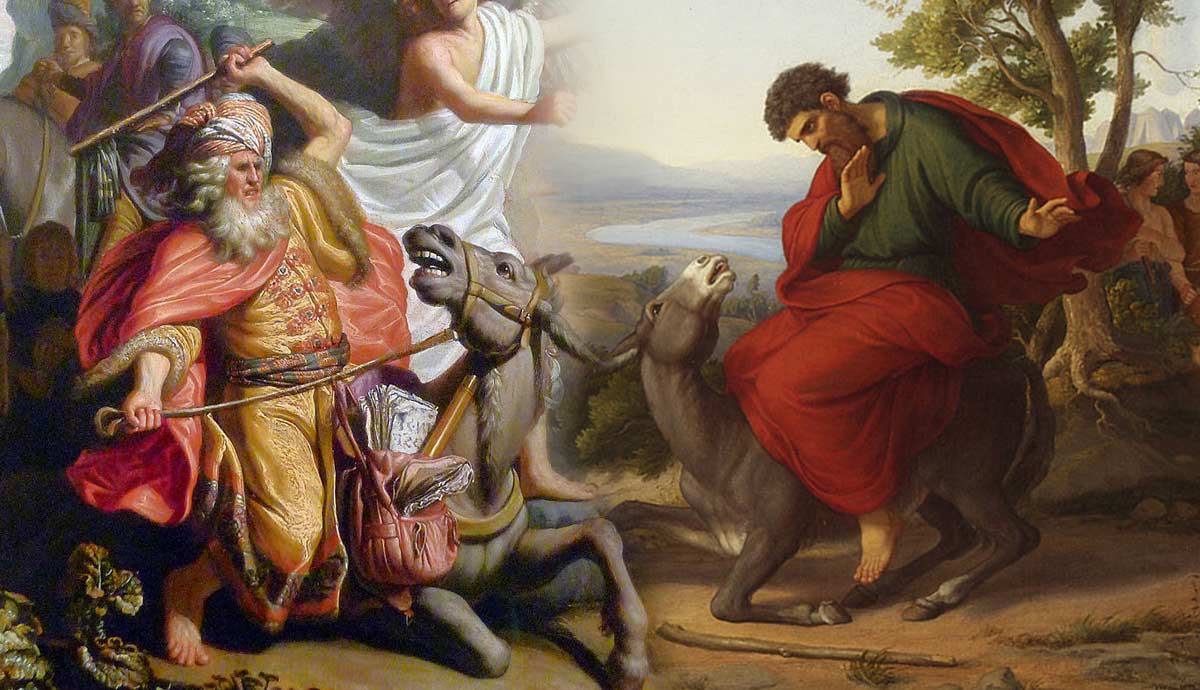 |
| Balaam and his ass |
And one of my favorite examples to demonstrate this is the strange story
of Balaam and his talking donkey. You may remember this one from Sunday
School. The story is found in Numbers 22,
but something very strange happens in a sequence of 3 verses that they
probably never pointed out to you in Sunday School. In verses 20-22, the
following progression occurs within the story:
- (verse 20) God comes to Balaam in a dream and says "go with the Midianites, but only tell them what I tell you to tell them."
- (verse 21) Balaam wakes up and goes with the Midianites.
- (verse 22) God gets angry at Balaam for doing what God told him to do.
Now as a side note, I originally posted this article in another forum. And in that forum, one user tried to argue with me about what I just said about the story of Balaam. His argument was that God told Balaam to go with the Midianites if they summoned him. So, this user argued, God was mad because Balaam went without being summoned. But this is such a good example of the "whack-a-mole" attitude I described, and in no small part because if you read verses 15-19 of this same story, you see that the Midianites were already there to summon him, and Balaam had told them to stay overnight with him.
But back to the concept of these writings coming from different sources - you need to understand this concept because scholars can see perspectives from different points of the progression I have described above represented in different places within the same stories at times, and it can be confusing. Sometimes these views are separated into different stories - such as when "the angel of the Lord" visits Hagar in Genesis 16, and then God seems to talk to Abram directly in the next chapter, and then in Genesis 18, three men visit Abraham directly and eat with him. And at one point in the story (verse 13), it simply says that YHWH said something to Abraham - seemingly indicating that one of the three men was YHWH in the flesh. But then there are other stories that can be very messy, and it seems like multiple perspectives are represented within the same story, indicating a process similar to the one I outlined with the story of Balaam.
But at this point I am going to stop. And like I said earlier, I plan to come back to this post periodically and update it with links to the rest of the posts so that this post can serve as a table of contents.

