Table of Contents:
Part 1: Introduction
Part 2: Two Case Studies
Part 3: Serpent = Satan?
Part 4: What is Satan's Real Name?
Part 5: Accuser
Part 6: A Son of God?
Part 7: God's State Prosecutor
Part 8: God’s Sifter
Part 9: Azazel
Part 10: Desert Temptation
Part 11: What Does a Jewish Messiah Look Like?
Part 12: Bow Down to the Domination System
Part 13: Proclaiming Jubilee
Part 14: The Evil One
Part 15: The Angels of the Nations
Part 16: The Gerasene Demoniac
Part 17: Further Lessons on Exorcism in the Bible
Part 18: Driving Satan from Heaven
Part 19: The Unveiling of the Beast of Rome
Part 20: Unveiling the Beast Today
Part 21: Jesus and the Domination System
Part 22: Violence
Part 23: Death
Part 24: The Advocate
Part 25: Conclusions?
--------------------------------------
Serpent = Satan?

One of the surprising facts a careful reader will observe when thoroughly examining the Old Testament instances where “Satan” appears is that he only appears a total of three times in the Old Testament as a character. Now, one might be inclined to argue with me here, right off the bat, and point to other supposed appearances of this character. For example, I might be told, in response, that Satan was right there in the garden of Eden - Genesis chapter 3. But a careful reading of this chapter reveals that there is actually nothing in this passage to indicate that “Satan” and “the serpent” are one and the same! The reader who insists that this is so is bringing assumptions into the text, rather than simply allowing the text to speak for itself!
What’s really interesting is that it seems that the source for this legend of the serpent being an incarnation of Satan seems to come from an apocryphal work, rather than one of the canonized scriptures. In the apocryphal “Life of Adam and Eve”, the Devil speaks with Adam, after having possessed a serpent, saying:
O Adam! All my hostility, envy, and sorrow is for thee, since it is for thee that I have been expelled from my glory, which I possessed in the heavens in the midst of the angels and for thee was I cast out in the earth.
When Adam questions what the Devil means by this, the Devil then tells a story of how, after the creation of Man (made in the image of God), the Archangel Michael brought all the angels out and told them to “Worship the image of God the Lord.” But the Devil replied:
“I have no (need) to worship Adam." And since Michael kept urging me to worship, I said to him, "Why dost thou urge me? I will not worship an inferior and younger being (than I). I am his senior in the Creation, before he was made was I already made. It is his duty to worship me."
When the other angels see this exchange, the story goes on to say that some joined the Devil in this rebellion, and it was because of this incident that they were cast out of Heaven. And later on, the Devil says to Adam:
And with guile I cheated thy wife and caused thee to be expelled through her (doing) from thy joy and luxury, as I have been driven out of my glory.
This seems to be the source of the idea that the serpent and Satan are one and the same - but this is not only an Apocryphal book, but was also written much later in time: scholars date the written sources available to us somewhere between the 3rd and 5th century, but believe that the tradition goes back to the 1st century A.D.
But without this context, there is nothing within the canonized Scriptures to indicate that Satan and the serpent in Genesis 3 are the same - the serpent seems to be nothing more than the animal we know by the same name!
Similar to the “Life of Adam and Eve” story, there are two pseudepigraphical works attributed to Enoch which have stories that sound similar to this mythological story of the fall of Satan and his demons. Now, the first Book of Enoch was originally contained within the collection which became our modern Bible, but was later removed. But scholars believe that it was not only considered to have been scripture in Jesus’ time, but also believed at that time to have actually been written by Enoch.
In the first book attributed to Enoch, a group of angels sees that women are beautiful, and proceeds to mate with them - producing children who were “great giants” (which, interestingly enough, is very similar to the brief mention of the Nephilim in Genesis 6:4).
 |
| A depiction of the Nephilim |
Later on, in chapter 10 of the Book of Enoch, it says:
And the Lord said unto Michael: "Go, bind Semjaza and his associates who have united themselves with women so as to have defiled themselves with them in all their uncleanness. And when their sons have slain one another, and they have seen the destruction of their beloved ones, bind them fast for seventy generations in the valleys of the earth, till the day of their judgement and of their consummation, till the judgement that is for ever and ever is consummated. In those days they shall be led off to the abyss of fire: and to the torment and the prison in which they shall be confined for ever."
Also, in the second book of Enoch, there is a very brief mention of a story which bears a resemblance to this myth in 2 Enoch 29:3-4:
And one from out the order of angels, having turned away with the order that was under him, conceived an impossible thought, to place his throne higher than the clouds above the earth, that he might become equal in rank to my power. And I threw him out from the height with his angels, and he was flying in the air continuously above the bottomless.
And perhaps even more interesting is the similarity between the myth presented in these three works and a similar story which appears in Qur’an 2:34:
And [mention] when We said to the angels, "Prostrate before Adam"; so they prostrated, except for Iblees. He refused and was arrogant and became of the disbelievers.
But as these are all apocryphal, I would wonder if we ought to take these stories as doctrine, or literature? And I would question if these stories were even meant to be taken as concrete history, or as a story illustrating spiritual principles?
 |
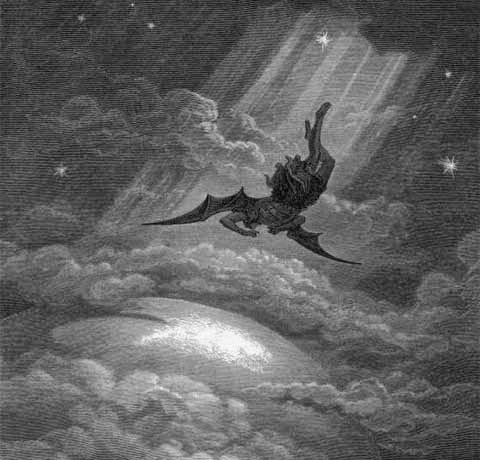
| A depiction of Satan and his angels being cast from Heaven |
Whatever the case, it would be my argument that there is nothing within Genesis itself to indicate that the serpent and Satan are one and the same - which is interesting to note, considering that so much of our children’s Sunday School material on this story seems to be dedicated to promoting this extracurricular myth. Why is it that we seem to be insisting that other, non-canonical works must speak for Genesis rather than letting Genesis speak for itself without a filter?
Dualism: The Source of Evil
I believe that the true meaning of Genesis 3 is often obfuscated by the idea that the serpent is a personality of pure evil whom rivals God. I believe that a much different meaning to the story is revealed if we dedicate ourselves to allowing Genesis 3 to speak for itself without filtering it through the lens of other works. A careful examination of the original language helps to reveal this meaning.
When we filter Genesis 3 through the lens of the mythology of Satan, we often hear a message that seems to say that God does not appreciate critical thinking - He doesn’t want us to ask questions, He doesn’t want us to seek knowledge, knowledge is bad, etc. I’ve heard sermons that seemed to promote this idea - if anything outside of our way of thought seems to contradict our way of thought, don’t listen! They are the servants of Satan and are only trying to deceive us! There is a name for this type of religious thought: cult.

But a careful reading of this passage and the context of the larger creation story will raise a curious question: why is the tree - the fruit of which God prohibited that they eat - called the tree of the knowledge of good and evil? If you’ve been paying attention, the creation of God is good. Everything God makes within the account is good. Adam and Eve were surrounded by good - they didn’t need to eat fruit to have a knowledge of good, they just had to look around! So why isn’t this tree just called “the knowledge of evil”?
But I believe that this is a major clue to the nature of what sin/evil is, at a metaphysical level. And there is a second clue which appears immediately after Adam and Eve eat of the tree - they begin to play the blame game. When God asks Adam and Eve why they’ve been hiding, they begin to point the finger outward in an attempt to displace blame - Adam even implicates God Himself: “the woman you put here with me….”
When you think about the categories of “good” and “evil”, how is it that we are naturally inclined to categorize things into these bins? Don’t we usually assume that we - and everyone within our tribe - are wholly “good”, and anyone who disagrees with our tribe is wholly “evil”? Don’t we usually displace all “evil” from ourselves and try to pin it outside of anything that resembles us? “We” are always “good”, whilst “they” are always “evil”. Here we see the birth of the scapegoat mechanism - the inclination to blame something outside of ourselves for the fact that we feel unfulfilled.
But before Adam and Eve ate the fruit, there were no tribes. There was only one tribe – those created by God! And there is still only one tribe, in reality – we’re all created by God, and are all related to each other in reality! Tribes are artificial categorizations our fallen minds came up with! So when you think of it this way, you realize that evil is not a "something" but rather it is an illusion! Because if everything God created is good, then there is no "us" and "them" - we are all loved by God!
This fits in very nicely with metaphorical imagery in the Bible of light and dark, such as when the devil is described as the "prince of darkness" or the "father of lies" (John 8:44), and Jesus is described in John 1:5 as a light shining in darkness - darkness is not a something, but is rather an absence of something! And thus we find that evil is a lie, and the way to combat it is with the truth - once the truth is injected, that illusion is gone and "evil" ceases to be!

A careful study of the original language of this passage reveals that it was indeed a message about the dangers of dualistic modes of thought: the original Hebrew words translated as "good" and "evil" - tov and ra‘ - are a bit more nuanced. Strong's Hebrew dictionary has at times defined them as functional and dysfunctional (or "non-functional" - though ra‘ can also mean "unpleasant", "harmful", and could even have to do with adversity, which as you will see throughout this series ties in to the concept of ha satan). Furthermore, when scholars examine Aramaic translations of this passage, the word in this passage that is translated as “good” - tava - meant “ripe”, “mature”, or “in harmony and in rhythm” (often used this way to speak of being in harmony and rhythm with the earth). Likewise, the Aramaic word translated as “evil” - bisha - meant “unripe”, “immature”, or “out of harmony and rhythm”. It is because of these clues that I believe the writer is using a Hebrew pun here. To illustrate - try imagining if the English translation were "the Tree of the Knowledge of Good and Bad", rather than "Evil". And then try further illustrating the point by calling it "the Tree of Good Fruit and Bad Fruit" - "bad", in the context of "fruit", does not mean the same thing as "evil". Bad fruit may be either unripe fruit or spoiled fruit - neither of which is evil. Both unripe fruit and spoiled fruit have a purpose - one will mature to become good fruit, and the other may be used as fertilizer for the seeds which will one day grow into a plant which produces more good fruit.
The tree’s fruit was not evil - it was unripe: not ready for consumption. God wisely warned Adam and Eve not to eat this fruit because it was not ready for consumption. And instead of understanding His command as coming from a good and loving God, Adam and Eve believed God was trying to keep good things from them. They created an idol out of this prohibition - thinking that by eating of the tree, they would become like God. This should be obvious to us due to the fact that the sacred object which was believed to be the source of godhood was so mundane - it was a piece of fruit! Christians often miss how important the sin of idolatry is in the worldview of Judaism - Pamela Eisenbaum points out in "Paul Was Not a Christian: The Original Message of a Misunderstood Apostle":
Idolatry is the Jewish equivalent to the Christian concept of original sin in that it is the first and primary cause of every other sin. Hence tirades against idolatry in Jewish sources portray idolatry as inevitably leading to every other kind of sin and debauchery: “For the worship of idols…is the beginning and cause and end of every evil” (Wis 14:27).
So Adam and Eve sought ultimate fulfillment in this ordinary object - this idol - but when they discovered their expectations to be a disappointment, they had already entered into dualistic thought by believing that their lives were lacking and that by obtaining a magical object outside of themselves they would achieve a higher state of being - and in this mode of thinking, when the magical object fails to fulfill, they subconsciously realized that the blame for their unfulfilled state truly rested within. But this is not a comfortable feeling, and so Adam and Eve tried to displace the blame by projecting it without, and so they each choose Scapegoats.
It is interesting to note that modern scholarship has revealed parallels between this story from Genesis and the ancient mythology of some of the surrounding cultures. One parallel of particular interest was brought to my attention by Gary Greenberg, president of the Biblical Archaeology Society of New York, in his book "101 Myths of the Bible":
In the Egyptian [Coffin Text 80], Nun (the personification of the Great flood) urged Atum (the Heliopolitan Creator) to eat of his daughter Tefnut, giving him access to knowledge of moral order. In Genesis, God forbade Adam to eat from the Tree of Knowledge of Good and Evil, denying him access to moral knowledge.
Further on, Greenberg writes:
The Hebrew story is actually a sophisticated attack on the Egyptian doctrine of moral order leading to eternal life. It begins by transforming Life and Moral Order from deities into trees, eliminating the cannibalistic imagery suggested by Atum eating of his daughter. Then, Adam was specifically forbidden to eat the fruit of Moral Order. Next, Adam was told that not only wouldn’t he achieve eternal life if he ate of Moral Order but that he would actually die if he did eat it. Finally, Adam was expelled from the Garden before he could eat from the Tree of Life and live for eternity.
If you think about it in light of this parallel, the Hebrew story of the tree of the knowledge of Good and Evil is, thus, one of the oldest attacks against Gnosticism (the idea that having the right knowledge will bring salvation, and that those without this knowledge will perish - declared a heresy by the early church). Even today, many Christians still believe that having the right doctrine in their head will bring them salvation, while those who do not believe the right things will burn in hell for eternity. We still seek artificial ways of categorizing parts of humanity into buckets of good and evil - we still seek ways of creating separation into artificial tribes.
There is an additional clue in this story about the nature of this tree and its fruit. If we flip backwards to Genesis 2:9, it says that when God "made to grow every tree", "the tree of life also in the midst of the garden, and the tree of the knowledge of good and evil."
Note the somewhat awkward formulation of this sentence - it describes
the location of the tree of life, but then tacked on to the end of the
sentence is "and the tree of the knowledge of good and evil",
with no verb and no description of its location. And then when Eve
relates the commandment not to eat of the tree of the knowledge of good
and evil when she is talking to the serpent, she says in Genesis 3:3: "You shall not eat of the fruit of the tree that is in the middle of the garden[....]"
This puts the tree of the knowledge of good and evil in the same
location as the tree of life. What if this was not two trees, but the
same tree, and the sin had more to do with how Adam and Eve related to it? Rather than relating to the tree and its fruit as a source of life and connection, they are seeing it in terms of utility and what they can gain from it. And when we approach life itself in this way, we cease to see the goodness and beauty of life itself.
When Jewish Rabbis approach this verse, they often point out that Proverbs 3:18 says
that wisdom is the tree of life, and this verse is often read before
reading from the Torah, implying that Jewish people think of the Torah
as the tree of life - and it is also their source of morality, making it
simultaneously the "tree of knowledge of good and evil." But what if
this story is trying to tell us that "knowledge" that sees things in black and white dualism isn't really wisdom at all?
Before eating of the tree, the universe was One. Man tended the Garden, and the Garden tended to the needs of Man. All things were connected.

But after entering into dualism, the Garden ceased to be benevolent - it now became adversarial. “By the sweat of your brow” is the curse. Are we to understand that work did not cause sweat before this moment? Did Adam sit down in his recliner and watch the Garden tend itself whilst enjoying a beer? I think not! But rather, after entering into dualistic thought, work was no longer fulfilling and purpose-driven - it was a task which was endured and suffered whilst imagining some form of "better life". And at the same time, the Garden was no longer something that Man had a symbiotic relationship with - it became a resource which Man exploited without any regard for the consequences. And as a result of this new kind of relationship with the Garden, the relationship with Nature ceased to be benevolent, but instead became a fearful, distrusting relationship.
This even spills over into Man's relationship with God - after dualistic thought entered the picture, Man perceives God differently. I believe that after entering into dualistic thought, Adam begins to interpret God through the lens of his own understanding, as do we all. It is often difficult for us to imagine a being that is outside of or greater than our own being, and so we all too often imagine another's intentions and actions as if they had the same thoughts and intentions as our own. In other words, Man fashions God in Man's own image, but is always at least subconsciously aware of the fact that by defining God in Man's own image, God has become distant and unavailable. This is not from God's doing, but because Man is looking in all the wrong places for the wrong thing - it is as if Man were holding a "Wanted" poster with the wrong picture, and missed out on the reward that was right in front of him.
Greg Boyd sums up the symbolism of the fruit of the Tree of the Knowledge of Good and Evil this way, in his book "Benefit of the Doubt: Breaking the Idol of Certainty":
[T]he forbidden tree was meant to serve as a sort of “No Trespassing” sign. It was God’s warning, placed in the garden out of love, not to try to take on God’s role of defining and judging good and evil. God was essentially saying, “Your job is to love like I love, not judge like only I can judge. And to do the first, you can’t do the second.” When non-omniscient beings like us start to judge, we stop loving and begin to look more like Pharisees, who reflect the character of their “father,” “the Accuser” (Rev. 12: 10, cf. John 8: 44), than like Jesus, who reflects the loving character of his Father and the character that all humans are supposed to reflect.
Understanding how dualism changes our perceptions and in so doing, damages our relationships dramatically reshapes the understanding of sin - sin is not merely a transgression against a rigid checklist of do’s and don’ts. Rather, sin is a transgression against the universal goodness of God’s creation by separating a piece of that goodness off into a category of “evil”, and thus denying relationship. And the reality of sin is that when we attempt to categorize others into “evil”, we actually cut ourselves off from the experience of God (see Mt. 25:45). We become the separated, and end up in a spiral where we try to solve our problem of separation through more separation. Unfortunately, Protestant theology all too often turns God into the one causing the separation - God is said to be unable to even look at us disgusting and totally depraved human beings. But this idea is actually seen as a heresy in the Orthodox church. In the Orthodox expression of sin and separation, it is not God who turns God's back on us, but we who turn our backs on God (see this illustration with chairs). Since "God is light and in him there is no darkness" (I John 1:5), the shadow we experience after entering into a state of sin is not because God turned God's back, but because we turned our back - we cause the shadow, not God.
When you begin to understand this reading of Genesis 3, you realize that the serpent cannot be a creature of pure evil - evil did not even exist before dualistic thought entered the picture! And when you realize this, you can avoid problems like: why would God allow His children to hang around unsupervised with the most evil being to ever exist? Wouldn't this make God the most irresponsible parent ever?
No, if the serpent in the story is meant to be taken as a literal serpent, it was a child just like Adam and Eve - an inquisitive, naive, ignorant child. When a loving parent tells a child not to put their hand on the stove, sometimes the child does not understand why the parent is giving this command - they wonder if perhaps the parent is keeping the child from some grand experience. But when the child puts her hand on the stove anyways, the parent does not then categorize this child as “evil”. The child made a poor decision, but this does not prevent them from ever making another good decision as long as they live. And yet this is the moral some Christians take from the story - that once these inquisitive, naive, ignorant children ate a piece of unripe fruit, they magically lost the capability to ever make another good decision ever again. And this becomes a bitter self-fulfilling prophecy.
There remains, however, the possibility that once again we are missing a Hebrew pun, because we are unfamiliar with the multiple meanings of the word used here for "serpent". You see, the word we translate as "serpent" - nachash - is not only translated as "serpent", but it also can be translated as a "hiss". Interestingly enough, the same word has been used in some cases to describe divination - sorcery, and the supposedly magic words used to cast spells. So the author could be playing on the double meaning - Adam and Eve heard a hiss, which was a voice in their own heads. Later on, they blame this hiss on a living serpent. Then, God "curses" the serpent by declaring that it will do what it's always done from the beginning of time - crawl on it's belly (in other words, the author put a joke into the story). But now that Adam and Eve are scapegoating, they believe that the crawling on the belly - which is the way God designed things from the start - is a sign of evil.
Another issue with the common interpretation of the serpent as evil incarnate tempting Adam and Eve to eat the fruit and bring evil into the world is the idea that the fruit of the tree itself was evil - if this was so, doesn't this make God evil for putting the tree there in the first place? Why would a good parent put evil within reach of their children? Regarding the idea that creation was perfect until the fruit of the tree was eaten - wouldn't this be like believing that God put a nuclear self destruct button in the middle of the garden and put no safeguards around it? Again, wouldn't this make God an incredibly irresponsible parent?
However, it is interesting to note that this is not the view that many ancient church fathers took. Gregory of Nazianzus wrote in Oration 45 of "On Easter":
God had not planted it originally for the undoing of man and it was not
out of jealousy that God forbade him to go near it - let not the
enemies of God intervene here; let them not imitate the serpent - no,
it was of his goodness, if this prohibition be understood rightly. For
that tree was, to my mind, the tree of contemplation, which only those
could enter into without harm whose spiritual preparation had reached
sufficient perfection. On the other hand, that tree could only be a
source of misfortune for souls as yet too coarse, endowed with too
bestial an appetite, just as solid food is harmful to babies who still
need milk.
I do not believe the fruit of the tree itself introduced evil into creation. I believe, rather, that it was man's accusing inner voice which did this. Scholars
Amy-Jill Levine and Douglas A. Knight - in "The Meaning of the Bible: What the Jewish Scriptures and Christian Old Testament Can Teach Us" - point out another pun which
strengthens this connection between serpent and inner voice I am making (it is important to note here that the original Hebrew did not contain vowels - these were added later):
The snake is described as arum, a Hebrew term usually translated “crafty” (Gen. 3:1). The human couple are described as arumim (plural), translated “naked” (3:7, 10, 11). The consonants are the same. The connection between the snake and the people is thus a visual and aural one, and it is fully lost in the English translation.
When we turn the serpent into Satan - our icon of pure evil who functions as the ultimate scapegoat - we ironically enter into the very same dualistic thought patterns that the passage is a warning against! Because when we start to categorize the other as “evil”, we end up harming ourselves - we begin to try to destroy the other in an attempt to protect ourselves, but in doing so we give rise to the very evil that causes us harm! We cut ourselves off from life-giving relationships in the name of our fear of the other, and in so doing we inflict self-harm!
This is not a theory I am just inventing, either - when Jesus taught to love enemies in Matthew 5:43-48, he was teaching that his disciples are not allowed to have enemies. Because how can we call a person we love our enemy? They may continue to call us their enemy, but we can no longer call them “enemy”. And when Jesus taught that the law is kept by love of God and loving our neighbor “as yourself”, Jesus was asked “who is my neighbor?” In response, Jesus told a story where a religious and cultural “other” - one who would have been seen as an enemy to a Jew in that culture - was the one who acted as a neighbor. Jesus is revealing that dualism is not the answer - dualism is the problem.
The Apostle Paul picked up on Jesus' annihilation of dualistic labels for those who are considered "other" when he wrote in Galatians 3:28:
There is neither Jew nor Gentile, neither slave nor free, nor is there male and female, for you are all one in Christ Jesus.
These labels Paul writes about here were the dominant religious, economic/political, and biological categories of his day. And Paul is saying that in Christ, we are not to label people through religious, economic, political, or biological categorizations any more. In Christ, there are no labels - only unconditional love.
In "The Lucifer Effect", Phillip Zimbardo - a psychologist and professor emeritus at Stanford University, famous for his Stanford prison experiment (which we'll talk about more later) - writes about how the dualism of good and evil actually masks the complex factors that contribute to a problem:
Upholding a Good–Evil dichotomy also takes “good people” off the responsibility hook. They are freed from even considering their possible role in creating, sustaining, perpetuating, or conceding to the conditions that contribute to delinquency, crime, vandalism, teasing, bullying, rape, torture, terror, and violence.
He writes of how the individualistic societies of the West, when seeking to understand how horrible events occurred, "begin their quest for understanding with the “Who questions”: Who is responsible? Who caused it? Who gets the blame? and Who gets the credit?" He then points out that psychologists have a completely different starting point:
Social psychologists (such as myself) tend to avoid this rush to dispositional judgment when trying to understand the causes of unusual behaviors. They prefer to begin their search for meaning by asking the “What questions”: What conditions could be contributing to certain reactions? What circumstances might be involved in generating behavior? What was the situation like from the perspective of the actors? Social psychologists ask: To what extent can an individual’s actions be traced to factors outside the actor, to situational variables and environmental processes unique to a given setting?
In similar fashion, scholars Miguel De La Torre and Albert Hernandez write in "The Quest for the Historical Satan":
Blaming Satan for the horrors of the Holocaust, or for the terrors of 9/11, has the tendency of acquitting thoughtless "normal" people from responsibility, people who fail to see the everyday immorality of social structures and indifference to human suffering.
When we remove dualistic thought that leads us to look for a scapegoat to blame, we can begin to see that the sources of a problem are a bit more complex - that there are factors which all contribute to a problem. And when we do this, we may be less prone to attack each other, because we will realize that situations contribute to behavior. This can lead to greater humility - as my childhood church community used to say: "there but for the grace of God go I."
But even more than this, we can learn not to identify evil with a person - evil is not that person's identity, but is merely an unhealthy response to a bad situation. In "New Seeds of Contemplation" (have you figured out that this is my favorite book yet?), Thomas Merton writes of how a saint judges no one:
The saint knows that the world and everything made by God is good, while those who are not saints either think that created things are unholy, or else they don't bother about the question one way or another because they are only interested in themselves.
The eyes of the saint make all beauty holy and the hands of the saint consecrate everything they touch to the glory of God, and the saint is never offended by anything and judges no man's sin because he does not know sin. He knows the mercy of God. He knows that his own mission on earth is to bring that mercy to all men.
What Merton is saying is actually a very old view as well - it's called privatio boni. And while I disagree with him on many other subjects, this is one area where I actually agree wholeheartedly with St. Augustine:
And in the universe, even that which is called evil, when it is regulated and put in its own place, only enhances our admiration of the good; for we enjoy and value the good more when we compare it with the evil. For the Almighty God, who, as even the heathen acknowledge, has supreme power over all things, being Himself supremely good, would never permit the existence of anything evil among His works, if He were not so omnipotent and good that He can bring good even out of evil. For what is that which we call evil but the absence of good? In the bodies of animals, disease and wounds mean nothing but the absence of health; for when a cure is effected, that does not mean that the evils which were present—namely, the diseases and wounds—go away from the body and dwell elsewhere: they altogether cease to exist; for the wound or disease is not a substance, but a defect in the fleshly substance,—the flesh itself being a substance, and therefore something good, of which those evils—that is, privations of the good which we call health—are accidents. Just in the same way, what are called vices in the soul are nothing but privations of natural good. And when they are cured, they are not transferred elsewhere: when they cease to exist in the healthy soul, they cannot exist anywhere else.
Serapion also shared this view, and says of evil:
It is of itself nothing, nor can it in itself exist, or exist always; but it is in process of vanishing, and by vanishing proved to be unable to exist.
In my next post, we will examine another myth which has been equated with Satan.
Note: After publishing this post, I later read a book called "The Science of Evil: On Empathy and the Origins of Cruelty", and wrote a later post summarizing the book and how it connects to these ideas. That post is a good follow up to this one, and I suggest that new readers check it out before moving on to Part 4.
--------------------------------------
Table of Contents:
Part 1: Introduction
Part 2: Two Case Studies
Part 3: Serpent = Satan?
Part 4: What is Satan's Real Name?
Part 5: Accuser
Part 6: A Son of God?
Part 7: God's State Prosecutor
Part 8: God’s Sifter
Part 9: Azazel
Part 10: Desert Temptation
Part 11: What Does a Jewish Messiah Look Like?
Part 12: Bow Down to the Domination System
Part 13: Proclaiming Jubilee
Part 14: The Evil One
Part 15: The Angels of the Nations
Part 16: The Gerasene Demoniac
Part 17: Further Lessons on Exorcism in the Bible
Part 18: Driving Satan from Heaven
Part 19: The Unveiling of the Beast of Rome
Part 20: Unveiling the Beast Today
Part 21: Jesus and the Domination System
Part 22: Violence
Part 23: Death
Part 24: The Advocate
Part 25: Conclusions?