This is part of an ongoing series of blog posts, meant to be read in order. In the first
post, I introduced the concept of Universalism, and introduced the concept
that I would be defending my position through a series of "chess
moves". I mentioned that I believe I have checkmate in 2 moves, but
because a lot of questions would be left, I would use a series of further moves
to keep the king in checkmate while I systematically removed the rest of the
pieces from the board. I would highly suggest you read the previous parts
of this series before reading this one:
Part
1: Moves 1-3
Part
2: Moves 4-5
Part
3: Moves 6-7
Part 4: Move 8
Part 5: Moves 9-10
Part 6: Move 11
Part 7: Move 12
Part 8: The Six Line Narrative
Part 9: Two False Gospels, and a Man in a Pit
Part 10: Creation/Fall and Spirit/Soul/Body
Part 11: The True Gospel
Part 12: Deconstructing Our Ideas of Heaven
Part 13: Resurrection and "Spiritual" Bodies
Part 14: A New Diagram
CONCLUSION
So now we have arrived at the final section of this exploration – now we test the fruits.
Let’s start by analyzing the fruits of our attitudes toward Creation if we believe in the Six Line Narrative.
Creation/Heaven Fruits
Let’s start by asking: what are the fruits of the attitude towards creation that says that it is inferior and evil? David C. Barker of the University of
Pittsburgh and David H. Bearce of the University of Colorado put together some
research, presented in this article, demonstrating that belief in the biblical end-times was
a motivating factor behind resistance to curbing climate change. A couple quotes from the article to consider:
[T]he fact that such an overwhelming percentage of Republican citizens profess a belief in the Second Coming (76 percent in 2006, according to our sample) suggests that governmental attempts to curb greenhouse emissions would encounter stiff resistance even if every Democrat in the country wanted to curb them,” Barker and Bearce wrote in their study, which will be published in the June issue of Political Science Quarterly.
Then, later on in the same article:
[I]t stands to reason that most nonbelievers would support preserving the Earth for future generations, but that end-times believers would rationally perceive such efforts to be ultimately futile, and hence ill-advised,” Barker and Bearce explained.
In a survey done for the American Geophysical Union in 2009 by researchers for the University of Illinois in Chicago, 3,146 scientists were asked two
questions:
- Have mean global temperatures risen compared to pre-1800s levels?
- Has human activity been a significant factor in changing mean global temperatures?
The results of this survey found that about 90 percent of the scientists
surveyed agreed with the first question, and about 82 percent with the
second. Furthermore, a subsample of the
survey of climate scientists showed that about 97 percent agreed that the
temperature has risen for the first question, and about 98 percent answered yes
to question number 2. Meanwhile, only
“fifty-two percent of Americans think most climate scientists agree that the
Earth has been warming in recent years, and 47% think climate scientists agree
(i.e., that there is a scientific consensus) that human activities are a major
cause of that warming, according to recent polling.” (Quoted from the same study.) Leading Evangelical theologian Mark Driscoll said at Catalyst (a major Christian conference) in 2013:
I know who made the environment and he’s coming back and going to burn
it all up. So yes, I drive an SUV.
Basically, those who believe that God is going to throw away creation in the end don’t believe they need to be good stewards of that creation, and don’t feel any need to live responsibly. Their rapture theology is an excuse for apathy.
Conversely, if you believe God actually cares about His creation, and that it is precious because it declares the glory of God, then you will be motivated to live more responsibly towards the environment. The fruits of rapture theology are apathy and destruction of creation, but the fruits of a proper theology towards creation are living responsibly and caring for God’s wonderful creation that He has
given us to enjoy.
N.T. Wright, in “Surprised By Hope: Rethinking Heaven, the Resurrection, and the Mission of the Church”,
said about rapture theology:
Note, though, something else of great significance about the whole Christian theology of resurrection, ascension, second coming, and hope. This theology was born out of confrontation with the political authorities, out of the conviction that Jesus was already the true Lord of the world who would one day be manifested as such. The rapture theology avoids this confrontation because it suggests that Christians will miraculously be removed from this wicked world. Perhaps that is why such theology is often Gnostic in its tendency towards a private dualistic spirituality and towards a political laissez-faire quietism. And perhaps that is partly why such theology with its dreams of Armageddon, has quietly supported the political status quo in a way that Paul would never have done.
This quote brings up an interesting point about the New Testament – there was a lot of political language throughout! For example, in Colossians 1:15-20, Paul uses political
language that is lost on us today:
15 Christ is the visible image of the invisible God.
He existed before anything was created and is supreme over all creation,
16 for through him God created everything
in the heavenly realms and on earth.
He made the things we can see
and the things we can’t see—
such as thrones, kingdoms, rulers, and authorities in the unseen world.
Everything was created through him and for him.
17 He existed before anything else,
and he holds all creation together.
18 Christ is also the head of the church,
which is his body.
He is the beginning,
supreme over all who rise from the dead.
So he is first in everything.
19 For God in all his fullness
was pleased to live in Christ,
20 and through him God reconciled
everything to himself.
He made peace with everything in heaven and on earth
by means of Christ’s blood on the cross.
This was a very politically subversive message – in Rome at the time,
Christianity was a very small percentage of the population. But Paul is
turning things around in verses 16 and 17 by saying that, because – through
Christ – God created everything, Rome is just a small piece of God’s
kingdom. Then Paul says that Christ is the “head of the assembly” (note:
many translations use the word “body”) in verse 18 – this was political
language. In Roman, their legislative branch was known as the “assembly” and Caesar was the head of it. This language is all too often lost on us today, and it is to our detriment as we seem to believe church is all about singing songs and
praying. Which I’m not knocking – those things are beneficial. But that’s not the end goal – the goal is to be a citizen of God’s kingdom, and to act as if we have responsibilities to inaugurate His kingdom on earth.
You see, because we believe in “heaven escapism” we push passages like Isaiah 2:4 into the future and think we have no
responsibility for it:
The Lord will mediate between nations
and will settle international disputes.
They will hammer their swords into plowshares
and their spears into pruning hooks.
Nation will no longer fight against nation,
nor train for war anymore.
Do you understand the imagery of hammering swords into plowshares and
spears into pruning hooks? What that means, as citizens of the Kingdom of
Heaven, is that we are supposed to turn away from instruments of destruction
and violence and turn towards instruments of cultivation, and we ought to
encourage everyone in the world to do the same, since “the earth is the Lord’s,
and everything in it.” (Psalm 24:1 and I Corinthians 10:26) So, in
the world of “heaven escapism”, prophesies are read and there is no purpose for
them except to give us a nice picture of what the future will look like in
heaven. But within the story of God
establishing His kingdom on earth through Jesus, we read prophesies of that kingdom
and wonder if perhaps we should be working towards achieving them as goals for
the establishment of God’s kingdom. In
the world of “heaven escapism”, the only role of the church is to sing pretty
spiritual songs and preach sermons every Sunday, and that’s it. But within the story of God establishing His kingdom on earth through Jesus, the role of the church is to be a body of
believers who go forth into the world and do work for the kingdom – the fruit
of this story is holy activism based on compassion.
Time for another break. When we continue, I will explore the fruits of believing in eternal conscious torment.
Next: Hell Fruits
This is part of an ongoing
series of blog posts, meant to be read in order. In the first
post, I introduced the concept of Universalism, and introduced the concept
that I would be defending my position through a series of "chess
moves". I mentioned that I believe I have checkmate in 2 moves, but
because a lot of questions would be left, I would use a series of further moves
to keep the king in checkmate while I systematically removed the rest of the
pieces from the board. I would highly suggest you read the previous parts
of this series before reading this one:
Part
1: Moves 1-3
Part
2: Moves 4-5
Part
3: Moves 6-7
Part 4: Move 8
Part 5: Moves 9-10
Part 6: Move 11
Part 7: Move 12
Part 8: The Six Line Narrative
Part 9: Two False Gospels, and a Man in a Pit
Part 10: Creation/Fall and Spirit/Soul/Body
Part 11: The True Gospel
Part 12: Deconstructing Our Ideas of Heaven
Part 13: Resurrection and "Spiritual" Bodies
A Better Diagram
So one might ask me: “if the Six Line Narrative diagram is not accurate, what would a better diagram
of the Biblical narrative look like?”
Before I even attempt to answer that question, it is important to note
that no diagram can ever do the Biblical narrative justice. One of the reasons for this is that we simply
cannot grasp concepts that regard the future – as N.T. Wright says:
All Christian language about the future is a set of signposts pointing into a mist.
When we try to grasp a hold of what exactly “the kingdom of God” is, we often are simply asking the wrong questions. It’s like asking “what does Jazz music smell like?” or “how does yellow sound?” And
perhaps this is why Jesus told so many stories to illustrate what the kingdom of God is like. And so, before I present some ideas of what a proper diagram would look like, I must point out the severe limitations of such an exercise.
With that being said, let’s start with three spheres.
This is how most people imagine our reality to be like. They imagine the realms of Hell, Earth, and Heaven to be entirely separate from each other, and imagine souls being transferred from Earth to either Hell or Heaven upon exit. So the first thing we must do to this diagram is to point out a flaw. I propose that
Hell is not a separate realm at all, but is in fact a manifestation of the results of sin. In his book “New Seeds of Contemplation”, Thomas Merton writes:
Hell is where no one has anything in common with anybody else except the fact that they all hate one another and cannot get away from one another and from themselves.
They are all thrown together in their fire and each one tries to thrust the others away from him with a huge, impotent hatred. And the reason why they want to be free of one another is not so much that they hate what they see in others, as that they know others hate what they see in them: and all recognize in one another what they detest in themselves, selfishness and impotence, agony, terror, and despair.
We see, from this description, that Hell is all too often a present reality. I am going to explore what I think Hell is in a later section, but for now I am going to leave it at this basic understanding, and propose that the realm of the sphere of Hell be superimposed on the sphere of Earth, like so:

Now before we move on to the next step, we must discuss another concept: the temple. We need to
expand our idea of “temple” from being simply a place of worship, to being a place that Deity rests within, and rules from.
A temple is a place where God’s presence comes to earth. When Jesus was present on earth, he referred
to himself as a temple when he said in John 2:19: “destroy this temple, and I will raise it again in three days.”
Now hopefully by now, you understand that “the gospel” is a message of God’s kingdom being established on earth through Jesus. And the singular defining act that proves this is so is the crucifixion and resurrection of Jesus. The story of the death and resurrection should never be separated – they belong together. Without the resurrection, Jesus’ death is meaningless. The resurrection is a sign that the kingdom of God is real and has in fact begun to break into the sphere of Earth, and Jesus’ death is the seed planted which resulted in this new life. Jesus is the way that the sphere of Heaven begins to invade the sphere of Earth, resulting in the kingdom of God. And so I propose the following diagram as a way of envisioning this concept:

But this diagram is not complete, because where the Kingdom of God breaks in, Hell is pushed out.
And so we expand the diagram like so:
Now there are some weaknesses to this diagram, because it does not convey the sense of transformation and expansion that is the very nature of the kingdom of God. Jesus’ parables about the kingdom of God often included the imagery of seeds and the plants that grew from them. In one parable, he compared the kingdom of God to a mustard seed:
Matthew 13:31b-32
The kingdom of heaven is like a mustard seed, which a man took and planted in his field. 32 Though it is the smallest of all seeds, yet when it grows, it is the largest of garden plants and becomes a tree, so that the birds come and perch in its branches.
The mystery of the kingdom of God is that as it produces new life, it not only changes that within which it was planted, but also causes it to grow and expand in a dramatic way.
This is the fundamental difference between “perfect” and “good” –
“perfect” is static and unchanging, whereas “good” continues to grow and expand
and become more good.
Another idea that I feel must be conveyed is the sense
that the church is not equal to the kingdom of God. The kingdom of God is not contained within
the church. The church is merely a vessel
through which the seeds of the kingdom of God are planted – it is a point where
the kingdom of God breaks through from the sphere of Heaven into the sphere of
earth, much like Jesus’ life, death, and resurrection was the first seed
through which the sphere of Heaven broke through into the sphere of earth. So we must learn to see the church as merely
a part of the kingdom of God, like so:
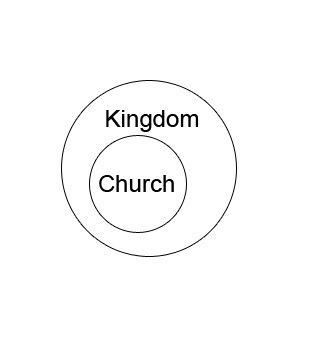
Without framing the church properly like this, we fail to
expand the kingdom of God and instead, end up forming a community removed from
the world and inaccessible to it. We
fail to expand His kingdom and instead separate us from it and the world, which
is the opposite of the way Jesus lived, and the opposite of the intention of
his teachings.
But there is another truth which must be conveyed, and that is the timeline of the kingdom of God. Living within the Six Line Narrative, one does not live in the now but rather is continually promising that which is not
currently present – an ideal and non-existent sphere of Heaven, outside of our own. The narrative of the kingdom of God changes all of that, and brings that future into now. The kingdom of God is a mystery in that it is both now and not yet – it is here, though not yet fully realized. This gives us a sense of hope which the Six Line Narrative is unable to deliver. In the narrative of the kingdom of God, we are able to see the new life that the kingdom of God is already creating and see it invading the sphere of Earth and
causing expansion. Eternal life, we learn
(though “eternal” is a mistranslation), is not a future ideal, but a present
reality, though not fully realized. In John 7:37-38, Jesus says:
Let anyone who is thirsty come to me and drink. 38 Whoever believes in me, as Scripture has said, rivers of living water will flow from within them.
Eternal life is meant to be a stream of living water
flowing through us and into the world outside, not a treasure we hoard and keep
from others for future use. In John 17:3, Jesus clearly defines eternal life as something that is not future, but available now:
Now this is eternal life: that they know you, the only true God, and Jesus Christ, whom you have sent.
Alfred Hitchcock popularized the term “MacGuffin” to
signify a plot device in the form of some goal, or other motivator that the
protagonist (and sometimes the antagonist) is willing to do and sacrifice
almost anything to pursue, protect or control, often with little or no
narrative explanation as to why it is considered so important. The most ingenious uses of a MacGuffin within
a plot are when the MacGuffin is never revealed by the end of the film. We find that the value of a MacGuffin is created by those who chase after it.
The frighteningly despairing possibility of a MacGuffin
is that the characters pursuing it may find it has no value at all, as in
"The Maltese Falcon", where at the end of the movie the Falcon is
discovered to be a fake. What's
interesting about "The Maltese Falcon" is that the characters who
profited from the Falcon were the ones who never had any intention of
possessing it at the end, while the characters who pursued it with the most
vigor were the ones who realized all their efforts amounted to loss in the
end. But the even worse possibility is
that the MacGuffin doesn't exist at all.
In the J.J. Abrams film "Mission Impossible III", the
MacGuffin is a mysterious object referred to as "the Rabbit's Foot",
and is never revealed. Various
characters are desperately seeking this unknown object throughout the movie,
and yet we never learn exactly what it is, nor do any of the characters chasing
it know of its nature: the only reason anyone desires it is because everyone
else seems to want it very badly as well.
What if Heaven were a MacGuffin? What if - by seeking it as an object outside
ourselves and in the unknown future - we can never obtain it? More frightening is the possibility: what if
it doesn't even exist?
Or...what if it did, and we discovered that it was here all along, right within our grasp? What if we found that it was within us, and all around us?
When Jesus was asked by the Pharisees when the kingdom of God would come in Luke 17:20-21, he answered:
People can’t observe the coming of the kingdom of God. They can’t say, "Here it is!" or "There it is!" You see, the kingdom of God is within you.
The apocryphal Gospel of Thomas has an interesting version of this statement:
Jesus said, "If those who attract you say, 'See, the Kingdom is
in the sky,' then the birds of the sky will precede you. If they
say to you, 'It is under the earth,' then the fish of the sea will
precede you. Rather, the Kingdom of God is inside of you, and it is
outside of you. [Those who] become acquainted with [themselves]
will find it; [and when you] become acquainted with yourselves, [you
will understand that] it is you who are the sons of the living
Father. But if you will not know yourselves, you dwell in poverty
and it is you who are that poverty."
What I believe the message of these statements was supposed to communicate is that the kingdom of God is not like human kingdoms, defined by borders, and insiders and outsiders. Rather, the kingdom of God is realized by recognizing that God loves us unconditionally and infinitely, and then realizing that this same love applies to everyone else. As the Gospel of Thomas said: it is inside of you, and it is outside of you. When we recognize the present reality of God's love for us, and our neighbors (even our enemies), and then we act upon the whispered commands of that love, we inaugurate the kingdom of God in our present reality.
We, each and every one of us, suffer from a tendency to
seek the future and place our hopes and dreams within it in a way that makes
hope unattainable. From an early age, we
say to ourselves “wait until I grow up – I will be a [fill in the blank] and
then I can really live!” This becomes
“wait until I get to junior high school – then I can really live!” Then “wait until I get to high school…”, then “wait until I get my driver’s license…”, then “wait until I graduate high
school…”, “wait until I get to college…”, “wait until I graduate college…”,
“wait until I get that job I want so badly…”.
Or maybe we’re putting our hopes and dreams into a person: “wait until I
get a beautiful girlfriend – then I can really start living!” Or perhaps we have somewhat more noble
pursuits: “wait until I have kids – then I can really start living!”
The hope that Jesus
gives us in the paradigm of the kingdom of God is that we can stop living in
the unattainable future, and start living now.
Within the kingdom of God narrative, we learn that Heaven is not a future
ideal that is outside our realm, but an existent present reality that is
continually growing and becoming more real.
Jesus says that the kingdom of God is within us. It's a heart matter: a matter of changing our hearts with the knowledge that God loves us - and our neighbors - unconditionally. The kingdom of God is not a MacGuffin. The kingdom of God presents real, tangible
hope. We see it when the love of a mother envelops her child and we hear it in the child's laughter. We see it when former enemies become friends and when people from very different traditions and backgrounds embrace. Its echoes resonate from the Civil Rights
movement and the overthrow of Apartheid in South Africa, and we are still
seeing signs of the kingdom of God breaking through into present reality
today. The kingdom of God is not a MacGuffin, and so the kingdom of God can give us real, present hope and the
promise of an even better future. The kingdom of God enables us to live in the present, and to live life to the
fullest.
But even more than this, the kingdom of God is not
achieved in the way that earthly kingdoms are achieved. Earthly kingdoms are achieved through
domination and grasping at power. But
Jesus showed that the kingdom of God is achieved in a way that contrasts the
way earthly kingdoms are inaugurated.
All of Jesus’ life was a contrast to conventional wisdom, and so it
should not be surprising that the way he died, and inaugurated the kingdom of
God, is contrasting to conventional wisdom as well. Jesus inaugurated the kingdom of God not
through force of will or domination, but by sacrifice. Jesus inaugurated the kingdom not by
displaying His power to subject others, but by using it to serve others. And in His death, Jesus inaugurated the kingdom of God by emptying himself of power.
And so we enter into the kingdom by that which is contrary to our nature
– by giving of ourselves in acts of self-emptying love.
Once again, we're going to take a break. But when we continue, we will explore the conclusion of this series - examining the fruits of a this understanding of Hell and the Kingdom of God.
Next: Conclusions
This is part of an ongoing series of blog posts, meant to be read in order. In the first
post, I introduced the concept of Universalism, and introduced the concept
that I would be defending my position through a series of "chess
moves". I mentioned that I believe I have checkmate in 2 moves, but
because a lot of questions would be left, I would use a series of further moves
to keep the king in checkmate while I systematically removed the rest of the
pieces from the board. I would highly suggest you read the previous parts
of this series before reading this one:
Part
1: Moves 1-3
Part
2: Moves 4-5
Part
3: Moves 6-7
Part 4: Move 8
Part 5: Moves 9-10
Part 6: Move 11
Part 7: Move 12
Part 8: The Six Line Narrative
Part 9: Two False Gospels, and a Man in a Pit
Part 10: Creation/Fall and Spirit/Soul/Body
Part 11: The True Gospel
Part 12: Deconstructing Our Ideas of Heaven
The Role of the Resurrection
One of the logical problems with “heaven escapism” is that it cannot explain why Jesus’ resurrection was necessary. If the whole point of being a “Christian” is
to “go to heaven”, why wouldn’t Jesus simply go to heaven after his death? One might say “to prove he had conquered death” – but if the whole point of Christianity is to leave this evil mortal plane of existence, why didn’t he simply appear to some people in a dream and
say “hey guys, I made it to heaven! See?” Resurrection has no role except “ta da!” in the realm of “heaven escapism.”
But Biblically, Jesus’ resurrection does have a role.
Remember earlier how I pointed out in Romans 8:18-27 in verse 23 the phrase “firstfruits of the Spirit”? There is another passage we’ll need to
consider before we can understand what this phrase means – in I Corinthians
chapter 15, Paul is addressing a problem within the Corinthian church where,
apparently, some have been denying that there will be a resurrection of the
dead. You see, Jews did not believe in
“heaven escapism” – Jews believed in the resurrection of the dead, and in I Corinthians 15:12-18, Paul argues that if there is no resurrection of the dead,
then Christ did not raise from the dead, “and if Christ has not been raised,
our preaching is useless and so is your faith.” (verse 14) Then Paul moves on:
20 But Christ has indeed been raised from the dead, the firstfruits of those who have fallen asleep. 21 For since death came through a man, the resurrection of the dead comes also through a man. 22 For as in Adam all die, so in Christ all will be made alive. 23 But each in turn: Christ, the firstfruits; then, when he comes, those who belong to him.
The First Fruits was a practice of offering up a grain
sacrifice after the…well…first fruits of different types of grains sprouted
up. The practice was coordinated with
various festivals and celebrations, and what is interesting is that the first
crop of barley was presented in a First Fruits offering during the Passover
festival – Jesus’ resurrection coincided with this offering! Then, another church holiday happened to
coincide with the next First Fruits offering – the first crop of wheat was
presented in a First Fruits offering at the same time as Pentacost!
As a side note, this makes Jesus’ illustration of
separating the wheat from the chaff a little more interesting, if we start to
think of it as listening to the Holy Spirit moving in our lives and separating
out the chaff of our lives.
Jesus’ resurrection
is not just a story – it has a purpose!
It is the firstfruits of God’s plan to raise the dead, as is spoken of
in Revelation! (See Revelation 20) But the meaning goes even
deeper. In John’s gospel, he carefully
lays out seven signs that Jesus is the messiah (note that not every scholar agrees about what parts of John's gospel are actually signs - John stops counting after the first few):
- Changing water into wine in John 2:1-11
- Healing the royal official's son in Capernaum in John 4:46-54
- Healing the paralytic at Bethesda in John 5:1-18
- Feeding the 5000 in John 6:5-14
- Jesus' walking on water in John 6:16-24
- Healing the blind at birth in John 9:1-7
- Raising of Lazarus in John 11:1-44
Seven signs, just like the seven days in a week. Then, Jesus dies and is resurrected on…the first day of the week. Seven signs for seven
days, and then…the beginning of a new week.
Jesus’ resurrection is the beginning of a new period of Creation!
2 Corinthians 5:17-21
17 Therefore, if anyone is in Christ, he is a new creation; old things have passed away; behold, all things have become new. 18 Now all things are of God, who has reconciled us to Himself through Jesus Christ, and has given us the ministry of reconciliation, 19 that is, that God was in Christ reconciling the world to Himself, not imputing their trespasses to them, and has committed to us the word of reconciliation.
20 Now then, we are ambassadors for Christ, as though God were pleading through us: we implore you on Christ’s behalf, be reconciled to God. 21 For He made Him who knew no sin to be sin for us, that we might become the righteousness of God in Him.
In the Six Line Narrative, there isn’t much of a purpose
for this time in between Jesus’ resurrection and the Day of Judgment. Oh, we’re supposed to “save souls”, but other
than that you just kind of sit on your butt until the end. But if you view this period of time in
between as a period of New Creation, then it completely changes how you look at
things. And what’s more, the true gospel
I told you about – the good news that God is establishing His kingdom on earth
through Jesus – doesn’t make any sense within the story that God plans to
eventually destroy the world and take everyone to heaven. But within the story of New Creation through
Resurrection, the theme of “the kingdom of God” makes a lot more sense. In his book “Surprised By Hope: Rethinking Heaven, the Resurrection, and the Mission of the Church”,
N.T. Wright wrote:
Jesus's resurrection is the beginning of God's new project not to snatch people away from earth to heaven but to colonize earth with the life of heaven. That, after all, is what the Lord's Prayer is about.
Along with the idea of “New Creation”, starting at the
symbolic “new week” – the first day of the week after the seven signs John
provides – is the idea of the purpose of the Temple. We have sort of built into our idea of modern
theology that the Sabbath is only for rest – it’s for doing nothing. But Jesus changes our ideas when he refers to
his body as a temple in John 2:19. And Paul picked up on the
connection of Jesus abiding in us (John 15:4) through the Holy Spirit, and refers to us as temples as well:
I Corinthians 16:9
Do you not know that your bodies are temples of the Holy Spirit, who is in you, whom you have received from God?
You see, the purpose of the Temple is not merely to sit. The purpose isn’t merely static. The temple is where God’s presence rests as
He continues His rule. Creation
continues from and through the Temple, and God’s presence is made known through
the Temple. Through the Temple, heaven
comes to earth. As Jesus says in Luke 17:20-21, “the kingdom of God is within you.” Once again, I go to N.T. Wright for a well
worded quote, this time from “Simply Christian: Why Christianity Makes Sense”:
Those in whom the Spirit comes to live are God's new Temple. They are, individually and corporately, places where heaven and earth meet.
Now before we move on, there is a pressing question which
may be on some of your minds if you have been living within the Six Line
Narrative for your whole life, and have been diligently trained in its ways of
thinking:
But what about Spiritual Bodies?
One passage which has caused much confusion, and been used to support the Platonian ideas of “heaven escapism”, is I Corinthians 15:35-49, where Paul draws a contrast between our “natural body” (some translation say “earthly bodies”) and the “spiritual body” we will be raised with. This conjures up – in the minds of those stuck in the Six Line Narrative – a “Casper the Friendly
Ghost” like image of our disembodied spirit leaving this earthly plane and flying up into Heaven. But in I Corinthians 15:35-49, when Paul talks about this physical body, he uses the
word “psychikos”, which does not mean anything like our word
"physical" - actually, the word "psyche" comes from this
word, and so you may correctly guess it has more to do with the mind or the
personality. But also, we need to
understand that "ikos" does not describe the material out of which
this body is made, but rather the power or energy that animates it. When those of us who have been stuck within
the Six Line Narrative read Paul drawing a contrast between the “natural body”
and the “spiritual body”, our Platonian thinking has been trained to think that
it is like asking "is this a wooden ship or an iron ship?" But rather, it is more like asking "is
this a steamship or a sailing ship?"
The word Paul uses that has been translated into "spiritual
body" in many versions, comes from the root word “pneuma”, and it means
God's breath of new life; the energizing power of God's new creation. This word is often translated as “spirit”,
but it is literally “breath” and is meant to be taken in the sense that God
breathed life into Adam in Genesis. Our
"psyche bodies" will be traded in for our "Holy Spirit
bodies".
When Paul says that "flesh and blood cannot inherit
God's kingdom", he doesn't mean physicality will be abandoned -
"flesh and blood" is a technical term for that which is corruptible,
but Paul is saying we're going to trade these bodies in for one that is
incorruptible. It's not a difference
between physicality and non-physicality, but corruptible physicality and
incorruptible physicality. In the
concluding verse of I Cor. 15, Paul is saying to be strong in what you do in the present, because
if it is influenced by the power of the Spirit, it will be reaffirmed and made
to last within the story of the establishment of God’s kingdom.
Ralph Waldo Emerson once said:
In our definitions, we grope after the spiritual by describing it as invisible. The true meaning of spiritual is real; that law which executes itself, which works without means, and which cannot be conceived as not existing.
Adding to this idea of "Heaven as a metaphor for a present reality", let's go to "Naming the Powers" by Walter Wink:
Contrary to much modern prejudice, "heaven" as used in Ephesians was already metaphorical, not spatio-literal. The physical image of heaven as "up" was a symbol, even for those times, of transcendence. But the literal pole of the metaphor had an effect on them quite different from the effect it has on us. We think of "the heavens" as vast intergalactic reaches of empty space, peppered with solar systems infinite light-years apart. As an image of transcendence it fails for us, because we take it too literally/scientifically and because it serves only to make God more remote. Their heaven, by contrast, was a local affair. The sun and the moon were very close and far smaller than we have now calculated them to be. The "air" was not emptiness, but "stuff," one of four elements out of which all things are fabricated. The firmament was a relatively narrow channel separating heaven and earth, and the contemplative or mystic could hope to bridge it. Philo describes this "flight" of the spirit: "while their bodies are firmly planted on the land they provide their souls with wings, so that they may traverse the upper air and gain full contemplation of the powers (dynameis) which dwell there" (De spec. leg. 11.45). Paul himself had traveled in ecstasy to the third heaven, although he himself is not at all clear how (2 Cor. 12:2-3). The author of the Apocalypse made a similar trip (Rev. 4:1ff.).
Once again, we're going to take a break. But when we continue, we are going to dismantle the rest of The Six Line Narrative. Here's what you have to look forward to:
Dismantling The Six Line Narrative: A New Diagram
Conclusion: Testing the fruits.
This is part of an ongoing series of blog posts, meant to be read in order. In the first
post, I introduced the concept of Universalism, and introduced the concept that I would be defending my position through a series of "chess moves". I mentioned that I believe I have checkmate in 2 moves, but because a lot of questions would be left, I would use a series of further moves to keep the king in checkmate while I systematically removed the rest of the
pieces from the board. I would highly suggest you read the previous parts of this series before reading this one:
Part
1: Moves 1-3
Part
2: Moves 4-5
Part
3: Moves 6-7
Part 4: Move 8
Part 5: Moves 9-10
Part 6: Move 11
Part 7: Move 12
Part 8: The Six Line Narrative
Part 9: Two False Gospels, and a Man in a Pit
Part 10: Creation/Fall and Spirit/Soul/Body
Part 11: The True Gospel
Deconstructing our ideas of Heaven
Now you may already be getting an uneasy feeling here – a sense that the common views on “heaven”
are incorrect. They most likely are. I believe it is a modern heresy of the
majority of Christians (in America, at least) to believe that the whole goal of
the Christian life is to lead a pious life, being careful not to associate too
much with “the world”, so that we can one day escape and “go to heaven.” “Going to heaven” is a Greek idea, not a
Christian one. It stems from Platonic
thought of this world being the cave of delusion, and the spiritual realm being
the ultimate reality – an ideal static being.
But if you try to force this view into the Bible, you run into some
problems, such as the following passage:
Acts 1:6-8
Then they gathered around him and asked him, "Lord, are you at this time going to restore the kingdom to Israel?"
He said to them: "It is not for you to know the times or dates the Father has set by his own authority. But you will receive power when the Holy Spirit comes on you; and you will be my witnesses in Jerusalem, and in all Judea and Samaria, and to the ends of the earth.”
Do you see what just happened there? Jesus was asked, in very plain language, when
the physical kingdom of Israel would be restored to them. And his reply? He didn’t say “you sillies – you’re all going
to leave this filthy mortal plane and come away to a spiritual realm; a kingdom
in the skies called Heaven! We’re going
to escape this cave of delusion!” No,
that’s not what Jesus said at all – rather than correct them in this fashion,
he said “it is not for you to know.”
Implying that the restoration of the kingdom of Israel would, in fact,
happen.
But that’s not the only passage you’re going to have problems with – try this one on for size:
Romans 8:18-27
18 I consider that our present sufferings are not worth comparing with the glory that will be revealed in us. 19 For the creation waits in eager expectation for the children of God to be revealed. 20 For the creation was subjected to frustration, not by its own choice, but by the will of the one who subjected it, in hope 21 that the creation itself will be liberated from its bondage to decay and brought into the freedom and glory of the children of God.
22 We know that the whole creation has been groaning as in the pains of childbirth right up to the present time. 23 Not only so, but we ourselves, who have the firstfruits of the Spirit, groan inwardly as we wait eagerly for our adoption to sonship, the redemption of our bodies. 24 For in this hope we were saved. But hope that is seen is no hope at all. Who hopes for what they already have? 25 But if we hope for what we do not yet have, we wait for it patiently.
26 In the same way, the Spirit helps us in our weakness. We do not know what we ought to pray for, but the Spirit himself intercedes for us through wordless groans. 27 And he who searches our hearts knows the mind of the Spirit, because the Spirit intercedes for God’s people in accordance with the will of God.
Now, most people who believe in “heaven escapism” also
believe in an apocalyptic end times scenario where this world, creation, will
be destroyed. Why would creation be
"waiting in eager expectation" for that, as it says in verse 19 of the passage
above? And how is complete annihilation
a "liberation from its bondage to decay and being brought into the freedom and
glory of the children of God", as in verse 21?
And how does the metaphor of childbirth fit this idea, as in verse 22?
But there’s another problem with the “heaven escapism”
view that is presented in this passage – see how it mentions firstfruits in
verse 23? The view of “heaven escapism”
doesn’t adequately explain what that means and how it fits into the picture…but
I’m getting ahead of myself. We’ll talk
more about firstfruits later.
Here’s another passage that is problematic for “heaven
escapists”:
Isaiah 65:17
For behold, I create new heavens and a new earth, and the former things shall not be remembered or come into mind.
New heaven and new…what?
This is not the only place this pairing appears:
Revelations 21:1
Then I saw a new heaven and a new earth, for the old heaven and the old earth had disappeared. And the sea was also gone.
Later on in the same chapter (note I switched to ESV for this one – I like that version because it uses the word “BEHOLD!” I like that.
I should say “BEHOLD!” more often.):
Revelations 21:5
And he who was seated on the throne said, "Behold, I am making all things new." Also he said, “Write this down, for these words are trustworthy and true.”
What’s all this about making ALL things new? I thought it was just going to be the
disembodied spirits/souls of us humans floating up on the clouds playing harp
music for all eternity….
Now, one might say “well, this ‘new earth’ is going to be
like, some sort of spiritual earth – up in the spiritual realm!” Well, then this next one is going to be a
little problematic for you:
2 Corinthians 5:17
Therefore, if anyone is in Christ, he is a new creation; old things have passed away; behold, all things have become new.
Ok, so if I’m a new creation NOW…and I have a body…I
thought “new creation” meant no body any more…no material….
Once again, we're going to take a break. But when we continue, we are going to dismantle the rest of The Six Line Narrative. Here's what you have to look forward to:
Dismantling The Six Line Narrative: The Role of the Resurrection
Dismantling The Six Line Narrative: But What About Spiritual Bodies?
Dismantling The Six Line Narrative: A New Diagram
Conclusion: Testing the fruits.
This is part of an ongoing series of blog posts, meant to be read in order. In the first
post, I introduced the concept of Universalism, and introduced the concept
that I would be defending my position through a series of "chess
moves". I mentioned that I believe I have checkmate in 2 moves, but
because a lot of questions would be left, I would use a series of further moves
to keep the king in checkmate while I systematically removed the rest of the
pieces from the board. I would highly suggest you read the previous parts
of this series before reading this one:
Part
1: Moves 1-3
Part
2: Moves 4-5
Part
3: Moves 6-7
Part 4: Move 8
Part 5: Moves 9-10
Part 6: Move 11
Part 7: Move 12
Part 8: The Six Line Narrative
Part 9: Two False Gospels, and a Man in a Pit
Part 10: Creation/Fall and Spirit/Soul/Body
The True Gospel
In “A New Kind of Christianity”, by Brian McLaren, he describes having lunch with
another pastor who asks him “if you were to summarize the gospel in one
Biblical statement, what would it be?”
Without any hesitation, McLaren quoted Ephesians 2:8-9: “For it is by grace you have been saved, through faith—and this is not from yourselves, it is the gift of God — not by works, so that no one can
boast.” McLaren’s friend replied:
“you’re quoting Paul. Why aren’t you
quoting Jesus?” McLaren views this point
in time as a turning point for him where he began a paradigm shift, and when I
read this story it was a similar point for me, as I would have answered in the
exact same way beforehand.
So this conversation caused a paradigm shift for McLaren. He began to see the Bible differently afterwards. In “A New Kind of Christianity”, McLaren describes how the average Christian has been
conditioned to read the bible like a lawyer – picking out single verses, out of
context, in order to prove their position.
In this method, any verse from anywhere in the Bible has the same weight as any other verse in the Bible. McLaren calls this the Constitutional method of reading the Bible, and it has
been responsible for such things as defending slavery, burning heretics at the
stake, witch hunts, and crusades.
McLaren suggests a new way of viewing the Bible. He uses two very poignant illustrations for
this method.
I like to adapt the first illustration slightly, as McLaren breaks it up into two illustrations, whereas I think it can be expressed in one clean move. In my version of the illustration, you must imagine 12 people – this would work great in a classroom
with 12 volunteers lined up at the front of the room. Each person in the line is given a sign to
hang around their neck, with the following labels (in order from left to
right):
- Adam
- Abraham
- Moses
- David
- Amos/Isaiah/Jeremiah/The Prophets
- John the Baptist
- Jesus
- Paul
- Augustine
- Luther/Erasmus
- Calvin/Wesley/Newton
- Modern theologians: Billy Graham/John Piper/N.T. Wright/etc.
Now, some people take a look at this lineup, and they
come at it from the right side – so they look backwards from the modern
theologians to Calvin/Wesley/Newton, and from that group to Luther/Erasmus, and
so on. So they are seeing Jesus through
the lens of other theologians, whom they are seeing through the lens of more
modern theologians, whom they are seeing through the lens of more modern
theologians, and so on.
Other people take the opposite approach – they love the
Old Testament, and start from the other side – so they see Adam, then Abraham,
then Moses, then David, etc. So they are
seeing Jesus through the lens of the Old Testament.
But what McLaren suggests we should do is to rearrange
the lineup so that Jesus is at the front, and the lines on either side fan out
behind him like a V. We ought to see that
Adam led the way to Abraham, who led the way to Moses, etc. – and the whole
group of Old Testament characters on up to John the Baptist were leading the
way to Jesus. We see these characters
through the lens of Jesus as being the necessary preparation for His appearance
onto the scene. Likewise, Paul was
reflecting on Jesus, and Augustine was reflecting on the teachings left behind
by Paul, etc. So we look at the modern
theologians through the lens of Jesus – every theologian since Jesus has merely
been trying to reflect on Him, and unpack what his life and teachings meant for
us. Jesus is central.
Another way to illustrate this idea is to take a Bible
and open it up, laying it flat on a table.
This is the constitutional approach to reading the Bible – everything
within has the same value as everything else and we can take a single verse out
of context to “prove” that slavery is Biblical.
Now in this illustration, the left side of the Bible that is spread out
like this represents the Old Testament.
Some people like to lift up the left side and say “now the Old Testament
– that’s the stuff! That’s where it
is!” They often emphasize a wrathful
God, as a result. Other people like to
lift up the right hand side of the Bible – which represents the epistles on up
to Revelations. These people say “now
Paul – that’s the stuff! That’s where it
is!” These are the people who will
typically quote Ephesians 2:8-9 as the best summary of the gospel there is.
But what McLaren suggests we should do instead is to lift
the Bible up by the spine so it makes a teepee-like shape – the spine
represents Jesus. The side which
represents the Old Testament is seen as leading the way to Jesus – anticipating
him and waiting for him, showing why He was necessary. And the epistles, sloping downward from
Jesus, were theologians reflecting on Jesus and seeking to understand the
connotations of what He had done, and what it all meant.
Now, this radical new way of looking at the Bible is
really not so revolutionary as you might think. I heard a
story about Charles Spurgeon where he describes a young intern he had hired,
and what happened after this intern gave his first sermon. The young man asked Spurgeon what he thought
afterward, and Spurgeon said “the format was good, you spoke clearly, and
inspired the audience – but you left the most important thing out.” The young intern asked what that was, and
Spurgeon replied “you left Jesus out.”
The young intern replied “but I was preaching from Ezekiel!” Spurgeon replied “son, until you can find
Jesus in Ezekiel, you will not set foot at my pulpit again.”
In “Speaking of Jesus: The Art of Not-Evangelism”, Carl Medearis describes an experiment he
tried at a missions school:
“Tell me,” I said to the group, “what is the gospel?”
A young lady raised her hand. “The free gift of God.”
“Good,” I said. I went to the chalkboard and wrote gift from God. “Somebody else?”
“Freedom from sin,” a man near the back called out.
“Eternal life,” said another.
“Keep going,” I said. I stayed busy at the chalkboard, listing the items as they came in.
Freedom. Righteousness. Moral purity. Grace. Unconditional love. Healing and deliverance. Redemption. Faith in God. New life.
After five minutes or so, we had filled the chalkboard with a list of things that we believed were the gospel.
“Excellent,” I said. “Did we miss anything?”
The room was silent for a minute. I could see heads turning. I could hear pages rustling. Everybody seemed to think there was something significant missing, but nobody wanted to volunteer to name the missing item.
Finally after the second minute of silence, a girl near the front raised her hand. “How come none of us mentioned Jesus?”
“Exactly,” I said. We closed the session and went to a break. Point made.
The idea of using Jesus as a starting point for understanding
scripture is also Biblical. Take a look
at John 1:1-18 - in the first verse it says:
In the beginning was the Word, and the Word was with God, and the Word was God.
Now, John is actually speaking on multiple levels here –
something he excelled at. First off, no
Bible reader can see the phrase “in the beginning”, and not immediately think
of Genesis. John is trying to tell us
something – he’s telling us that Jesus is a new starting point. Jesus gives us new vision into the creation
story and everything that happened, because, as it says in verse 2, “he was
with God in the beginning.”
It’s interesting that John refers to Jesus as “the Word”
– when I speak a word, it is, in a certain sense, a part of me. It certainly comes from within – a breath
from my lungs causes my vocal chords to vibrate, and my mouth and tongue form a
shape that affects the sound that comes out.
But it also comes from the thoughts of my mind, and the attitudes of my
heart. People who hear this word feel
they are able to know something about me from this word, and they assume that I
intended this word. “But you said…”,
people will say, if I later on do or say something that contradicts my earlier
word.
In Genesis chapter 1,
God creates through His word. Psalm 33:6 says:
By the word of the Lord the heavens were made, their starry host by the breath of his mouth.
When God speaks, things happen. John is saying that Jesus is God’s Word – God’s creative power embodied in the form of a person, which goes forth from God
to make things happen; to begin new creation.
We will talk some more about the concept of new creation later on.
But this isn’t where the meaning of John’s phrase, “the
Word”, ends. In the times when Jesus
came, Greeks were very concerned with reason.
As I mentioned before, there were great debates between philosophers
(such as Plato and Aristotle), considered the wise men of their day. The original Greek word that John uses here
is “logos” – literally meaning "a ground", "a plea",
"an opinion", "an expectation", "word",
"speech", "account", "reason". But this word “logos” had a deeper meaning than just the literal - it became a technical term in philosophy, beginning
with Heraclitus (ca. 535–475 BC), who used the term for a principle of order
and knowledge. John is saying that if you
want to understand reason - if you want a principle of order and knowledge by
which to base all of your reasoning - look no further than Jesus.
What’s also interesting is that we’ve come to use the phrase “the Word” to speak of the Bible.
So once more, John’s choice of phrasing speaks on multiple levels – if
you want to understand the Bible, look right here! Look at Jesus!
But Jesus is so much more than just reason and
understanding – in verse 4 and 5 of the passage, John says “in him was life,
and that life was the light of mankind. The
light shines in the darkness, and the darkness has not overcome it.” Jesus gives new life! How does he do that? By illuminating – he is light. He doesn’t confuse us, he illuminates! Jesus makes clear what has been muddled by
the shadow we live in.
So let’s talk about the Gospel. To understand what it is, we must understand a bit about the history – the background story.
In the world Jesus was born into, the Roman Empire was in control.
In the Roman Empire, when a new Caesar came to power, he would send out messengers
throughout the Empire to tell them the news – basically they would tell the
Empire that “everything is going to be OK now – I’m in control of the Empire
now, and I’m going to set things right. I am Lord now, and you will be
saved through me. I am the savior through which you will find economic
stability and safety from your enemies. There will be peace and
prosperity through me.” This was called
the “euangelion” – or, gospel – and it was good news for Caesar’s
friends. But to the new Caesar’s enemies, the news was not good.
Caesar controlled through power. Caesar saved his friends by destroying his
enemies. Caesar brought economic
stability by giving support to the rich and powerful and marginalizing the poor
and disenfranchised. Caesar brought
peace through war.
Jesus’ gospel was an answer to the gospel of a new Caesar, but it was a stark contrast. When
Jesus was born, an angel told Shepherds that there was “good news that will
cause great joy for all the people.” (see Luke 2:8-11) Notice two contrasts with Caesar's gospel here:
- The news does not come first to the elites, but to lowly shepherds.
- The news is good and causes joy for all the people.
Then, when John the Baptist began to “prepare the way for
the Lord”, what did he preach? “Repent, for the kingdom of heaven has
come near.” (see Matthew 3:1-2) Now, this phrase has also
been translated into English as “is near”, “has drawn near to you”, and “is at
hand.” I, personally, prefer the “at hand” translation because I feel it
is ripe with metaphorical imagery – it tells me that though the kingdom is not
yet fully realized, it’s so close that if I were to simply stretch out my hand
in faith I would be able to touch it; to grasp a small piece of that kingdom now, in this world and time.
After Jesus was baptized by John, he was tempted, and after he was tempted, Matthew 4:17 tells us that he began to preach
“Repent, for the kingdom of heaven has come near.”
Now, this verse is also similar to Mark 1:15, where Jesus' first message is "The kingdom of God has come near. Repent and believe the good news!" A proper understanding of this phrase and its historical context highlights one of the weaknesses of the language and understanding of modern culture. In our modern culture, we read "repent and believe" and we think that it means something along the lines of: "feel really sorrowful and insert dogma into your head." But modern scholars have discovered that many Jewish "messiahs" used the same language of the Kingdom of Heaven/God, repenting and believing. And when you insert the language into its proper historical context, you find that "repenting" has more of a sense of doing a 180 degree turn in your life in order to follow the messiah, and "believing" means to follow this messiah as they lead the way to establishing the Kingdom of God. This is quite different from the lazy theology of modern thinking that believes that if you insert the right dogma into your head, you have a ticket to a place called "Heaven" which is "out there somewhere" but not ever on this earth in this time. The proper understanding of "repenting and believing" - in order
to become part of establishing a Kingdom - is a much more active way of life.
But let's move on with the story:
Later on, in Matthew 10:7-8, Jesus sends his disciples out
to proclaim that “the kingdom of heaven has come near”, and he tells them to
“heal the sick, raise the dead, cleanse those who have leprosy, drive out
demons. Freely you have received; freely give.” See, these are all
signs that what they are saying – that the kingdom of heaven is at hand – are
true. This is another contrast to Caesar’s gospel - Caesar proves his
gospel through violently destroying his enemies. Jesus proves his gospel
through healing and restoration – even for his “enemies”.
This message – “the kingdom of God/Heaven is at hand/has
drawn near/is near” – is repeated all throughout the New Testament, and this
should indicate to us its importance! Not only is the message “the
Kingdom of Heaven/God is at hand” repeated throughout all four gospels and then
later on in Acts and even the epistles, but most of Jesus’ parables start out
with “the kingdom of Heaven is like….”
Now, as a side note, it should be noted that the phrase “the Kingdom of Heaven”
seems to be interchangeable with “the Kingdom of God”, and this may cause some
confusion, but it is easily explained. When Moses asked God what His name
was, God says “I Am Who I Am” – this isn’t really a name. And God never
really gives himself a name, though the Jews used many names for Him. But
the phrase, “I Am Who I Am”, is often represented by the Hebrew letters “YHVH”,
which do not produce a pronounceable word, or name. Many Jews believed
that this, in conjunction with the command not to take the Lord’s name in vain,
meant that they should not ever say
the name of God, and so they would substitute the word “Heaven” for his
name. This is somewhat similar to the practice in American culture of referring to things that "the White House" did. So when Jesus preached, he kept his audience in mind, and in some
areas he would say “Kingdom of God” – because they had no qualms with that
phraseology there – and in other places he would say “Kingdom of Heaven”.
Moving on with the story, after Jesus’ death and resurrection, right before His ascension, He
says:
Matthew 28:18-20
Then Jesus came to them and said, "All authority in heaven and on earth has been given to me. Therefore go and make disciples of all nations, baptizing them in the name of the Father and of the Son and of the Holy Spirit, and teaching them to obey everything I have commanded you. And surely I am with you always, to the very end of the age."
All authority in heaven and on earth - right before Jesus
died, he said “it is finished.” All
throughout the story of his life on earth, he had been preaching “the gospel”,
proclaiming his kingdom was near. Then,
after he is raised, he said that all authority in heaven and on earth has been
given to him.
If you want to understand “the gospel”, and want to summarize it with one short phrase that comes from the Bible, you should use the phrase: “the kingdom of God is at hand!”
Once again, we're going to take a break. But when we continue, we are going to dismantle the rest of The Six Line Narrative. Here's what you have to look forward to:
Dismantling The Six Line Narrative: Deconstructing Our Ideas of Heaven
Dismantling The Six Line Narrative: The Role of the Resurrection
Dismantling The Six Line Narrative: But What About Spiritual Bodies?
Dismantling The Six Line Narrative: A New Diagram
Conclusion: Testing the fruits.


