Note: This post is meant to be read after reading part 1 of this series, where I lay some groundwork and introduce some important concepts. I would also advise reading the other preceding parts, but this is not completely necessary.
Up until this point in the series, I've been talking about various depictions of "God" in the Bible that we could say were anthropomorphic. To put it in pejorative terms, you may hear people outside of Christianity making fun of Christians for worshiping "sky daddy", or something along those lines - and this portrayal of the god-concept is really not far off from the portrayals we've seen thus far in the series.
But later on, the Hebrew writers began to be uncomfortable with anthropomorphism - they began to seek ways of removing anthropomorphism from the picture, and ways to talk about God in more abstract terminology. We are going to explore that in this post.
The Angel of the Lord
In previous posts in this series, we've discussed some anthropomorphic portrays of God - such as when God got down in the dirt and formed man out of the clay like a potter, and then planted the garden of Eden like a farmer in Genesis 2. Or when YHWH eats with Abraham in Genesis 18. Another example we did not discuss would be Exodus 33:18-23, where Moses asks to see YHWH's glory, and YHWH informs him that to see his face would kill Moses, so Moses hides in the rocks and YHWH covers Moses with his hand, and Moses sees YHWH's backside. And we could give many other examples, such a when God is described walking, talking, laughing, or resting, or when human emotions like jealousy, anger, or regret are attributed to God.
But at some point, the Hebrew writers began to try to offset anthropomorphism within the old stories. And the way they did this was to replace references to YHWH directly with references to the angel of the Lord (literally: malak YHWH). And what's interesting is that you can often see the signs of this by the fact that stories will switch back and forth between referencing YHWH and referencing malek YHWH.
For example, we can look at the story of Balaam and his talking donkey, which I mentioned in part 1 of this series. After YHWH gets mad at Balaam for going with the Midianites (which, as I pointed out, is what YHWH told him to do), it says in Numbers 22:22 that the angel of the Lord (the malak YHWH - and note that malak literally means "messenger") stood in the road as Balaam's adversary (literally: satan). Then it says that the donkey saw the malak standing there with a sword in his hand in verse 23. And as the story progresses, it continues to mention the malak YHWH, but then it switched back to referencing YHWH directly when it says in verse 28 that YHWH opened the donkey's mouth, and then later on it says that YHWH opened Balaam's eyes in verse 31. But then it switched right back to referencing the malak YHWH, whom it says was standing there with sword drawn. And then there's some dialogue between Balaam and the malak YHWH.
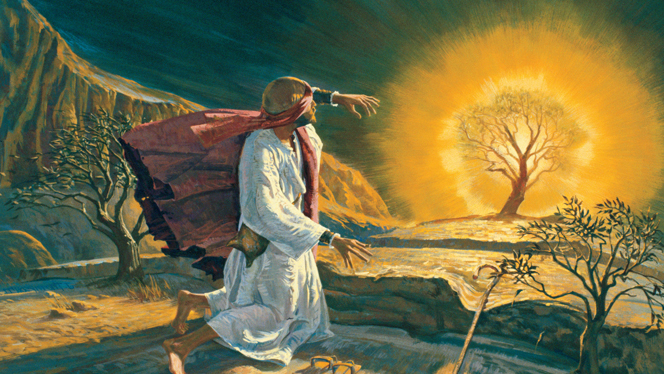
A more striking example of this is found in the story of the burning bush, in Exodus 3. Note how, in this story, the malak YHWH is what appears to Moses in the "flame of fire out of a bush" (verse 2), but then in verse 4 it is YHWH who speaks to Moses directly, and for the rest of this story it seems to be YHWH speaking directly to Moses. For this reason, many scholars believe that what is happening here (and in other instances where we see the story switching between "malak YHWH" and "YHWH") is that either: 1) a scribe has come along and edited an older story, replacing direct references to YHWH with malak YHWH, or 2) we are seeing how two separate versions of the same story were combined.
The Wisdom of God
At the beginning of the book of Proverbs, we see a personification of Lady Wisdom:
Wisdom cries out in the street; in the squares she raises her voice. (Proverbs 1:20)
This is a theme that Proverbs returns to in chapter 8 and continues in chapter 9. In Hebrew, the word for wisdom, chochmah, is grammatically feminine. When these passages are translated into Greek, the word for wisdom is a word that becomes a name: Sophia. A personified wisdom - as a she - is also found in some apocryphal books. For example, the book of Baruch, which is used in Catholic and Orthodox churches, has a personified Lady Wisdom in Baruch 3:9-4:4. And Wisdom of Solomon 7:7-14 also contains a reference to Lady Wisdom (Wisdom of Solomon is considered canonical by some traditions).
Proverbs 8:22-31 refers to Lady Wisdom in ways that might remind one of the malak YHWH - saying that YHWH "created me at the beginning [or as the beginning] of his work, the first of his acts of long ago", that she was created "before the beginning of the earth", and that she was there "[w]hen he established the heavens, [...] when he drew a circle on the face of the deep, [...] when he made firm the skies above, when he established the fountains of the deep, when he assigned to the sea its limit", and finally stating "when he marked out the foundations of the earth, then I was beside him, like a master worker." Likewise, Wisdom of Solomon 9:9 states that Lady Wisdom "was present when you made the world". This all seems to imply that Lady Wisdom was a collaborator in the act of creation.
We then see a striking development when we compare a certain passage in the non-canonical Book of Enoch to a certain passage in the canonical scriptures. But before I make that comparison, I'd like to note - while Enoch is not canonical, it was popular in early Christianity and even included in some early canon attempts. It fell out of favor as early Christians would debate Greek philosophers, who would point out that Enoch couldn't have written the book, because how would it have survived the flood of Noah if he had? But despite it being excluded from most canons, the Ethiopian Orthodox church still considers it canon, Matthew 22:29-30 seems to be alluding to a section of the Book of Enoch, and Jude 1:14-15 calls Enoch a prophet and then quotes this book.
Keeping that in mind, examine the following statements from Enoch 42:1-2:
Wisdom found no place where she might dwell [...] Wisdom went forth to make her dwelling among the children of men, and found no dwelling-place...
Now compare this to John 1:10-11:
He was in the world, and the world came into being through him, yet the world did not know him. He came to what was his own, and his own people did not accept him.
And at this point, I need to introduce a New Testament concept that is deeply connected to the concept of Lady Wisdom.
Logos
In the first verses of the gospel of John, the writer uses the word "logos". Most English Bible translators render this as "Word" - people familiar with this passage would usually recite it as "in the beginning was the Word...." But, unfortunately, this translation doesn't nearly capture the concept behind this word.
The concept of logos begins with the Greek philosopher Heraclitus. We don't know much about this pre-Socratic Greek philosopher, and only have fragments of his writing. But for Heraclitus, logos is an underlying intelligence in the Universe that governs all. In the fragments we have, he writes:
Although this Logos is eternally valid, yet men are unable to understand it – not only before hearing it, but even after they have heard it for the first time [...] though all things come to pass in accordance with this Logos, men seem to be quite without any experience of it...
Later on, Aristotle wrote in Rhetoric about three appeals one must make in order to persuade another person. These three were ethos (or appeals to credibility and character), pathos (appeals to emotion), and logos. Logos was the appeal to reason, logic, and facts.
This concept is then merged with the Biblical writings on Lady Wisdom by the Jewish philosopher Philo, who lived between 20BCE and 50CE. In "De Somniis", he writes:
For there are, as is evident, two temples of God: one of them this universe, in which there is also as High Priest his firstborn, the divine Logos...
He further develops this connection between High Priest and Logos in "Flight and Finding":
For we say that the high priest is not a man, but is the Logos of God... God being his father, who is also the father of all things, and wisdom being his mother, by means of whom the universe arrived at creation....
In "Confusion of Tongues", he writes:
And even if there be not as yet any one who is worthy to be called a son of God, nevertheless let him labour earnestly to be adorned according to his first-born logos, the eldest of his angels, as the great archangel of many names; for he is called, the authority, and the name of God, and the Logos, and man according to God's image, and he who sees Israel... for the image of God is his most ancient Logos.
When we compare this to the opening verses of John 1, we see similar concepts of the Logos being the firstborn, and the one through whom God created the Universe - John writes that the Logos was "in the beginning with God", and that "all things came into being through him." John ties the Logos to Jesus, and so if we're following, we could say that, according to John, Jesus was the argument of God. He was God's appeal to reason. He was the image of God. And, as when Heraclitus said that "men are unable to understanding - not only before hearing it, but even after they have heard it for the first time", John writes in verses 10-11 that "the world did not know him", and that "his own people did not accept him."
And we can make further connections between the Wisdom of God, the Logos, and Jesus if we turn to Paul's writing in Colossians 1:15-20, where he writes that Jesus is the "firstborn of all creation", that "in him all things in heaven and on earth were created", that "in him all things hold together", and finally that "through him God was pleased to reconcile to himself all things, whether on earth or in heaven."
Note here also: these connections between the Jewish Wisdom literature, Logos, and Jesus challenge traditional ways of thinking about the Trinity, rather than affirm them. One must ask: If Philo says that the High Priest is the Logos of God, the first born, the eldest of angels, and divine, does this mean Philo believes every High Priest is a part of the trinity? And if not, this ought to challenge how we read John, as his own Logos statements clearly draw from this same tradition and are also likely inspired by Philo's own writings.


No comments:
Post a Comment