Table of Contents
-----------------------------------------------------
A Ball on a Moving Train
We've been discussing a mystical understanding of the Creation narratives of Genesis, and I have been delving into various details about those narratives. In the last post, I mentioned that an old scientific paradigm - which might be termed "Newtonian Physics" - is actually outdated, and that new scientific information challenges this paradigm. I also alluded to the possibility that the new scientific paradigm may offer support to the mystical view of God that I have been discussing in this series. I'd like to discuss this science by starting with a meditation on the first command of creation found in Gen. 1:3: "let there be light."

In 1905 (called Einstein's "year of miracles"), Einstein provided one of the foundations for modern physics, and Quantum Mechanics in particular, when he challenged the popular conception of light as a wave by publishing a paper introducing a particle theory of light. In the same year he published a paper on Special Relativity, which was later combined with General Relativity to become the Theory of Relativity.
In his paper on Special Relativity, Einstein pointed out a problem between Newton's theories and James Maxwell's equations defining the speed of light as a constant. A popular way of describing the problem Einstein outlined is the analogy of a train. Imagine that you are observing a person on a stationary train, and this person throws a ball at the wall on the other side of the train. You are able to measure the speed of the ball when it is thrown in this scenario based on when the ball arrives at the other side of the train. This measurement is complicated, however, when the train begins to move - as now, the speed of the ball calculated by the time it takes for the ball to reach the other side of the train must be added to the speed of the train. This faster speed is how you would observe the speed of the ball. If there were another observer standing on the train and measuring the speed of the ball, however, they would measure it as the speed when the train was stationary. You will have produced a different numerical speed in your measurement than the observer on the train - but both are correct, given the frame of reference.
Now if we replace the ball that is thrown with light, however, everything is thrown off. If the person on the train were shining a light at the other side of the train, rather than throwing the ball, you (measuring the speed of light as the train passed by) and the other observer (standing on the train) would measure the speed of light with the exact same value. Thus, the speed of light is outside of the laws of "normal physics" in a sense.
 |
| Another way to illustrate special relativity. |
This is a great illustration for Special Relativity in a nutshell. Special Relativity contains two postulates: 1) the speed of light does not vary, and 2) the laws of physics are the same wherever you are (whether you are on the moving train or the road next to it). Putting these two postulates together causes complications - in order to keep the speed of light constant for all observers (as in the train analogy), space and time become variable.
According to Einstein's theories on relativity, when you approach the speed of light, time slows and measurements shorten - if it were possible for us to travel at the speed of light itself, we would experience no time nor movement at this speed. If we were to take a trip at the speed of light, when we returned, we'd find that everyone else had aged considerably while we did not.
Unfortunately, it seems that it is nearly impossible (without taking advantage of certain loopholes which I will not go into) to travel at the speed of light. This is because of that fact that as normal matter reaches higher speeds, its mass increases exponentially - which means that any amount of matter would take an infinite amount of energy to travel at the speed of light. But light has no mass. So light is outside the laws of physics and yet the laws of physics seem to build off of the law of light.
Interestingly enough, other experiments have shown that time changes as well - in October of 1971, Joseph C. Hafele and Richard E. Keating put four atomic clocks on board commercial airliners. They flew twice around the world, first eastward, then westward, and afterwards compared the clocks against others that remained at the United States Naval Observatory. Afterwards, the clocks from the planes disagreed with the clocks on the ground. This experiment - known as the Hafele–Keating experiment, showed that the experience of time itself changed based on the speed one was traveling.

All of this is further complicated by the arrival of Quantum Mechanics - but I'm getting ahead of myself, as I'd like to make a quick pit stop to meditate on the first act of creation in Gen. 1:3.
Let There Be Light!
Personally, in light of the fact that light itself seems to be outside of the laws of physics in a way that makes it foundational to the way our universe works, I find it interesting that the first act of creation in Gen. 1:3 is "let there be light." But light is more than just the first act of creation in the Bible - it is a recurring theme symbolizing movement to a higher consciousness.
The Hebrew for "let there be light" in this verse actually reads: "let there be light, and let there be light" - a repetition. The mystical Jewish interpretation offers that the light is not a physical light, but awareness, and the repetition reveals that God is giving awareness to the side of goodness and darkness as well.
The opening lines of the gospel of John allude to Genesis 1 with the phrase from John 1:1: "in the beginning was the Logos." The writer of this gospel goes on to describe this Logos as a being - a "he" - whom has been since the beginning with God, and all things came from this being. Then in verses 3-5, the writer of John declares:
What has come into being in him was life, and the life was the light of all people. The light shines in the darkness, and the darkness did not overcome it.Verse 9 then goes on to say:
The true light, which enlightens everyone, was coming into the world.For John, the gospel of Jesus must be framed in the language of enlightenment - a theme repeated in Jn. 8:12, where Jesus declares: "I am the light of the world. Whoever follows me will never walk in darkness but will have the light of life." (emphasis mine)

Matthew uses the same metaphorical imagery when he quotes Isa. 9:2 in Mt. 4:16:
[T]he people who sat in darkness have seen a great light, and for those who sat in the region and shadow of death light has dawned.Later on, Matthew has Jesus commanding his followers in Mt. 5:16:
[L]et your light shine before others, so that they may see your good works and give glory to your Father in heaven.This theme appears all over the Bible (in the scriptures of other religions as well), and it is interesting to me that verses like Ps. 27:1 and I Jn. 1:5 say that God is light.
In my opinion, it seems very clear that these verses are not speaking literally, but are using light as a metaphor for consciousness. When we "see" the light, we become enlightened - we change from a state of unconsciousness (spoken of very poetically as a state of death) to a state of higher awareness, and then if we let our light shine before others, as Jesus says, we cause them to become more conscious or more aware as well.
I find it even more interesting that the book of I John uses light and love interchangeably. God is said to be light (I Jn. 1:5) and God is said to be love (I Jn. 4:8, 16). And compare I John 1:6-7:
If we say that we have fellowship with him while we are walking in darkness, we lie and do not do what is true; but if we walk in the light as he himself is in the light, we have fellowship with one another[....]To the language of the fourth chapter of I John - specifically the verses where the author says that "whoever does not love does not know God" (vs. 8), and that "those who abide in love abide in God, and God abides in them." (vs. 16)
In the mystical view of the author of I John, love is that which enlightens and raises us to a higher consciousness.
Or could it be better stated that love is the source of consciousness?

When we contemplate consciousness and light, there are some important parallels - light has no mass and does not seem to be a part of the universe in the same way as "physical" or "material" things (we'll discuss the problem with this language later). Consciousness, likewise, is an incredible mystery that science has only recently begun to contemplate more seriously, and while earlier scientific paradigms insisted that consciousness was merely an illusionary epiphenomenon arising out of the material of the brain, more recent science has uncovered the fact that consciousness is a much more complicated problem (more on that in a bit). Thus, it seems as though consciousness, like light, has no mass and is not part of the "physical" or "material" universe.
We cannot define the material of consciousness - consciousness cannot be reduced to the parts it seems to be made of. Buddhism provided a wonderful parable to illustrate this. The story goes that Buddha asked one of his disciples to remove the wheels and axle of a cart, and then asked the student if he had disposed of the cart - "no", was the answer. Buddha replies "Good, I did not ask you to burn the cart. You merely disposed of the wheels, the axle, the body, and the yoke. Where is the cart then?" The point made is that if we were to fully dismantle a cart and throw each piece into a pile, this would not make a cart, because a cart is more than the sum of its parts. Likewise, consciousness cannot be reduced to a scrap heap of parts - we cannot define consciousness as the sum of the parts which seem to make it. Consciousness is an idea which encompasses many things - ideas and thoughts flow in and out of consciousness and we cannot reduce the nature of consciousness to the sum of these ideas. And so, after demonstrating with the pile of cart pieces, Buddha asks: "where is the self?" This is a mysterious question we seem to be incapable of providing a definitive answer for.
This is analogous to the idea of God, and helps us make sense of how we are made in the image of God - we are more than the sum of our parts, because we can take the parts away and still say “this is me”. While I would not be happy about this, I could lose an arm, a leg, I could even lose memories, and I would not have ceased to exist. I am more than the sum of my parts. I cannot point to anything concrete and say "there - that is where my consciousness resides."
Even more mysterious is another parallel - while light seems to be fundamental to the laws of the universe, consciousness seems to be as well.
Quantum Weirdness
I have mentioned a few times now that science has shifted from the paradigm of "Newtonian Physics" to another paradigm - we could call this new paradigm the Quantum Paradigm. To put this another way that will clarify the nature of the shift, Quantum Mechanics presents some serious problems with the philosophy of materialism - the idea that everything is made of "stuff" called "matter".
As a side note, with the paradigm shift that occurred in the Age of Enlightenment, of which Newton played a bit role, most popular forms of Christianity seem to have gone back to the heresy of Gnosticism - specifically the following beliefs:
- that there are two realms of reality (the material realm and the spiritual realm),
- that the goal of Christianity is to escape the material realm (effectively rendering the material realm "evil", or at least beyond the hope of being redeemed), and
- that holding the right beliefs (understood as having ideas in one's head that one insists are true, no matter what contrary evidence seems to show) is what gives us the golden ticket into the spiritual realm, so to speak.
Uncertainty
The first thing that is strange about Quantum Mechanics is uncertainty. Uncertainty doesn't sit so well within the materialism of Newtonian Physics - Newtonian Physics is all about being able to predict things very precisely. But you can't predict quantum events very precisely - in the quantum world, you have to speak in terms of probability. A diagram will demonstrate:

What this diagram is showing is that if we look for a quantum particle, there is a higher probability that it will be near the center of the range of probability than near the edges. These probabilities are quite reliable, and technology has been built using the math behind this science - but in the world of Newtonian Physics, it's a bit strange that we can't predict precisely where a particle will be.
As a side note, if my readers are interested in the free will/determinism (or free will/predestination in theological terms) or Calvinism/Arminianism debate, you might want to check into how uncertainty complicates the whole matter - you can watch this video (with Michio Kaku), or read articles like this one, this one, or this one.
Einstein himself was so uncomfortable with uncertainty that he famously said: "God doesn't play dice with the world." To which the famous Quantum Physicist Niels Bohr replied: "Stop telling God what to do with his dice."
But it gets even weirder with something called the Heisenberg Uncertainty Principle. The simplest way of stating this principle is that we cannot simultaneously know the location of a particle and it's speed, and that the more certain we are of one, the less certain we will be of the other.
But things get weirder.
The Double-Slit Experiment
As I said before, Einstein introduced the idea that light was made up of particles (which we now call photons) rather than being a wave. However, it's a bit more complicated. You see, quantum particles such as photons and electrons act like a particle under certain circumstances, and like a wave in others. Actually, to put it more precisely (and more confusingly), quantum particles act like a wave when we're not looking, and like a particle when we are. It's like a child who squirms and wiggles when her parent is not looking, and sits still whenever the parent glances at her.
Don't believe me? I wouldn't either. Except that it's been proven over and over again by one of the most repeated and famous experiments in history - the double-slit experiment.
The basic principle is this: when you direct light at a barrier with two slits, you ought to see one pattern if light is a particle and another if it is a wave. The two patterns are demonstrated in the following illustration:

The bottom pattern is what you'd call a wave interference pattern - you can demonstrate this kind of interference next time you're in shallow water by stomping both feet at the same time, and observing how the two waves cancel each other out in certain places.

If you shine a lightbulb at a model of the double-slit experiment, you will notice that the outcome is the wave interference pattern:

So Einstein was wrong then - light is a wave, right? Well...when pictures are captured with dim light, have you ever noticed that they get grainy?

How can light be both a wave and a particle?
Here's where things get really weird. One of the original versions of the double-slit experiment involves setting up a scenario similar to the illustration above with an electron gun, like so:

It gets weird when they reduce the stream of electrons to where they can be certain that only one electron is being fired at a time...and they still get the wave interference pattern. What's so strange about that can be easily demonstrated by asking the question: where is the interference coming from?
It gets even weirder, though, when scientists try to figure out more of what's going on by adding an "observer" to help them figure out which slit the electron is going through. There are a variety of ways to do that, but no matter what they've tried, what happens when they add an observer is that they no longer get a wave interference pattern: they get a particle pattern instead. Like I said - it's like the kid who stops wiggling as soon as her parent glances at her.
When adding an observer to the experiment results in a particle pattern, this is referred to as collapsing the wave.
This video provides a good demonstration of what happens with the double-slit experiment:
Well, that's certainly strange, but it gets even weirder. I'm going to tell you about another version of the double-slit experiment, but first I have to explain another strange concept in Quantum Mechanics. This concept is so weird, that Einstein made fun of it and called it "spooky action at a distance." A more technical name for the concept is Quantum Entanglement.
Basically, when two quantum particles become entangled (and I won't go into how this is done, because I'll massacre it), an action that changes one particle changes the other instantaneously. And I do mean instantaneously - faster than the speed of light. Tests have been done.
Just so you know I'm not making this up, I'm going to let a very smart man explain this to you:
Things get interesting when entanglement was added as a factor in the double-slit experiment. Here's how it's done (and in case I mangle this, this paper explains the same concept): first off, one of the ways that an "observer" has been added to the double slit experiment is to use photons instead of electrons, and to use what's called a quarter wave plate in front of each slit - one plate would be configured to only allow positive polarized photons through, and the other would only allow negative polarized photons through:

Of course, once you do this, there is no longer a wave interference pattern. But let's say we entangle two photons and shoot them in different directions, like so:

On either side there is a double-slit experiment - and though it's not represented well in the diagram above, one version of this experiment puts the detector for line P (Detector Dp) closer to the photon firing mechanism than the detector for line S (Detector Ds). We then add the quarter wave plate observers for line S:
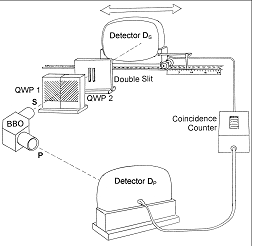
In this scenario, you would think that if we added an observer to the scenario for S, the results of the experiment for line P would still show a wave interference pattern - because line P is a shorter path, and so one would imagine that when the observer collapses the wave for line S, this will have occurred after the measurements for line P have already occurred. But what is so strange is that the results show a particle pattern for Detector Dp - implying that the collapse of the wave occurred not only faster than the speed of light, but retroactively through time.
You can read about other versions of this scenario if you look for John Bell's test experiments, or the Einstein-Podolsky-Rosen (EPR) paradox. To explain the latter, I found the following illustration and quoted explanation on this article:

The Einstein-Podolsky-Rosen (EPR) experiment verified by Aspect et al. (1982); Tittel et al. (1998), and many others. On the left is an isolated, entangled pair of superpositioned complementary quantum particles, e.g., two electrons in spin up and spin down states. The pair is separated and sent to two different, spatially-separated locations/measuring devices. The single electron at the top (in superposition of both spin up and spin down states) is measured, and reduces to a single classical state (e.g., spin down). Instantaneously its spatially-separated twin reduces to the complementary state of spin up (or vice versa). The effect is instantaneous over significant distance, hence appears to be transmitted faster than the speed of light. According to Penrose (2004; cf. Bennett and Wiesner, 1992), measurement/reduction of the electron at the top sends quantum information backward in time to the origin of the unified entanglement, then onward to the twin electron. No other reasonable explanation has been put forth.So here's where all of this coincides with mysticism - what many scientists and others aware of these results have begun to conclude is basically stated in this way: the double-slit experiment implies that matter arises from consciousness, rather than consciousness from matter. In other words, consciousness creates our reality. Time and time again the double-slit experiment has shown that at a quantum level, what we call "matter" only exists as potentia prior to being observed, and that somehow our conscious perception of this "matter" causes this potentia to become "reality" - or "collapses the wave", as it is sometimes spoken of. This has even been reproduced (quite recently) at the atomic level with helium scattered by light.
As Bernard Haisch puts it in "The God Theory: Universes, Zero-point Fields, and What's Behind It All":
By limiting the infinitely possible, you create the finitely real.One interesting question that has been asked in light of this: if we stop looking at the moon, does it stop "existing" (or become "wavy", or go back to being potentia)? To ask this question is, I feel, a misunderstanding of the complexity of what I'm saying. I am saying that our individual consciousnesses are part of a larger reality - the Source. This is what we call God, and God - the "ground of being" as Paul Tillich puts it - is the Consciousness: the flame from which the sparks of our individual consciousnesses come. So a better question would be: if God forgets about the moon, does it cease to exist?
Don't Take My Word For It - Read!
If all this sounds just a bit too crazy, consider the fact that some of the greatest minds in modern scientific history - minds who developed the initial science of Quantum Mechanics - have come to the same conclusions. Niels Bohr, called the father of Quantum Theory, once said: "Everything we call real is made of things that cannot be regarded as real." He has also notably said: "If quantum mechanics hasn't profoundly shocked you, you haven't understood it yet." Bohr is also recorded by Werner Heisenberg in "Physics and Beyond" as having said:
We can admittedly find nothing in physics or chemistry that has even a remote bearing on consciousness. Yet all of us know that there is such a thing as consciousness, simply because we have it ourselves. Hence consciousness must be part of nature, or, more generally, of reality, which means that, quite apart from the laws of physics and chemistry, as laid down in quantum theory, we must also consider laws of a quite different kind.Influential biologist Robert Lanza writes in "Rethinking Immortality":
That matter is the mere surface of reality was evident even to Einstein, who, when asked by Ben-Gurion if he believed in God, responded to the effect, "There must be something behind the energy." That something, it seems is the human mind. The physicist stares into the world of the atom and finds there elementary particles that spring into existence as real objects only when he observes them. As John Wheeler, the Nobel laureate, puts it, "No phenomenon is a phenomenon until it is an observed phenomenon." If the Copenhagen interpretation of quantum mechanics, which most physicists now accept, is not in error, it is not possible to formulate the laws of natural science quantum theory imply that consciousness must exist, and that the content of the mind is the ultimate reality.Lanza - currently Chief Scientific Officer at Advanced Cell Technology and Adjunct Professor at Wake Forest University School of Medicine (according to his Bio) - has received numerous awards and recognition, and has written what is considered to be the premier reference book in the field of tissue engineering (among many other books and articles). He also wrote "Biocentrism: How Life and Consciousness are the Keys to Understanding the True Nature of the Universe", which very clearly and logically explains the evidence and scientific concepts which have led to the conclusion that we live in, as Lanza puts it, an "observer-created reality". In his book on Biocentrism, he writes:
Indeed, Eugene Wigner, one of the twentieth century’s greatest physicists, stated that it is “not possible to formulate the laws of [physics] in a fully consistent way without reference to the consciousness [of the observer].”
Dr. Amit Goswami, a theoretical quantum physicist, wrote a similar book entitled "The Self-Aware Universe". Goswami thoroughly explains the science of quantum physics, as well as delving into philosophy and eastern mysticism (he even quotes some Christian mystics!). His book has a particularly exotic flair that I appreciated, as he is coming from a Hindu background. His book also delves into the science behind meditation and the connections with these concepts.
Dr. Bernard Haisch is an accomplished astrophysicist who studied the physics of light specifically in relation to the sun, and worked with Alfonzo Rueda to develop the theory of stochastic electrodynamics. His book entitled "The God Theory: Universes, Zero-point Fields, and What's Behind It All" develops on subject of a zero point field of light (a theory he and Rueda did some ground breaking work on) as being the ground of all Being, and consciousness as an expression of this Being, and he does this using language that is very sensitive to spiritual/religious seekers. Haisch has also written a book titled "The Purpose-Guided Universe: Believing In Einstein, Darwin, and God", which I have not currently read at the time of this writing.
Peter Russell studied mathematics and theoretical physics at Cambridge (receiving an honors degree, which is the English equivalent of summa cum laude), before he became so fascinated by the problem of consciousness (meaning, the question: what is consciousness?), that he switched to studying experimental psychology. In his continual pursuit, he traveled to India to learn meditation, and conducted research into the neurophysiology of meditation at the University of Bristol. He writes about this, and the conclusions he has come to through his process, in "From Science to God: A Physicist's Journey into the Mystery of Consciousness".
These are just some of the ones I've read! I have plenty more on my "to read" list - such as:
- "The Mind of God: The Scientific Basis for a Rational World" and "The Goldilocks Enigma: Why Is the Universe Just Right for Life?", by Paul Davies. Davies is a physicist, and is quoted in "The God Theory" as saying that he has "come to the point of view that mind - i.e. conscious awareness of the world - is not a meaningless and incidental quirk of nature, but an absolutely fundamental facet of reality."
- "Quantum Physics and Theology: An Unexpected Kinship" and "Science and Religion in Quest of Truth" by the Rev Dr John Charlton Polkinghorne, KBE, FRS, who has the coolest name ever, with all those titles around it, haha! I have, by the way, read "Questions of Truth" with Polkinghorne co-writing with Nicholas Beale, and it was excellent - this one is in a question and answer format where the authors deal with direct questions from online users of their website.
- "Quantum Enigma: Physics Encounters Consciousness", by Bruce Rosenblum and Fred Kuttner.
- "The Nature of the Physical World" by Sir Arthur Eddington - a British astronomer, physicist, and mathematician of the early 20th century who is quoted in "The God Theory" as saying "that the physical world is entirely abstract and without “actuality” apart from its linkage to consciousness" and that consciousness is in "the fundamental position" rather than "an inessential complication occasionally found in the midst of inorganic nature at a late stage of evolutionary history."
- Sir James Jeans was a contemporary of Eddington, and was a physicist, astronomer, and mathematician with a mystical view of reality - "The Mysterious Universe" was a book he wrote marrying science with spiritual views.
- "Eternity: God, Soul, New Physics", by Trevelyan.
What About the Brain?
One question you might ask in response to this is: what about the brain? Since we know that the mechanics of the brain can change the nature of consciousness, doesn't that debunk the whole concept of consciousness as the ground of reality (or "observer-created reality", as Robert Lanza puts it)?
As I noted in my post on "The Science of Evil" and privatio boni, there are cases like Phineas Gage where we find that a change to the mechanism of the brain changes the way consciousness functions. When considering how damage to brain impairs mental functions, materialists have concluded that the brain is the source of the mind, and the mind is simply an epiphenomenon of the brain.
But things get a bit more complicated when you factor in the placebo effect. You see, not only can the brain change consciousness, but consciousness has the power to rewire the brain. Dr. Joe Dispenza wrote a book called "You Are the Placebo: Making Your Mind Matter" recounting dozens of stories exemplifying how consciousness is able to alter the body and the brain, and he spends some time explaining the science behind how this works, as well as how to make it work on yourself. Dr. Dispenza teaches that the meditative process - which has been proven to be able to activate bodily changes even to the genetic level - is a process of transformation where participants discover that they are "divine creators". He calls his process "information to transformation". Dr. Dispenza writes in his book:
I believe that there’s an intelligence, an invisible consciousness, within each of us that’s the giver of life. It supports, maintains, protects, and heals us every moment. It creates almost 100 trillion specialized cells (starting from only 2), it keeps our hearts beating hundreds of thousands of times per day, and it can organize hundreds of thousands of chemical reactions in a single cell in every second— among many other amazing functions.(Another great book that draws out the need for nuance in understanding the relationship between brain and consciousness is "Brain Wars: The Scientific Battle Over the Existence of the Mind and the Proof That Will Change the Way We Live Our Lives", by Dr. Mario Beauregard.)
Consider the analogy William James - the father of modern psychology - gave in 1898: he proposed that the brain is like a prism with light being consciousness itself. With this analogy, while the prism (the brain) affects and changes the way we perceive the light (consciousness), it is not the source of that light.
Consciousness has also been compared to the light from a projector shining on a screen - the screen is a bit like the brain, and the images shone on it are our perceptions, feelings, and memories. While changes to the screen can alter the way we perceive the picture on it, consciousness is the light itself, and while it may flow in different wavelengths in order to create an array of colors, it is always light. And just like we do not normally think about how all the images we see on a movie screen are composed of this light, we also do not think about how our perceptions, feelings, and memories are all composed of our consciousness, and do not in themselves define our being. There is a disconnect between our perceptions and reality that we don’t normally consider as well. There is an old philosophical query that was meant to be a joke: "if a tree falls in the middle of the woods and no one is around to hear it, does it make a sound?" But joking aside - the correct answer is actually "no". While the air in the forest still forms waves that would have been perceived as sound if someone had been around to hear it, since what we call "sound" is really a perception based on those waves, then if no one was around to perceive those waves, there is no experience of "sound". As George Berkely once said, "the only things we perceive are our perceptions."
The fundamental problem that science is always struggling against is that there is no way to get into an objective position from which to observe the system we are within - the laws of the system produced the observer which is attempting to observe the system! Going back to the analogy of sound, we must realize that everyone else's perception of sound might actually be different than our own. As a personal example, I have very insensitive ears compared to my wife’s sensitive ears, because I have been to far too many loud Metal concerts (ha! Too many - as if there was such a thing!). Similarly, Dogs can hear frequencies that we are totally unaware of, and can also smell a person’s scent hours after they have left - enabling them to track other creatures with their sense of smell. So we must always wonder how much we are missing - what possibilities of perception are out there that we simply do not have the equipment to perceive?
Even Einstein saw this truth within the physical laws of the universe - he was a pantheist rather than a panentheist, and once said:
...a spirit is manifest in the laws of the Universe - a spirit vastly superior to that of man, and one in the face of which we with our modest powers must feel humble.In Peter Russell's book, "From Science to God: A Physicist's Journey into the Mystery of Consciousness", he writes:
When science sees consciousness to be a fundamental quality of reality, and religion takes God to be the light of consciousness shining within us all, the two worldviews start to converge.
Nothing is lost in this convergence. Mathematics remains the same; so do physics, biology, chemistry. The shift may throw new light on some of the paradoxes of relativity and quantum theory, but the theories themselves do not change. This inclusion is a common pattern in paradigm shifts: the new model of reality includes the old as a special case.
He goes on to write about how the spiritual paradigm shift is very similar:
The same integrity is maintained on the spiritual side. Much of the wisdom accumulated over the ages remains unchanged; forgiveness, kindness, and love are as important as they ever were. Many of the qualities traditionally ascribed to God remain, being equally applicable to the faculty of consciousness. The difference is that spiritual teachings and scientific knowledge now share a common ground.As Christians who see God revealing God's self through Creation, we need to drop the war between theology and science. We need to see how science can enhance faith, rather than seeing it as an enemy. Mysticism, I believe, is where this can happen, and where we can find a convergence.
In the area of consciousness, there is a powerful faith to be found - a faith that can embrace mystery without falling into depression and fear. Rene Descartes once said: "Consciousness is the one absolute truth which cannot be doubted." This panentheistic view of God I have been writing about is, basically stated, that God cannot be found in space or time, but rather is found within - in "deep mind". This is why so often we feel as if we’ve found God in a place and time, but then later may doubt our experience. It is because we are not in tune with God within that what we experience outside seems to be so confusing. When we realize that God is within all, and that the path to discovering divinity is found through love, which is the mystical wavelength that ties spirits together just as atoms are mysteriously bound together, we can begin to really tune in.
In a passage reminiscent of the phrase from Psalm 46:10, "be still and know that I Am God", Thomas Merton wrote:
If I penetrate to the depths of my own existence and my own present reality, the indefinable am that is myself in its deepest roots, then through this deep center I pass into the infinite I am which is the very Name of the Almighty.
Next Chapter: The Tree of Life.


